The approaches of the workers will not transcend the narrow frames in which they are expressed.
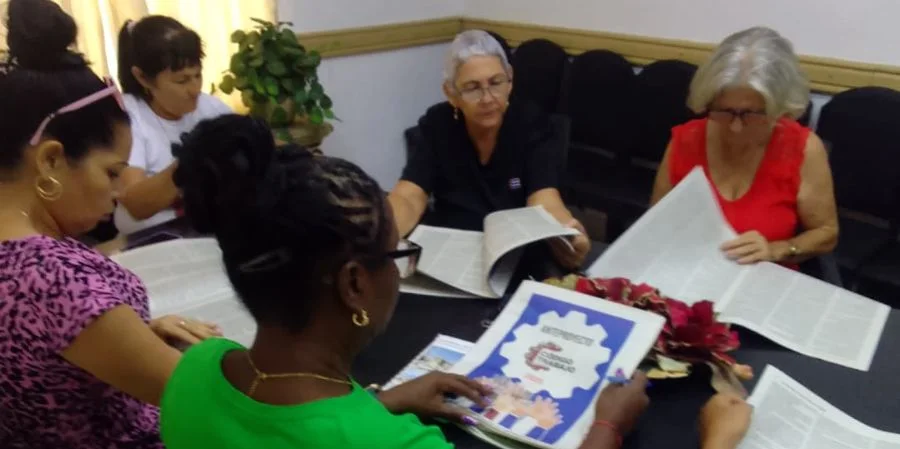
Havana, Cuba. – On Monday, September 8, the discussion of the draft Labor Code began throughout the country. The document is discussed in all labor groups, both in state entities and in non -state management (MSMEs, non -agricultural cooperatives and self -employed workers).
Government propaganda has armed a great reconciliabulus around the discussion of this preliminary project. It has been said, with hype and saucer, that workers will have full freedom to express their opinions in these assemblies; that the approaches will not be voted, but will be collected as said at the meeting. Even an email has been provided so that any worker “elevates” their opinions beyond the work collective belonging. Apparently, authorities want to know what their workers think. Although, of course, one thing is to want to know what you think, and another very different is to attend to these approaches, or give full response to workers’ concerns.
This type of “participatory democracy” was already applied by Castroism during the debates of the Constitution of the Republic In 2019, and then in the discussions of the Family Codeand in reality for everyone it was clear that there was no such democracy. In these processes many interesting ideas emerged that did not transcend the narrow frames of the meetings where they were exposed. That is, that they were assembly processes where the great absent was true democracy.
Now the Castro hierarchy has everything prepared for these little meetings to be repeated, something like small compartments in which what will be raised, without the approaches, transcending little beyond each meeting.
That is, if in a certain labor collective the proposal arises, for example, that the creation of independent unions is allowed, regardless of the central officer of workers of Cuba (CTC), it is very likely that this proposal will remain in the frames of that meeting, and no one else finds out that this was the suggestion of a Cuban worker, of the same that, according to the castrist propaganda, he has all the right to express his ideas.
Obviously, this form of workers’ participation, as before it was from the entire population, in a matter of its total incumbency, differs from what happens in true democracies in which even the approaches that do not have the approval of the authorities, go to the means of mass dissemination, especially of television, so that they can be known to the whole population.
Consequently, the instances involved in the discussion of this draft – the new CTC directive headed by Osnay Miguel Colina, and the new Minister of Labor and Social Security, Jesús Otamendiz -, will only incorporate into the document the modifications or additions that agree to the regime and, as always, will discard the approach that has arisen in a certain worker collective and that does not adapt to the interests of the communist party of Cuba, unique, ruler.
As a climax, the preliminary draft, already free of all the “impurities” that contradict or bother the authorities, will be taken to the National Assembly of Popular Power, where – who doubt it? – It will be approved by the obedient deputies.
That is the “democracy” that Cuban workers will have to publicize their opinions and concerns about something as important to them as the new Labor Code.