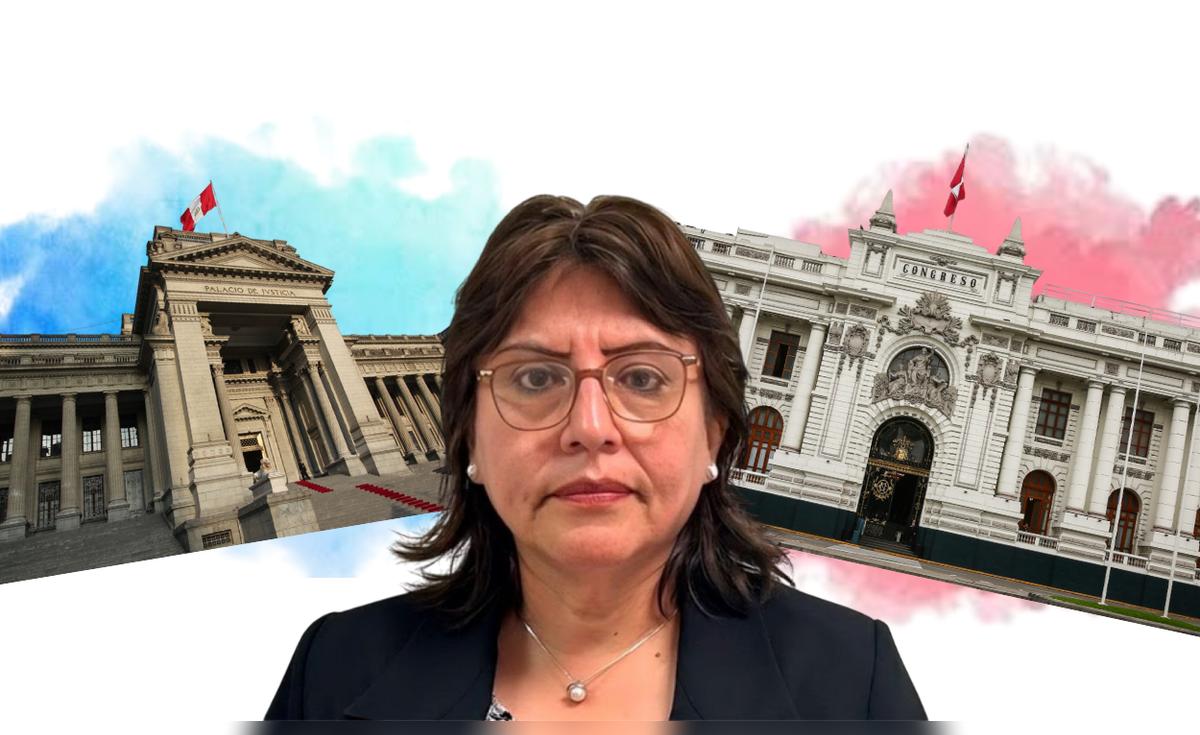
The suspended fiscal of the Nation, Delia Espinozawill present an action for protection against the questioned 10-year disqualification imposed by the Congress of the Republic against him. In this way, Espinoza Valenzuela will try to reverse the decision of Parliament in order to once again occupy the position of prosecutor of the Nation.
listen to the newsText converted to audio
Artificial intelligence
Likewise, the supreme prosecutor announced that she will file complaints against the congressmen for allegedly having committed violations of the Political Constitution. According to the former representative of the Public Ministry, the parliamentarians failed to comply with due process and there were no guarantees of the right to defense. Espinoza recalled that previously, in the Subcommittee on Constitutional Accusations (SAC), the legislators turned off the transmission of the session that should have been public to their then defender Samuel Abad.
WE RECOMMEND YOU
THE SCANDAL OF THE BANNALS AND THE PACT DOES NOT CEASE | WITHOUT SCRIPT WITH ROSA MARÍA PALACIOS
“Because this warrants an action for protection. Sooner or later, I insist, despite the abuses from which I am suffering (I will return),” he expressed.
Along the same lines, the prosecutor mentioned that in Parliament “they did not evaluate the material evidence, the documents with which I was proving that I have not participated in the regulation.”
Precisely, Parliament decided to disqualify Espinoza for supposedly having been part, in October 2024, of the publication of the regulation that “disobeyed” Law 32130, a rule that empowered the National Police of Peru (PNP) lead preliminary investigations of crimes.
However, in the Resolution of the Attorney General’s Office No. 2246-2024-MP-FN there is no signature that confirms that Espinoza was part of said publication. According to the supreme prosecutor, that decision corresponded solely to the then National Prosecutor, Juan Carlos Villena.
Although Parliament’s constitutional complaint included Villena, Pablo Sanchez and Zoraida Avalosonly Espinoza was disqualified because the votes were not reached against the other prosecutors.
“That power to prepare and approve a regulation does not belong to the Board of Supreme Prosecutors. And that has been demonstrated with documents, that there has not been any meeting to approve, to discuss or to determine the scope of that regulation. That is the exclusive task of the nation’s prosecutor. What I have finally endorsed and that the public that has seen it knows, is that in reality what the gentlemen have wanted and have given the very clear message to all the officials of Peru: either you submit or you leave,” he explained Espinoza.
The path of the amparo action against the disqualification of Congress
Rodolfo Perezlawyer of Delia Espinozawarned that in October 2024 Congress modified the Constitutional Procedural Code (CPC) through the Law 32153in which constitutional processes are “strengthened.”
In accordance with said rule, all amparo actions against Parliament must be presented before the Constitutional Chamber of the Supreme Court and must be resolved in their entirety if contrary to the Legislature.
That is, if in the first instance, the Chamber rules against Congress and agrees with Espinoza, this institution may appeal in the second instance and until the appeal is resolved in the Constitutional and Social Chamber, the prosecutor could not return to the Public Ministry. In that route, the amparo action would take months to be resolved.
“Obviously, they do this so that there is more time so that their decision is not publicly questioned and exposed,” he explained.
Along the same lines, the lawyer assured that, if they do not agree with him in said instance, they will turn to institutional entities. However, he flatly ruled out such action because “according to domestic law and precedents”, the Chamber must rule in his favor.
Delia Espinoza held a press conference with her lawyer in which she detailed the amparo action and ruled on the disqualification against her. Credits: Rosa Quincho / URPI–LR.
“It is important that this is said because the level of institutional deterioration that we have when we have a Congress that, upon seeing itself exposed, changes them to benefit itself and not be exposed, is typical of dictatorial and authoritarian regimes,” Pérez highlighted.
On the other hand, the legal defender questioned Congress’s decision to disqualify his client and described said act as “illegal, absent any legal logic.” In addition, he mentioned that Espinoza was “disqualified without any legal basis.”
“Congressman Montoya has not been able to justify to the media why he has been disqualified. Congressman Salhuana even said that she has been denounced for denouncing congressmen. She cannot be disqualified for doing her job. There are no congressmen whose immunity has been lifted. The political persecution that the congressmen allude to is false,” he said.