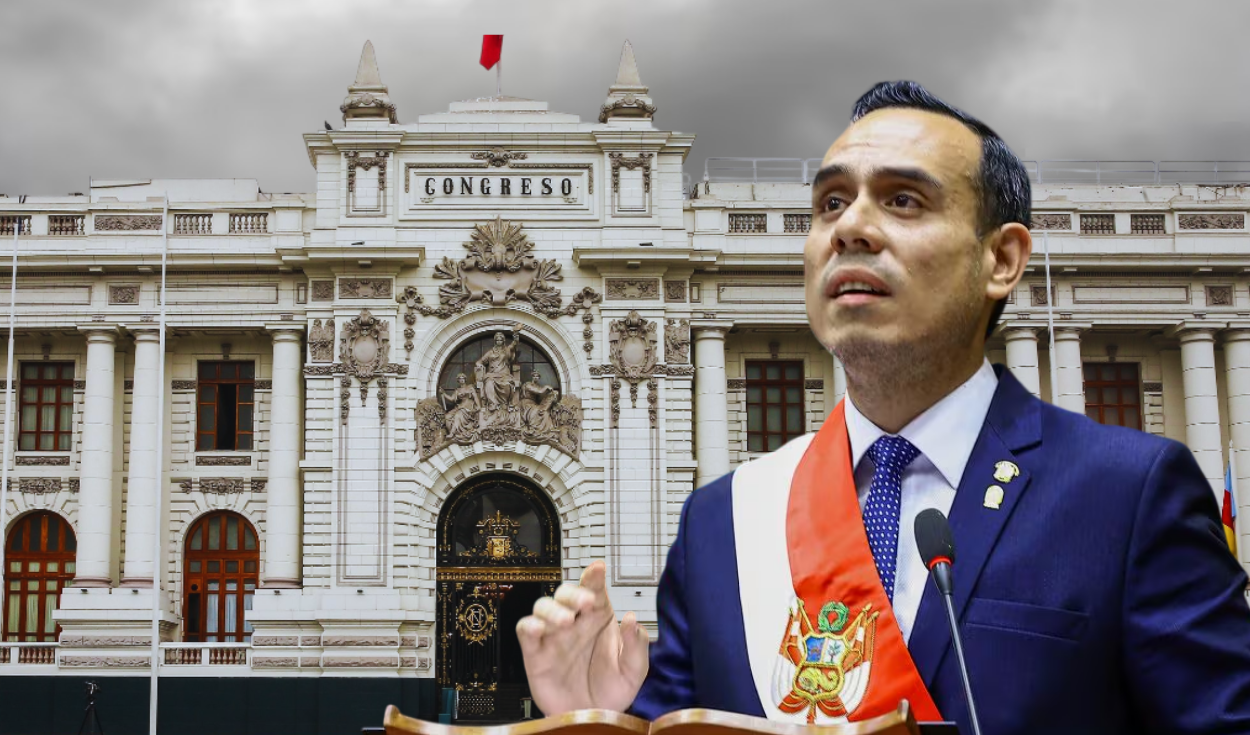
José Jerí’s future depends on Fuerza Popular and Alianza para el Progreso. While the majority of parties are inclined to vote in favor of the motion of censure against the president this Tuesday the 17th in the Extraordinary PlenaryKeiko Fujimori’s party has already confirmed that it will not join the cause and the positions of the Alliance for Progress (APP) bench are still dispersed.
In addition to this, the Fujimorist Fernando Rospigliosi, president of Congress, announced that only the motion of censure will be debated and that a possible vacancy motion would only be seen in March when the parliamentary recess ends.
Popular Force It is the only party that has shown its support for Jerí. In a video shared on social networks, Keiko Fujimori stated that they will not vote in favor of censures, since a change of command on the eve of the general elections would only cause “instability” in the country.
César Acuña of APP announced that his party will support the motion of censure against the president. He said that this is “very confirmed”, however, within the parliamentary group the congressmen are not entirely sure due to the ungovernability that Jerí’s departure could generate.
The other groups reported that they will meet before the Plenary Session to establish their position as groups.
However, the left-wing parties such as the Democratic Block, the Socialist Party and some from JPP and Perú Libre have signed the call for the Plenary Session and are expected to vote in favor of censure. In addition, Renovación Popular and Podemos Perú would continue with that same line.
Play to save Jerí
Given the various interpretations and positions within Congress and President Jerí himself on whether a censure or a vacancy corresponds, the possibility of presenting a prior question to guide and define the process of the process has been raised. (And in this way save Jerí).
That is, a congressman could request a deadline for this controversy to be resolved. In this scenario, the Plenary Session of the Congress of the Republic would first debate whether a censure or a vacancy corresponds and, subsequently, it would vote to define what mechanism should be used to remove José Jerí from the Presidency.
In the event that it is determined that what corresponds is a vacancy, the president would remain in office. This is because, according to the Regulations, in an Extraordinary Plenary Session only what is expressly on the agenda can be debated, which in this case are motions of censure.
Thus, a possible vacancy could not be addressed in that session and would be pending for the next legislature. This last measure necessarily requires 87 votes.
This is the “play” that Parliament has been warning about to save Jerí.
In this regard, during an interview for a local media, criminal lawyer Benji Espinoza assured that what would correspond would be a vacancy because Jerí is being tried for his actions as president. Along the same lines, he mentioned that, if Jerí is censured, he could resort to constitutional means through an amparo action alleging that he has undergone a procedure different from that provided for in the Constitution. “They have the votes, but I think the procedure is wrong,” he said.
Censorship points to Jerí and not to the Board of Directors: a simple mayor would be needed to remove him
As the seven motions of censure point out, the measure only targets President Jerí. In that sense, 87 votes would not be needed to remove him from office, but only a simple majority of the congressmen present and authorized in the chamber. Currently, the institution has 127 members because Guillermo Bermejo is sentenced, Jerí is president and Carlos Anderson died.
It is important to highlight that the Extraordinary Plenary Session could not include a censure against the entire Board of Directors or a vacancy motion. The reason is that, as detailed in the Regulations, when Congress is in parliamentary recess and a Plenary Session is called with 78 signatures, the only explicit agenda is the one that was presented in writing; that is, the censure against Jerí.
Precisely because it is a censure, the president will not attend the Plenary Session to exercise his right to defense. The reason arises because the regulations do not stipulate that in cases of censorship the public official be summoned to speak.
Only since March 1, the day that legislators return to their daily duties, could a censure be presented against the entire Board of Directors or vacancy and a Plenary Session would be called without the need for 78 signatures. In the case of a vacancy, by law, it would be debated obligatorily and quickly.
If Jerí is censured, who takes over?
Now, if Jerí falls, in accordance with the entity’s Regulations, the current president in charge of Congress, Fernando Rospigliosi, must call an election to elect the head of the entity, who will be the same one who assumes office as head of state.
The groups will present their chosen ones to be subjected to the congressional scrutiny that will take place in the José Faustino Sánchez Carrión auditorium. The candidate who wins by a simple majority will be the next interim president of the Republic.
The voiced
So far, as La República reported on February 11, there are two candidates to replace Jerí: María del Carmen Alva (Popular Action) and José María Balcázar (Perú Libre).
Alva assumed the presidency of Congress in the period 2021-2022. However, he faced various criticisms for his actions. One of those episodes occurred when he pulled his colleague Isabel Cortez by the arm during a plenary session. However, everything stayed there.
For these 2026 elections, he tried to seek re-election, but his Popular Action party was withdrawn from the electoral race.
Meanwhile, Balcázar had the support of Guido Bellido ( Podemos Peru). “The doctor is currently not running for any elected position and is a figure of consensus, appropriate for the critical scenario that the country is going through. Personally, I consider this to be a positive proposal,” he said.
Both Alva and Balcázar have in common that neither is up for re-election.
Motion of censure will not be debated in the traditional chamber
The motion will not be debated in the traditional chamber but in the main auditorium of the Faustino Sánchez Carrión Building, located near Parliament and the headquarters of the Ombudsman’s Office. This auditorium does not have parliamentary seats, so the congressmen will not be arranged in the usual way. It turned out that journalists will have restricted access to this session.