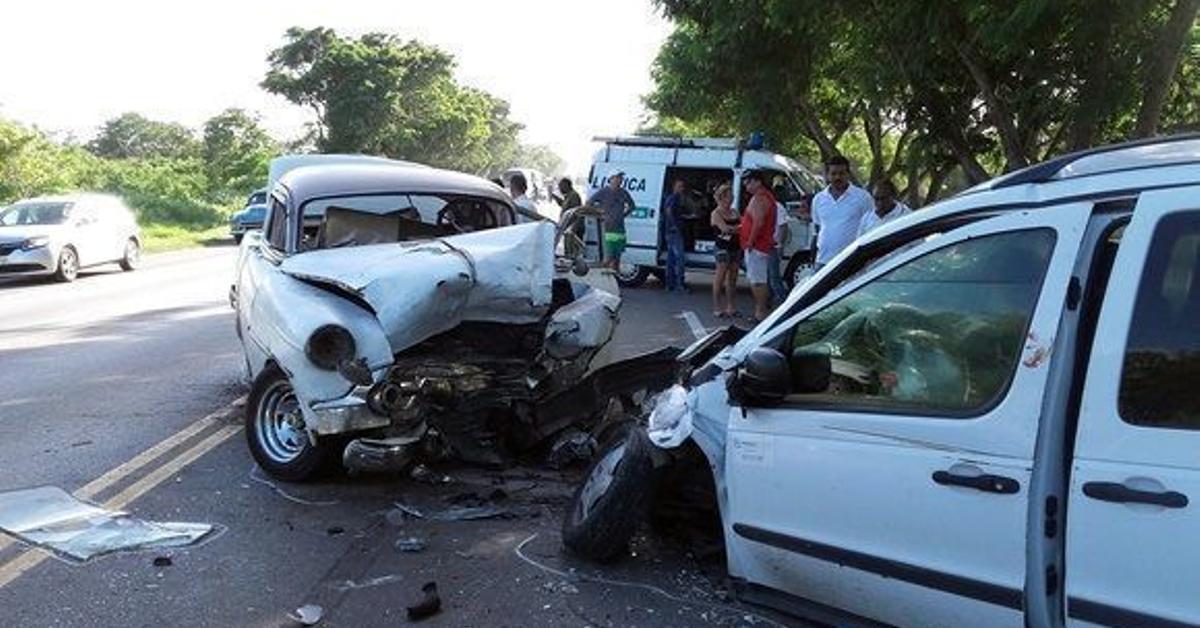
Havana/Last year Cuba registered a increase in deaths from traffic accidents, compared to 2024. According to figures released this Monday by the National Road Safety Commission, 750 deaths were recorded in the country, 18.2% more than a year before, when 634 were reported.
That was not the only rising figure. The number of mishaps also increased, although marginally. Last year, according to the newspaper Granmathere were 7,538 accidents, compared to the 7,507 that were recorded in 2024. The same happened with the injured. Authorities revealed that there were 6,718, 105 more than a year before, with 6,613. In these three areas, the country showed a rebound, after a decline in 2024.
The numbers shown reflect that the state sector was involved in half of the accidents. And an even more worrying fact: 98% of state drivers involved in an accident had their licenses revoked for being “under the influence of alcohol.”
According to the authorities, 72% of road accidents were the fault of the “human factor.” In their defense, they pointed out that “not respecting the right of way, not paying due attention to the driving of the vehicle and excessive speed” were the “main causes of most of the accidents.”
Motorcycles, mopeds and pedestrians “were present in 63% of the events”
In addition, they pointed out that motorcycles, mopeds and pedestrians “were present in 63% of the events.” 2025 “was characterized by a sustained increase in the vehicle fleet, mainly of vulnerable means, such as motorcycles and mopeds and, with it, a greater number of drivers with less experience and capacity for maneuver to face the challenges imposed by a greater flow of vehicles,” said Chetty Carlos Lastre, head of traffic of the General Directorate of the Police.
In the text, the mention was minimal, almost hidden, to the poor condition of the streets and highways due to the general lack of maintenance, as well as a good part of the vehicle fleet with between 40 and 70 years of operation. The phrase “deteriorated road axis” was barely mentioned in the country, denounced time and again by the population as one of the determining causes of the high incidence of accidents.
The problem has been admitted by the Minister of Transport himself, Eduardo Rodríguez Dávilawho recognized at the beginning of last year that “deterioration is accumulating” around roads and vehicles.
Another factor – not mentioned – has been the blackouts, which have kept dozens of traffic lights out of operation throughout the country for long periods a day. However, the traffic chief of the General Police Directorate said that there is progress. “Despite resource limitations, 122 kilometers of road were marked between centerline, edge and lane, 14,217 signs and 84 traffic lights were recovered.”
Eduardo Rodríguez Dávila recognized at the beginning of last year that “deterioration is accumulating” around roads and vehicles
Likewise, he indicated that, “as part of the technological development and computerization of society, energy backup was achieved with solar panels for 28 traffic light cabinets that guarantee the vitality of the busiest and most dangerous intersections in Havana,” which have been registered multiple accidents in recent years.
However, the figures presented contrasted the mood of the official, since, despite this investment, the country’s capital, as well as Villa Clara and Ciego de Ávila were the provinces with the most accidents reported last year.
Where there was a decrease was in the mishaps in which animals loose on public roads were involved, although no figures were given. They reported that 49% of the cases occur in Mayabeque, Villa Clara, Holguín and Sancti Spíritus.
Regarding the accidents on the railway network, also without providing data, they pointed out that most of the mishaps were the fault of the vehicle drivers and pedestrians, as well as the manipulation of switchboards of the connections by unknown persons, “the poor technical condition of the railway tracks, due to non-compliance with maintenance cycles, negligence on the part of the crew members in the train handling processes, the reception and lifting of poorly loaded equipment, in addition to violations by the inspection personnel in the processes of technical attention to the material rolling.”