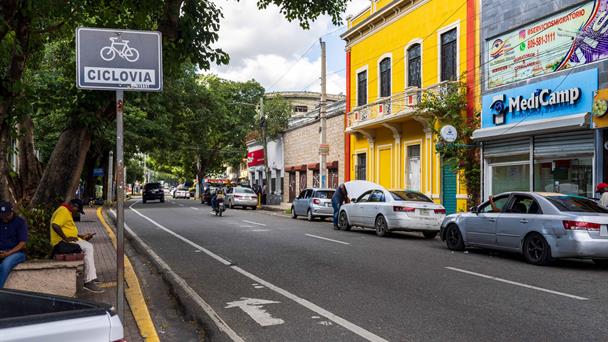
As an alternative to the extensive plugs that form daily in the streets and avenues of the Greater Santo Domingo and SantiagoSince 2018, work has been carried out on a general cycle path project that, although it has been “pedaled” to make it a reality, has not reached the expected speed.
Saint Dominic has tried to make its way towards a model of mobility more sustainable, but has been caught between the lack of continuityinstitutional conflict and a city increasingly overwhelmed by traffic.
The cycle lane project involves several sectors: the National Transit Institute and Transport Terrestrial (Intrant), the cyclists organized, the Ministry of Public Works and the Town hall of the National District, although the latter has been practically left aside, concentrating the coordination in it Intrant.
International entities such as the European Unionthe French Development AgencyEuroclima, Egis Group and other institutions, which coordinate actions for the implementation of the Urban Mobility Plan Sustainable (SUMP).
-
Surveys carried out indicate that only 1% of people who get around in the National District do so by bicycle, and a slightly lower percentage in Santiago. Users include security guards, private employees, construction workers and students, although the latter have increasingly opted for electric vehicles such as skateboards.
Miguel Alejandro Martínezformer member of the collective Santo Domingo by Bikemaintains that the problem is not the lack of plans, but the abandonment of those already existing. “The project was left out in the open; there is no dialogue with the movements cyclistsneither with the neighborhood associations nor with the citizens,” he says.
As he explains, the Cycling Action Plan of the National District, approved by the Council of Aldermencontemplated a interconnected network of cycle paths that linked the north-south and east-west axes, connecting with metro stations and bus corridors, but it was never executed.
Martínez estimates that in Saint Dominic the plugs can make you lose up to 500 hours per year, time that translates into stress, financial expense and deterioration of the quality of life. He claims that the city has collapsed.
Given this reality, the bicycle and other modes of active mobilitylike electric skateboards, are not a fad, but a necessity in the absence of real alternatives to the private vehicle. “Every person who rides a bicycle “It’s one less car on the road,” he explains.
However, the lack of secure infrastructure has generated a distorted use of existing spaces. Cycle lanes are invaded by motorcycles and vehicles, putting people at risk. cyclists and pedestrians. “This discourages its use and fractures the cycling movement itself,” says Martínez.
In the National District there are currently some 80 kilometers of cycle paths, some semi-used, such as the Bolivar Avenuewhich begins in Independencia Park, and others completely abandoned, such as the Columbus Lighthousein Saint Dominic North.
Santiago bike path
In the case of Santiagothe most important cycle path is the South Ring Road.
Is little frequented by cyclists and, on the other hand, used by motorcyclists. Santiago It is a city where cycling has an increasingly marked presence as a recreational and sporting activity, but not as means of transportation to go to work, schools or universities.
Its main avenues, urban areas and peripheral areas are used daily by cyclists and people who practice recreational activities. The cycle path of the South Ring Road It is not widely used due to its location, since it borders several marginalized sectors where there is no tradition of using this type of road infrastructure.
Look from the Intrant
From the National Transit Institute and Transport Terrestrial (Intrant), Rosanna Ferrerasin charge of Mobility Management of the Directorate of Mobility Sustainable, it ensures that the institutional approach goes beyond an isolated cycle path.
“We do not work a cycle path; we work active mobility. We have to see the mobility as a whole,” he explains. According to Ferreras, the country is advancing under the framework of Urban Mobility Plan Sustainable, with the support of the European Union through the IPEmus program, which has allowed the development of the first Cycloinfrastructure Manual of the Dominican Republic.
Recognizes that many projects have been pilots and that their implementation depends on the coordination with the mayors and other actors. In addition, it points out that bicycle lanes must be integrated into traffic corridors. transport public in the process of reform, such as the one on Independencia Avenue.
Saint Dominic remains trapped between plans that exist on paper or are not visible and a daily reality marked by plugspollution and lost time.