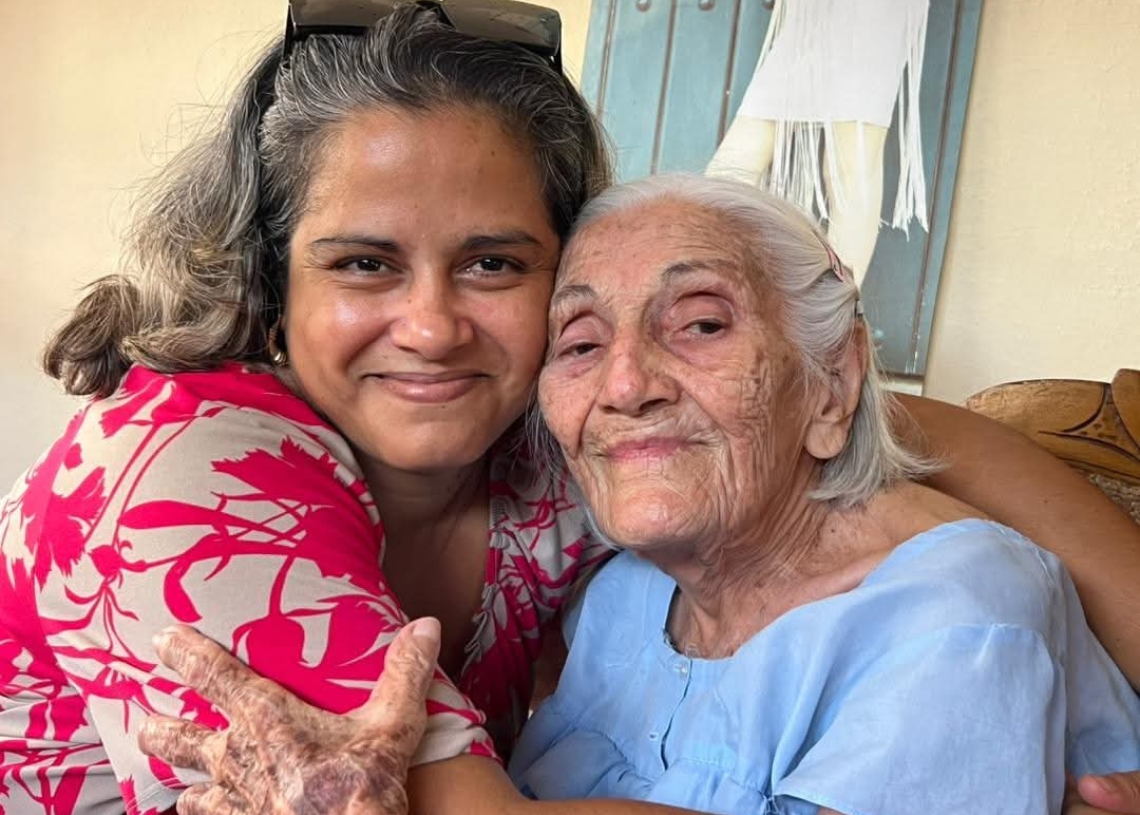
Yudelyn’s day starts early. At eight he arrives at Nelsy’s house, prepares her bath and breakfast. It is his third home service, although at this point he has also provided care in hospitals. She divides her time between another job, her family and her caregiving routine, a service she performs with Elianis and Helen at Nelsy’s house. Between the three of them they cover 24 hours a day.
The lady I was caring for before Nelsy had dementia. “It was a little more complicated; I was only there for a month because there are situations that affect you and become another problem,” he says. However, with Nelsy it is a different experience: they take care of each other, talk, watch television and do housework together. “She’s alone, it’s just her and us.”
Nelsy is 65 years old. She was a radiologist and teacher for years at the Vladimir Ilich Lenin Provincial Hospital in Holguín. In addition, she carried out internationalist missions until several illnesses prevented her from continuing to practice and forced her to remain at home. Her children live outside of Cuba and here she only has an older sister who cannot help her as she needs. That’s when the family contacted emergency services. Take Care of Art with Love, where Yudelyn works.
Caring, accompanying, helping…
In January 2024, it emerged CuidArte with Love SRLwhen Celia del Carmen Hernández Arias, a historian by profession and then a professor at the University of Holguín, motivated by the alarming results of a study she carried out with colleagues on female migrations to the United States based on real cases, felt the need to help the elderly who remained on the island.
At the same time, he says, he wanted to alleviate the burden of families who, with concern, left parents and grandparents alone, often caring for grandchildren, in the midst of the national economic and energy crisis.
Cuba is a highly aging country; in fact, It is considered the oldest in Latin America and the Caribbeanwith 25.7% of its population made up of people aged 60 or over. Holguín is one of the oldest provinceswith more than 22% of its population in that age range and a notable decrease in the birth rate added to the emigration of young people of reproductive and working age.
Added to this is a high life expectancy: 76 years for men and 80 for women. According to figures from the National Office of Statistics and Information (Onei), It is expected that by 2030 the population will decreasewith 100 thousand fewer working-age inhabitants, while Cubans aged 60 or older will increase to represent 30% of the total.
On the other hand, according to data from Onei itself, more than 400 thousand Cubans officially emigrated abroad between 2020 and 2023, figures that do not consider the flow of irregular emigration in recent years. More than 1.5 million Cubans reside outside the countrymainly in the United States, Spain and Mexico.
Most of the elderly depend on their family to survive. 17.4% live alone, and pensions and social benefits for sickness are far from covering the cost of food, medicine and basic expenses. Besides, the partial increase in pensions starting in September —which benefits 1,573,320 people, 88% of the total, according to official data— is still far from being enough for the comfortable development of older people.
The increase in rehired retirees, elderly people working in basic jobs such as yard cleaning, errands, minor sales, etc., and people with wandering behavior are phenomena to take into account.
Given this scenario, Celia looked for references for care projects for the elderly in Cuba and found TaTamaniathe first of its kind, with headquarters in Havana and subsidiaries in several provinces. “In Holguín we didn’t have anything like that,” he remembers. So, together with Adrián Ludet Arévalo Salazar and Carlos Máximo Leyva Zaldívar, with whom he is a member of this company of which he is a direct representative, he explored forms of economic management until registering as an MSME.

“We proposed that the company should stand out for humanizing care from sensitivity. That has been the essence of our work towards a very vulnerable, sensitive, demanding and somewhat forgotten sector, for which the State does not have sufficient resources,” he adds.
Today, more than a year and a half after its creation, CuidArte con Amor is the first and only company of its type in the province. It offers personalized support and protection to family members, in their homes or in hospital institutions. Thus, a sector of the population—mostly with family abroad—can hire 24-hour care services, with availability of caregivers for the elderly, sick and people with disabilities, with the aim of preventing loneliness and isolation, in addition to providing psychological support meetings for caregivers and family members.

Getting started in the care sector in Cuba: challenges and obstacles
Starting a business in Cuba, in the current economic circumstances, is complex: obstacles, bureaucracy and a fluctuating labor market. “As it is a new type of company, several people are afraid to leave a stable job to come work with us,” says Celia.
The promotion of private companies has been essential to generate jobs, revitalize depressed sectors and provide new goods and services. At the end of March of this year, according to Onei, About 9,550 private MSMEs operated in Cubaamong which three activities stand out: manufacturing industries, construction and accommodation and food services. Businesses dedicated to care are few, and linked to older adults, even fewer: TaTamanía, D’Hall Cares and Asirte, in Havana; Cuba Care, in Villa Clara; Pazilda, in Santiago; and CuidArte con Amor, in Holguín.
“We want to do a lot, but there are many obstacles to achieving, for example, collaboration agreements with state institutions and further professionalizing services,” he insists.

“We had to perfect everything because we were blind. You work with stress, under pressure, with almost no vacations,” he emphasizes. Added to this are the financial challenges to operate and the exchange rate problem that distorts the economy, which prevents important chains or alliances between private and state companies.
Despite this complex panorama, Celia seeks to grow through self-improvement: she researches care and other ventures, the laws that govern this type of company in Cuba, and digital marketing. He insists that “undertaking involves double sacrifice and preparation.”
Together with her team, she has found support in the Network of Holguin Entrepreneurs and Entrepreneurs, the New Moon/Collaborative Space project, the Local Development Center of the University of Holguín, the Women without Limits project, the Municipal Health Directorate and the Technological Platform of Holguin Entrepreneurs. There is also a Cuban Network of Care Studies, which promotes research to support social policies through technical rigor and citizen participation.
“When you make alliances, collaborate with others and others want to collaborate with you, the work is easier. In collaborations we not only talk about money, but about work that we want to turn out well, because it is necessary, human and sensitive. We assume a social responsibility with the community. This has been achieved in the Network and in Mujeres sin Límites.”

Focused on CuidArte…
Nelsy says that since the “girls” are with her she feels better and her children calmer. She laughs and adds that she likes to have new recipes cooked for her, she enjoys the conversations and some of the caregivers’ pranks.
“It is a multidisciplinary team that is always looking out for me and I thank them very much. It is a virtue that at this age they love me and take care of me like they do,” she says.

CuidArte con Amor has a professional team that includes the administrative and communication part, led by Celia. The caregivers—currently 14, while 10 are in the placement process—receive an average salary of 10,460.23 pesos, higher than the average monthly salary of 6,649 pesos, according to official figures for the first half of 2025 provided by Onei. Although, depending on the complexity of the services, the salary may increase.
In addition, a commercial manager, a human resources manager, supervisors and a group of health professionals such as geriatricians, psychologists, psychiatrists and nurses work at CuidArte. To apply for caregiver positions, Celia highlights, you must be of legal age and not necessarily professional, but you must have the desire to work, sensitivity and patience.
“Women are the majority among the workers in the company. They leave their comfort zone to undertake and be owners of their economy, although we would like to incorporate more men.”
For better functioning of CuidArte, teams are created in stages, depending on the services and to protect the health and emotional stability of caregivers. In turn, they established a code of ethics and disciplinary regulations.
For Yudelyn, this is a challenging experience, especially when it comes to doing housework at Nelsy’s house, because in the previous services she had only been a companion. “It teaches you to interact, observe and know the environment. We learn that it is not about imposing, but about adapting to personality, habits and needs,” he says.
“We tell the people we hire,” says Celia, “that, in addition to doing domestic work, they will accompany them. Care goes beyond what the word implies: it is not only being there, but taking them out of their comfort zone, taking them for a walk, reading them a book, visiting relatives or helping the family come together again. We also educate the caregivers so that they know that they have other capacities that they can develop.”

The School for caregivers and other challenges
At the same time, Celia promotes – together with her team and the Municipal Health Directorate of Holguín – the School for Caregivers, with the aim of providing training and professional improvement to those who work in this sector. In the first edition, 22 people graduated, and the second will be held in the second half of October. The school is open to both professional staff and those without prior training. They all obtain their qualification as caregivers.
As a partner of this company that is consolidated in the city of Holguín, Celia Hernández still has many dreams to fulfill in CuidArte con Amor: expand services to other municipalities, respond to the growing demand for requests, open a store of supplies and products for older adults and strengthen alliances with Public Health institutions and the University of Medical Sciences.
Near the end of the conversation, Yudelyn insists on the role of women and their warrior nature. “We are moving forward without fear. I wish this venture could be extended, because for the elderly having someone to lean on—both physically and psychologically—is important, and that is something that CuidArte con Amor prioritizes.”