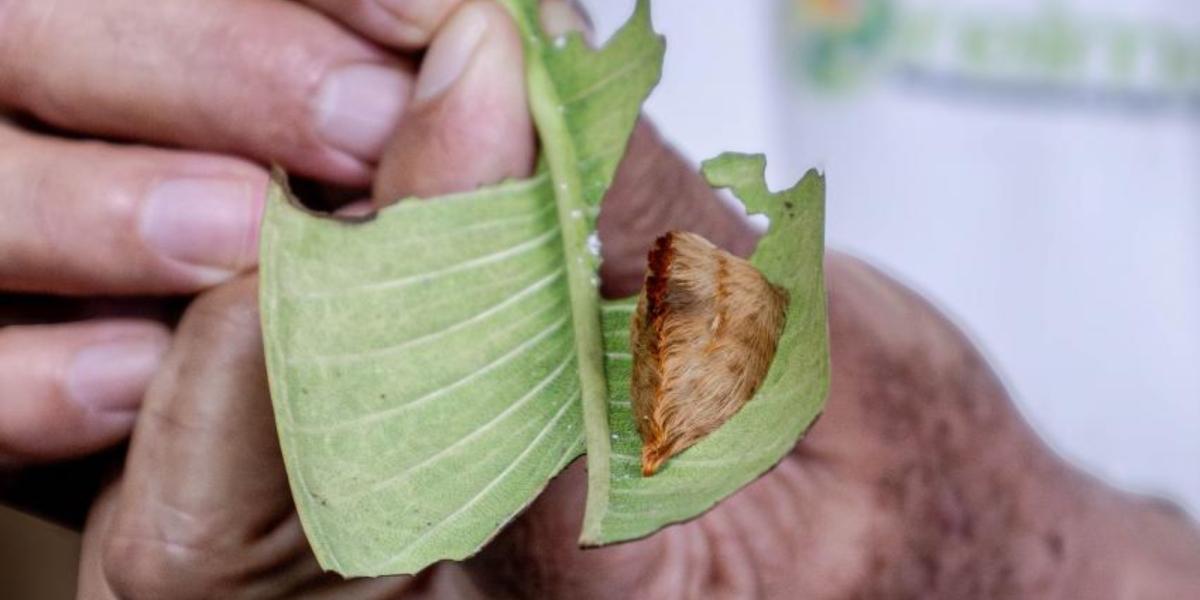
The University Center of the South Coast (CUCSur) of the University of Guadalajara (UDG) issued an alert after confirming the presence of the so-called stuffed caterpillar or “woolly cat” (larval stage of the moth Megalopyge opercularis) in Tlajomulco de Zúñiga, Jalisco.
The entomologist Luis Eugenio Rivera Cervantes, professor-researcher of the Department of Ecology and Natural Resources of CUCSur, He asked the population not to touch the insect despite its striking appearance and to report sightings.
Photo: CUCSur
Why is it dangerous?
The caterpillar has spines hidden under the fur that, when they come into contact with the skin, are activated and inject a toxin used as a defense against birds and parasites. In people, this contact can trigger:
- intense pain (described by those affected as similar to a fracture, a gunshot or walking on hot coals), which begins in the fingers and can radiate to the shoulder.
- Nausea and vomiting.
- Tachycardia.
- Affectations to the peripheral nervous system.
According to the specialist, there is no antidote to counteract its effects and the groups most at risk are girls, boys and older adults.
Why is it appearing now?
Rivera Cervantes related the sightings to the past rainy season, recalling history of the presence of these caterpillars in public parks in Guadalajara “like years ago”, when it was decided to fumigate and close spaces to avoid incidents.
In addition to Jalisco, There are reports in Nuevo León, Puebla and Yucatán, as well as in the United States and Central America; However, studies are still needed to understand in depth the biology and habits of this species in the country.
Recommendations to the population
- Avoid direct contact with the insect.
- If it is essential to handle it: wear clothing that covers arms and legs, gloves and tweezers.
- Do not fumigate: the measure may affect beneficial insects (other caterpillars, ants, bees, among others).
- Report sightings with photographs or videos and, if possible, identify the host tree or plant to systematize information.
How to report
CUCSur enabled the following channels to receive material and confirm presence of the species:
Mail: [email protected]
Phone: 31-7104-0070
The call of CUCSur is to remain calm, avoid manipulation and collaborate with evidence that allows mapping its distribution in Jalisco without affecting other organisms in the environment.
You may be interested
-

Art and Ideas
In the face of death, animals have “very complex” reactions

Latest Posts

Government evaluates contracting insurance against rise in oil prices
The Dominican Government is holding talks with investment banks to
Caixa resumes financing for properties above R$2.25 million
Caixa Econômica Federal announced this Tuesday (3) the resumption ofAmerican convicted of trying to produce child pornography with a minor in Cuba
On February 11, a federal jury convicted Earl Richard Clouser,
In Coppelia they no longer sell ice cream, only dry wine
Havana/On the corner of 23rd and L, where for decades
Cum at clita latine. Tation nominavi quo id. An est possit adipiscing, error tation qualisque vel te.









Latest from Blog

Government evaluates contracting insurance against rise in oil prices

Caixa resumes financing for properties above R$2.25 million
American convicted of trying to produce child pornography with a minor in Cuba

In Coppelia they no longer sell ice cream, only dry wine
