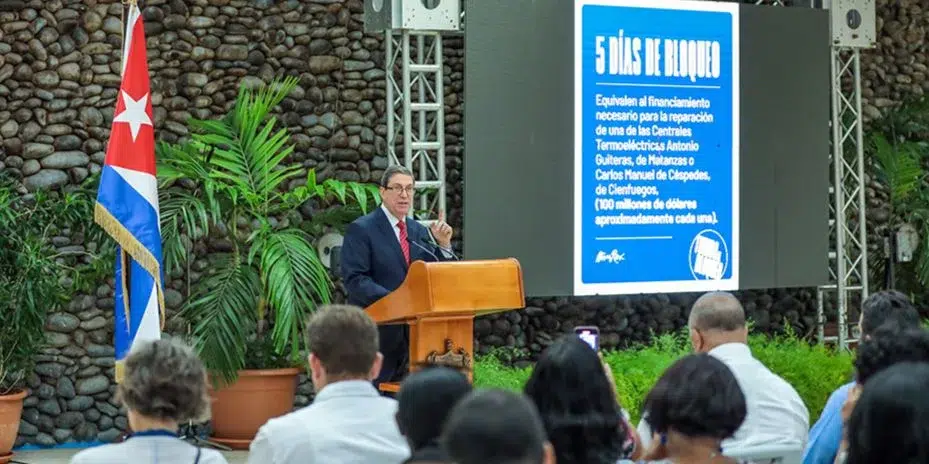
Havana ensures that the national economy would have grown 9.2 percentage points more without the embargo.
Miami, United States. – The chancellor of the Cuban regime, Bruno Rodríguez Parrilla, presented on Wednesday in Havana the official report on the effects of the United States embargo. The document It almost exclusively attributes economic and social deterioration to the “blockade”, which defines as “central axis” of Washington’s policy towards the island and as a “genocidal policy”, without recognizing its own failures.
“The economic, commercial and financial blockade constitutes the central axis of its maximum pressure against the island, seeking to suffocate its economy, generate shortcomings and discontent to cause a social outbreak,” says the report.
The document quantifies at 7,556.1 million dollars the damage of March 2024 to February 2025 – a 49% increase compared to the previous period – and argues that the economy would have grown 9.2 percentage points more without that “genocidal policy.” He also recognizes that GDP contracted 1.1% in 2024.
The official narrative denies that the crisis obeys management errors. The text itself qualifies as “cynics” the statements that “the difficulties experienced by the Cuban economy are the result of the socialist model and government errors”, and affirms that “I would lie who deny that I deny that [el bloqueo] It represents the main obstacle to the development of Cuba. ”
As key pieces of the “coercive scaffolding”, the document highlights the permanence of Cuba in the American list of “allegedly sponsors of terrorism”, the activation of Title III of the Helms-Burton law and actions aimed at “collapsing the Cuban economy.”
He also points out that until March 2025, 45 demands had been filed under that title, of which 30 followed their course, and that in February 2025 Washington rejected “dozens of Cuban passports” and denied visas processed by Cuban state entities. Also denounce he PRESIDENTIAL MEMORY No. 5 of June 30 of this year, which “ratifies the maximum pressure policy.”
In sectoral matters, the report states that financial and commercial persecution impacts health, energy, culture and foreign trade. He quotes, for example, the frustrated purchase of hemodialysis bags for a business fusion with an American firm; the impossibility of placing Heberprot-P in the United States (estimating lost income for $ 90); and damage to energy and mines for 496.08 million in the period, with the electricity union accumulating 279.35 million.
The text adds that the current electrical crisis – for “equipment failures”, hurricanes and lack of diesel – caused daily effects of 1,400 to 1,500 MW and three national disconnections between October and December, which “strongly influenced” the economy and the population.
To base his thesis, the Cuban government returns on the memorandum of April 6, 1960 of the American Undersecretary Lester Mallory: “(…) You have to quickly use all possible means to weaken the economic life of Cuba (…) cause hunger, despair and overthrow of the government.”
The report also invokes international support for your demand to raise sanctions. He quotes that in October 2024 the UN General Assembly approved by 187 votes in favor, two against and one abstention the annual resolution against the embargo, and lists statements of groups and countries in the same way.
In its conclusions, the document ensures that the “blockade” “violates international law”, “undermines the Cuban economy” and constitutes “a massive, flagrant and systematic violation of the human rights of the Cuban people. With this, Havana reaffirms that the main origin of the country’s impoverishment is external, while publicly discarding that the crisis responds to internal decisions and policies.