It will accept the offer of three million dollars, channeled through the Catholic Church, but made it clear that the aid will be managed by its own authorities.
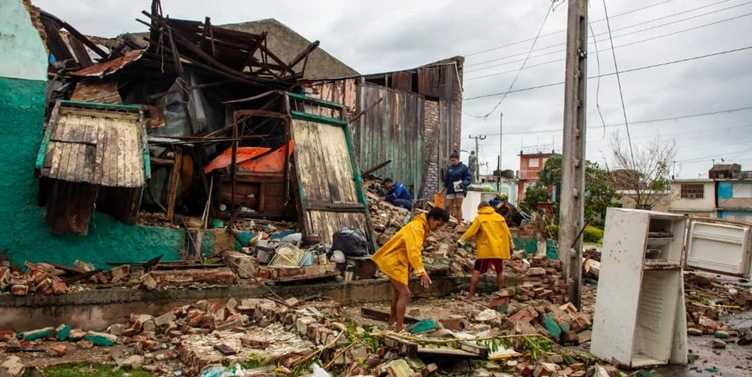
MADRID, Spain – The Cuban regime announced this Monday that it will accept the humanitarian aid offered by the United States — valued at three million dollars — intended for those affected by Hurricane Melissa in the eastern part of the country and channeled through the Catholic Church. However, it made clear that the distribution will be managed “in full coordination with its authorities,” a point that raises concerns among citizens and observers, due to past issues with lack of transparency in handling international donations.
In a statement from the Ministry of Foreign Trade and Foreign Investment (MINCEX), and echoed by the state-run outlet Cubadebatethe regime confirmed that the Catholic Church of Cuba had communicated the offer of material assistance via the US-based Catholic Relief Services (CRS), with funds provided by the US government, as well as another donation from the Archdiocese of Miami.
MINCEX stated that “these humanitarian gestures are appreciated” and assured that Cuban authorities are working to “channel the aid in the fastest and most efficient way” so that it reaches “needy communities promptly.” The statement also emphasized that Cuba has “a positive history of years of cooperation related to the Catholic Church’s humanitarian work,” always under the coordination and control of the State.
However, this condition raises concern both inside and outside the island. In previous emergencies, the distribution of international aid has been marked by a lack of transparency, diversion of resources, and absence of accountability. Often, donations are filtered through state or party-controlled structures, without directly reaching the affected communities.
The Catholic Church as mediator in the delivery of aid
A day before the MINCEX statement, the Catholic Bishops of Cuba and Caritas Cuba had announced that they were engaged in “useful and positive conversations with all parties” to finalize the delivery of the US humanitarian aid. In their message, they acknowledged that communities in eastern Cuba are experiencing a “catastrophic, very painful and sad” situation, and emphasized the urgent need for solidarity with the dioceses of Santiago de Cuba, Guantánamo, Bayamo, and Holguín.
The bishops’ announcement came just hours after the US Department of State, through its Bureau of Western Hemisphere Affairs, stated that it was coordinating directly with the Catholic Church in Cuba to distribute the humanitarian aid. Washington clarified that the three million dollars in aid would go directly to the most affected sectors, reiterating that the assistance is “intended for the Cuban people, not the regime.”
Regime reactions and diplomatic tensions
The initial offer was publicly made by US Secretary of State Marco Rubio, who stated that Washington was “prepared to offer immediate humanitarian aid to the Cuban people affected by Hurricane Melissa.” The proposal sparked mixed reactions within the Ministry of Foreign Affairs (MINREX).
Deputy Minister Carlos F. de Cossío confirmed on the social platform X that “we have made contact with the Department of State and are awaiting clarification on how and in what manner they are willing to help.” However, other officials and regime propagandists, including Ambassador Juan Antonio Fernández Palacios, took a hostile tone. The latter wrote: “No handouts or conditions.”
Other international aid and lack of transparency
Meanwhile, other countries and organizations have offered aid to the island following the devastating passage of Melissa. The Red Cross of China sent one thousand emergency family kits containing warm clothing, hygiene items, and other essential supplies. The UN, for its part, released 4 million dollars from the Central Emergency Response Fund (CERF) as an “anticipatory action” before the cyclone’s impact, although there is no public information about how those funds were used, nor any independent oversight mechanisms.
The Norwegian Embassy in Cuba also announced a contribution of $400,000, as stated by its ambassador, John Petter Opdahl.
However, as in previous disasters, the regime manages these donations without accountability or external supervision, while affected communities face blackouts, food and clean water shortages, infrastructure collapse, and a lack of basic services.
The acceptance of the US donation, although presented as a humanitarian gesture, thus reopens the debate over the Cuban government’s lack of transparency in handling international aid and the need to ensure that assistance truly reaches those who need it most — without political control or official manipulation.
Receive information from CubaNet on your cell phone through WhatsApp. Send us a message with the word “CUBA” on the phone +1 (786) 316-2072, You can also subscribe to our email newsletter by giving click here.