In recent years, highlights The New York Times, only a fraction of the Venezuelan oil destined for Cuba has actually reached the Island.
LIMA, Peru – The American newspaper The New York Times This Friday in a publication he exposed the oil resale scheme with which the Nicolás Maduro regime subsidizes Havana in international markets.
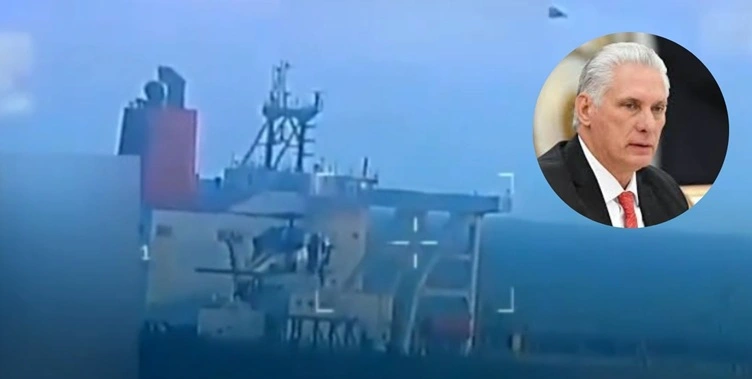
The article comes after the Venezuelan oil tanker Skipper was seized this Wednesday by United States forces off the coast of Venezuela, heading to Cuba, where the state company Cubametales expected to receive a substantial part of the crude oil shipment to resell it to Asian intermediaries, according to documents from the Venezuelan state oil company PDVSA, maritime monitoring data and officials cited by media such as AP, Reuters and POLITICAL.
Cubametales is the Cuban state company in charge of the import and export of oil. The US Department of the Treasury He sanctioned her in 2019when he pointed out it as “the Cuban state oil importing and exporting company” and accused it of continuing to receive Venezuelan crude oil despite the sanctions against PDVSA. Since then, Washington considers it a central cog in the scheme that allows Havana to obtain oil in exchange for political, security and intelligence support for the Nicolás Maduro regime.
“Most of the oil allocated to Cuba has been, instead, resold to China, and the money has provided much-needed foreign exchange for the Cuban government,” people close to the Chavista government assured the North American newspaper.
In recent years, the The New York Timesonly a fraction of the Venezuelan oil destined for Cuba has actually reached the Island.
“It is believed that part of that money has been used by Cuban officials to acquire basic goods, although the opacity of the country’s economy makes it difficult to estimate where that money ends up going, how it is spent or how much goes to commercial intermediaries with ties to both governments,” the newspaper states.
According to the publication, the main person who manages the flow of oil between Cuba and Venezuela is a Panamanian businessman named Ramón Carretero, sanctioned this last Thursday by the US.
The United States Treasury Department reported this week that Carretero has facilitated the shipment of petroleum products on behalf of the Venezuelan government. “He has participated in lucrative contracts with the Maduro regime and has had various business relationships with the Maduro-Flores family, including association in several companies,” he stressed.
PDVSA documents indicate that Cubametales has obtained contracts to purchase around 65,000 barrels per day of Venezuelan oil so far in 2025. This represents an increase of 29% compared to 2024 and seven times more compared to the previous year.
According to the American newspaper, “the travel history of the Skipper “It points to a broader, more flexible network connecting the energy industries of Venezuela, Cuba, Iran and Russia, the four US adversaries that have been, to varying degrees, excluded from the formal global oil market by Washington sanctions.”
In this regard, a US official stated that the crew of the seized ship was made up of about 30 sailors, mostly Russian.
What the route shows: from Venezuela to Cuba and beyond
Maritime tracking data allows part of the journey to be reconstructed. The Skipper set sail in early December from the port of José, Venezuela’s main crude export terminal, loaded with heavy crude oil. According to the firm TankerTrackers.comthe ship used typical “dark fleet” techniques, such as falsifying its position signals and carrying out ship-to-ship transfers to conceal the origin of the oil.
The same database indicates that before the seizure, the Skipper transferred nearly 200,000 barrels of its cargo to another tanker, the Neptune 6, near Curacao, and that this second ship was headed to Cuba.
The Skipper is part of a group of sanctioned tankers that have been used to transport Iranian and Venezuelan crude oil through opaque operations, according to Reuters.
Skipper’s link with financing networks of organizations designated as terrorist by Washington goes back a long way. In 2022, the Treasury Department sanctioned the then Adisa —the ship’s previous name—and its owner Triton Navigation Corp. as part of “a vast and complex network of front companies” used to blend Iranian oil and export it in support of Hezbollah and the Revolutionary Guard’s Quds Force.
This same network of “obscured” ships has been key for Venezuela, under sanctions, to continue placing its crude oil in Asian markets with the help of intermediaries, relabeling the cargo or transshipping it on the high seas. China has become the main final destination of this oil, while Cuba systematically appears as one of the intermediate recipients through Cubametales.
Cuban activist Rosa María Payá, coordinator of the Cuba Decide platform, summarized this connection in a message in X. The opposition leader, also a commissioner of the Inter-American Commission on Human Rights (IACHR), assured that the Skipper was sanctioned years ago “for helping an illicit network linked to foreign terrorist groups” and that “Cubametales planned to move the cargo to Asian corridors.” In Payá’s opinion, “the route says a lot about who really runs Maduro’s lifeguards.”
In response to Payá, Congresswoman María Elvira Salazar supported andThis seizure and stated: “Cuba is the nerve center of Maduro’s criminal lifeline, moving sanctioned oil, financing terrorist networks and destabilizing our region.” I applaud President Trump for taking decisive action. Going after the oil tankers, smugglers and dictators who poison our region is the way to restore security and freedom in the hemisphere.