Tiendas Caribe promotes repellents in MLC at prices inaccessible to the majority of the population, while the Government says it has limitations to face the epidemiological crisis.
MADRID, Spain.- In the midst of a growing health crisis due to mosquito-borne diseases, the state company Tiendas Caribe promoted this Wednesday on social networks the sale of repellents in foreign currencies, generating a wave of criticism among the population.
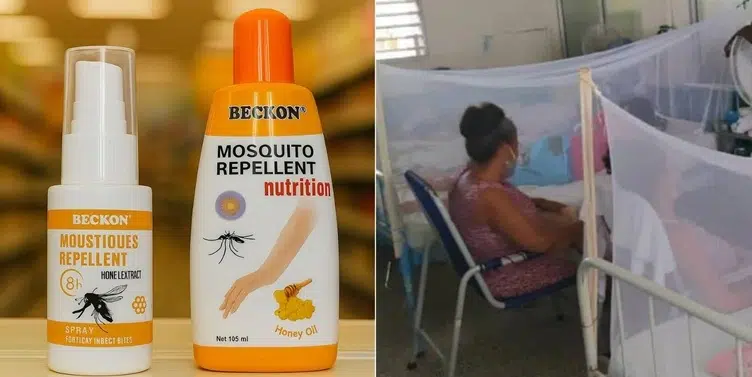
The publication, published on the chain’s official website, invites you to buy “Protection against mosquitoes!” in the store located in the Kohly Hotel, in Havana, with prices of 2.20 and 1.50 dollars, payable by international cards or cash in freely convertible currency (MLC).
Tiendas Caribe, subordinate to the Business Administration Group SA (GAESA) – under the control of the Ministry of the Revolutionary Armed Forces – is one of the main retail networks in the country. In a context of health and economic crisis, this promotion is interpreted by Cubans as another example of inequality and state abandonment.
“They sell the repellent for a quarter of what many retirees earn. Where for Cubans there is death, suffering, misery; for the dictatorship there is a business,” denounced journalist José Raúl Gallego on his Facebook profile, where the publication has generated dozens of indignant comments.
“They should sell in national currency too, not everyone has dollars,” commented one user. Another Internet user described it as “lack of respect” to sell and promote these products in the midst of a health crisis.
According to the Representative Rate of the Informal Market (TRMI) published by the independent media The Touchone dollar is equivalent today to 465 Cuban pesos. This means that a $2.20 repellent would cost approximately 1,023 Cuban pesos, almost half of the minimum monthly wage on the Island, set at 2,100 pesos.
The controversy occurs while health authorities recognize an increase in cases of arboviruses, including dengue and chikungunya. The Vice Minister of Public Health, Carilda Peña, admitted this Wednesday that Cuba is going through “a particularly complex epidemiological situation”, aggravated by “high vector rates” and a shortage of fuel for fumigation.
“We are in a period of rising diseases transmitted by mosquitoes, specifically the genus Aedes aegypti,” explained Peña, recalling that dengue is endemic on the island. “The vector indices are very high. The situation in the country at this time is complex to have the amount of fuel that we might need to carry out large fumigations like in the past,” he acknowledged.
The sale of repellents in MLC occurs in a scenario in which large sectors of the population lack access to foreign currency, while the number of people sick from mosquito bites increases and the state’s capacity to control outbreaks decreases. The government response to this health crisis translates, once again, into turning necessity into business.