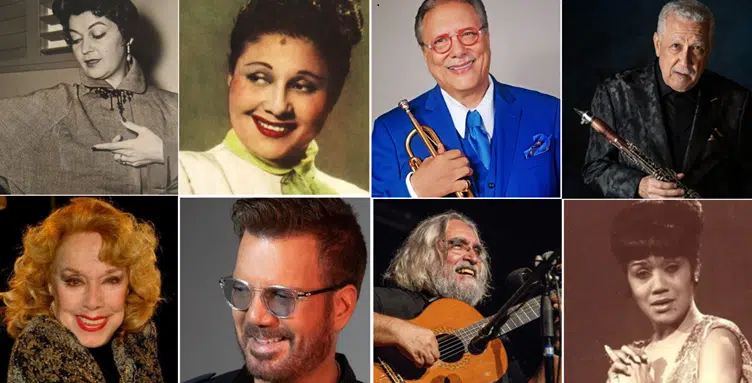
The history of Cuban music is marked by a plurality impossible to enclose in a Top 10.
Havana, Cuba.- Two articles on the 10 best interpreters in Cuban music appeared in Cubanet recently. One related to artificial intelligence, and The other of my colleague Luis Cino, who refuted the statement of producer Roberto Ferrante that baby is the greatest Cuban performer of all time.
Ferrant’s statement is an exaggeration: popularity is one thing and another quality. With respect to both works appeared on the matter, I want to express my point of view, even if I am not a musicologist.
We can say, without fear of being wrong, that the figure of great figures of the Cuban staff exceeds the amount and the names indicated. I will try to list a list of some that deserve to be included in a large group.
I will start with the nineteenth century, pointing to the violinist Salas toastto the pianist Ignacio Cervantes and the Matancero Miguel Faílde, creator of the Danzón, a genre that still has many dancers and is considered today national heritage. Among his representatives are the pianist Antonio María Romeu and the singers Barbarito Diez and Paulina Álvarez, the Empress of the Danzonete, a variant of the danzón.
Also in the nineteenth century, Santiago de Cuba gave a genre that has gone around the world: the bolero, created by Pepe Sánchez. Pointing to all singers who have ventured in Bolero would make the relationship very extensive. Some of them are: Panchito Riset, Vicentico Valdés, Orlando Contreras, Orlando Vallejo, Welcome Granda, Celio González, Lino Borges, Fernando Álvarez and Fernando Albuerne,
And the interpreters of the traditional trova could not be missing: Sindo GarayManuel Corona, Alberto Villalón, Rosendo Ruiz, María Teresa Vera, Eusebio Delfín and Eliseo Grenet.
In the Eastern region, the Son. Among its main growers are Ignacio Piñeiro, the unmatched Miguel Matamoros (with his trio completed by Ciro and Cueto) and Carlos Embale.
From the first half of the twentieth century there were singers such as Rita Montaner, Rosita Fornés, Esther Borja, Marta Pérez, Lucy Provedo, Gladys Puig, Alba Marina, Xiomara Alfaro, María de los Ángeles Santana and Iris Burguet, all very versatile and with their own style.
In more recent times we have Elena Burke, Omara Portuondo and Moraima Dryada, which integrated the quartet of Aida right.
Let’s also quote José Antonio Méndez, creator of the Filin Movement, César Portillo de la Luz, Ela Calvo, Marta Valdés and Ela or Farrill.
In musical groups with different formats, the major representation of personalities of the Cuban musical world is perhaps. They are, in addition to Formell and Chucho Valdés, indicated by Cino, among others: the creator of the cha cha, Enrique Jorrín, who with his orchestra America, transformed Cuban music with his rhythm; the Aragon, whose sound is unmistakable; the trumpeter Chapotin, who had Miguelito Cuní as a whole singer; Arcaño and his Wonders, Fajardo and his stars, the sensation orchestra with Abelardo Barroso, the Anacaona Women’s Orchestra, the Riverside Orchestra with Tito Gómez, Pacho Alonso, Elio Revé (creator of the changüí), Cándido Fabré, the original of Manzanillo, Adalberto Álvarez and José Luis Cortés (El Tosco).
Let us also remember the Lake Sisters, Meme Solís, Los Zafiros, Pello El Afrokan, Los Papines, Celina and Reutil, Ramón Veloz and Coralia Fernández, the duo of Olga and Tony.
Among the great directors of orchestra and symphonic composers are: Amadeo Roldán, Gonzalo Roig, Odilio Urfé, Hubert de Black, Alejandro García Caturla, Manuel Duchesne Cuzán, Enrique González Mantici, Leo Brouwer, Osvaldo Farrés, Harold Gramatges, Adolfo Guzmán and Félix Guerrero to mention some.
No relationships of Cuban music would be complete without the names of Ignacio Villa (snowball), Frank Domínguez, Frank Fernández, Paquito d’EntraArturo Sandoval, Felipe Dulzaides, Pedro Luis Ferrer, Claudio Brindis de Salas, Alfredo Brito, Luis Carbonell, Isolina Carrillo, Luis Casas Romero and Pedro Junco.
It is good to remember that other musicians and singers have triumphed outside our ground. I will only mention important figures such as Antonio Machín, Miguelito Valdés (MR Babalú), Chano Pozo, Willy Chirino and Maggie Carlés.
He who wishes more information to Encyclopedic Dictionary of Music in Cuba From the missing researcher Radamés Giro, the works on Cuban discography of José Reyes Fortún, or the numerous musical catalogs of before and after 1959.
My name inventory is not intended to be exhaustive. Of course I include those already cited by Luis Cino with whom I agree. I just want to point out that an inventory of names of Cuban famous artists cannot be limited to 10, because they are many more.