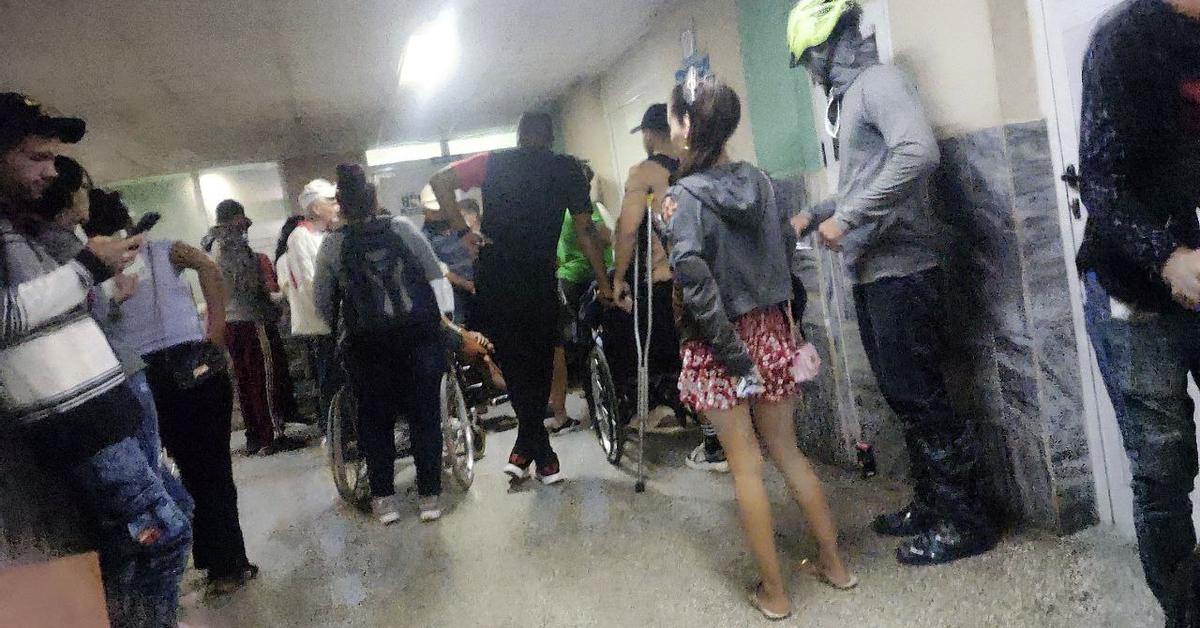
Sancti Spíritus / Havana /The Camilo Cienfuegos hospital in Sancti Spíritus remains between a rock and a hard place. “That is a complete collapse,” says Sandra, a Sancti Spiritus native who recently had to take my grandmother to the center due to a case of chikungunya that was getting complicated. “That’s every man for himself: there are no reagents, they have no way to detect anything and everything is done by eye,” he says.
The young woman affirms that the majority of the medical staff is very young and works at full pressure. “At around 3 am we decided to take her, because they didn’t have a diagnosis and they were already looking for meaningless diseases, and we were clear that it was the virus, because in my neighborhood it was like a plague that spread quickly,” he laments. The visit left her impressed by the number of patients the doctors treated, the comments from those who lost a loved one, and the cases of corruption that could be seen right there. “Up to 3,000 pesos for a bag of serum on the left, because only one, or two in extreme cases, of sodium chlorine is assigned to hydrate,” he says.
The reality is still that, although the cases are beginning to decline statistically. This Monday, the health authorities stated that the epidemic seems to have “a very positive course” in the coming weeks, “towards control” of both arboviruses. If confirmed, the premise they announced in November would be fulfilled, according to which December is a month in which infections due to this type of disease traditionally decrease.
This Monday, the health authorities stated that the epidemic seems to have “a very positive course” in the coming weeks, “towards control” of both arboviruses.
The Vice Minister of Public Health, Carilda Peña, assured in statements to state television that last was the eighth consecutive week with declining figures in the key variable, new cases of non-specific fever symptoms (high fever is the first symptom of the two diseases).
“The situation is favorable for both arboviruses,” he assured. Furthermore, it has not added any deaths to the lists, after putting the death toll at 55 on Friday, three more than 48 hours earlier. Two thirds of those who died are minors.
The forecasts point to new cases remaining stable or decreasing in the coming weeks “if we do what needs to be done,” said the vice minister without specifying what those tasks are.
Peña put the number of new cases of non-specific febrile syndrome detected in the entire previous week at 16,214 and also said that the incidence rate of dengue fever stood at 10.49 per 100,000 inhabitants in that period of time (compared to 15.25 the previous week).
The Pan American Health Organization (PAHO), which bases its records on official figures, indicated that so far this year and until the second week of December, Cuba had accumulated 28,850 cases of dengue and 17 deaths from this disease, although the ministry’s own accounts indicated 18, since of the 55 total, 37 were attributed to chikungunya.
The accumulated cases of this disease stood at 48,223 infected, according to the vice minister.
The Cuban Government recognized for the first time on November 12 that the country was suffering from an epidemic of chikungunya and dengue, despite the fact that the first cases were diagnosed in July and that infections had skyrocketed in September and October.
The Cuban Government recognized for the first time on November 12 that the country was suffering from an epidemic of chikungunya and dengue, despite the fact that the first cases were diagnosed in July.
Two and a half weeks before recognizing the epidemic, the Cuban Government made an international request for help for Hurricane Melissa, which included enormous quantities of chemicals to combat the mosquito, the vector of transmission of dengue and chikungunya.
The epidemic has found fertile ground in Cuba to spread due to the country’s serious economic crisis, which limits the prevention capacity – mainly through massive fumigation against mosquitoes, for which there are no materials or fuel to transport technicians -, control and care for the sick, due to lack of medicines and other health supplies.