Despite the frequent donations to the regime, the population remains without medicines or basic foods.
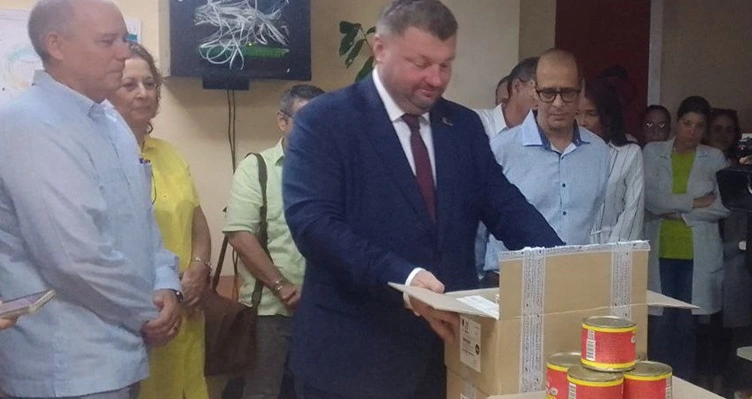
Madrid, Spain.- The Cuban government received on August 20 a donation of medicines and foods from Belarus, valued at more than $ 238,000. The shipment was delivered to the Institute of Hematology and Immunology of Havana and will be distributed in 27 hospitals in the capital, with priority in pediatric centers, according to They said official means
The cargo includes specialized medications such as cytostatic, anxiolytic, immunostimulants, antihypertensive and vitamin complexes, in addition to basic foods such as powdered milk and canned meat. According to health authorities, these products are intended to improve the treatments of patients with hematological, oncological and immunological diseases, as well as older adults.

The director of the Institute of Hematology, Wilfredo Roque García, described the gesture as a “noble” contribution that reinforces the brotherhood ties between Cuba and Belarus. For his part, the Belarusian ambassador to Havana, Vitaly Petrovich Borchuk, expressed satisfaction for the contribution and recalled the Cuban aid provided to victims of the nuclear accident of Chernobyl, highlighting cooperation as an act of reciprocity.
The import of medicines from Belarus is among the agreements signed last May between the regime of Havana and The once territory of the Soviet Union. On that occasion, the XII session of the Intergovernmental Commission between the two countries, was the scene of memorandum for the joint production of medicines, the expansion of the dairy complex with technology and scarry raw materials, and a second phase in the assembly of tractors.
In April 2025, Belarus had already sent more than 20 tons of humanitarian aid after natural disasters on the island. In addition, since 2021 both governments have reinforced their relationships in strategic sectors such as health, biotechnology, agriculture and industry. Among these agreements are donor milk donations, the importation of beamorruse tractors and the creation of mixed companies, such as Academsol, focused on the manufacture of medications.
However, despite the arrival of these shipments, the daily reality of Cubans is far from improving. The island crosses a deep economic and health crisis That has been dragged for more than five years, marked by food shortages, chronic medication shortage, uncontrolled inflation, prolonged blackouts and a health system that no longer manages to meet the most elementary needs of the population.
Despite the frequent international donations, most Cubans ensure that he does not perceive any relief: they continue to go hungry, without finding the most essential medications, while the national health system faces a total collapse.