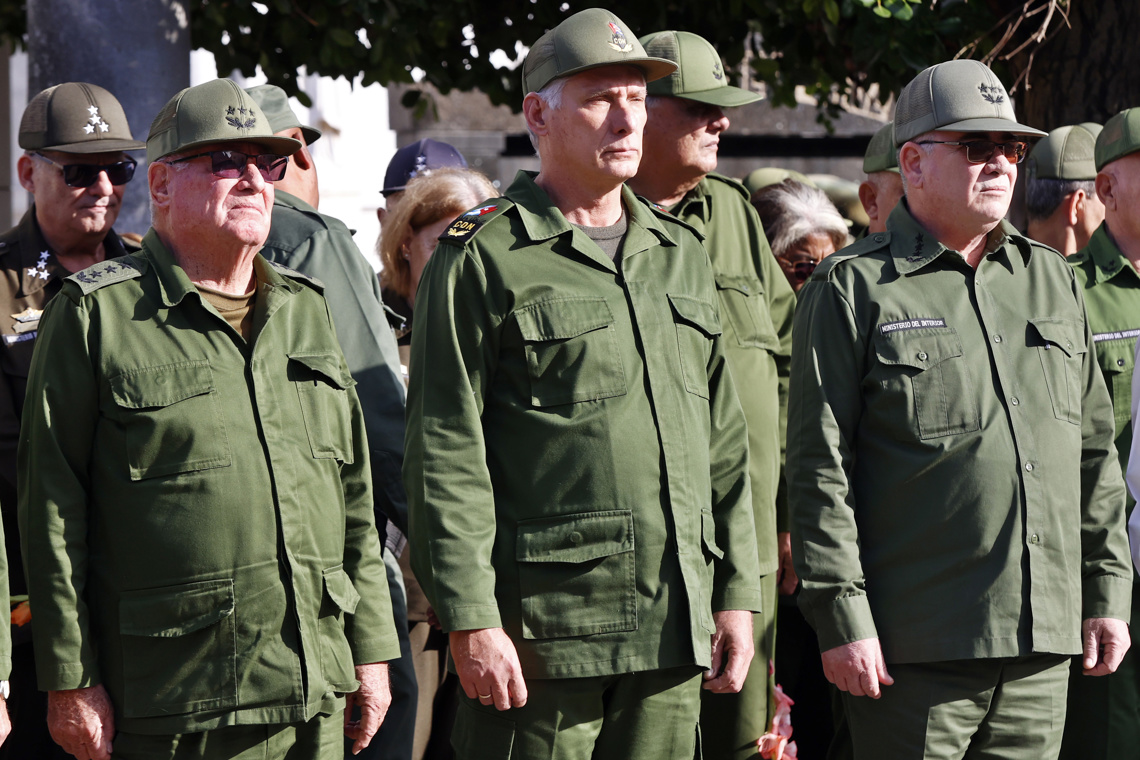
The National Defense Council of Cuba approved this Saturday the “plans and measures for the transition to the State of War,” according to the official Cuban press.
A brief note published in the main media on the island, it indicated that said approval was carried out “in compliance with the activities planned for Defense Day and with the objective of increasing and perfecting the level of preparation and cohesion of the management bodies and staff.”
The information also indicates that this took place “as part of the country’s preparation under the strategic conception of the War of All the People,” which governs the country’s actions in matters of defense.
Likewise, he adds that former President Raúl Castro “stayed aware of the development of the activity” and described it as “a good and efficient meeting,” without providing more details.
The note does not explicitly state which authorities in the country attended the Defense Council meeting, although it is assumed that it was led by President Miguel Díaz-Canel, who leads it as established by law, as well as other government figures and the military establishment.
Cuba before the US: lessons and anti-lessons from the intervention in Venezuela
After the events in Venezuela
The brief official information does not detail the approved plans and measures, nor a presumed schedule for their implementation if the circumstances that would justify it arise.
Regarding the moment of what happened, the agency Latin Press (PL) points out that the session “took place in the context of the celebration throughout the territory of the National Defense Day, during which the popular forces were trained to confront any aggression.”
It also remembers that the National Defense Council is “the highest body of the State” and “has the mission of organizing, directing and preparing citizens, in peacetime, for their protection, and ensuring compliance with current regulations relating to the defense and security of the nation.”
On the other hand, none of the official reports refer to the fact that the meeting of the government entity took place at a time of tension and uncertainty in the country after the recent attack by the United States on Venezuela, which led to the capture of President Nicolás Maduro and his wife and caused the death of 32 Cuban soldiers, as well as injuries to another group.
Precisely in recent days, those killed and wounded during the US military action were received and honored in Cuba, who, according to the island’s Government, were in Venezuela by virtue of agreements with the authorities of the South American country, despite the fact that they had not previously publicly confirmed their presence.
Furthermore, although the Trump Administration has not been largely open to a military incursion in Cuba, it has increased its pressure on Havana and has warned it to sit down to negotiate. Meanwhile, the Cuban Government has said it is willing to “dialogue”, but in “equality”, without “coercion” and without this implying political concessions.