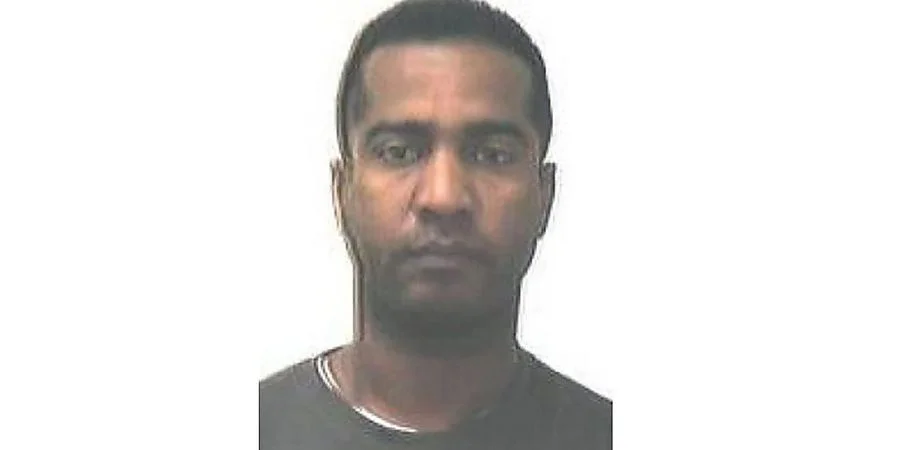
Guillermo Valle-Quintero was sentenced indefinitely for repeated abuses against two women.
Miami, United States. -The Canadian probation board again denied Freedom to Guillermo Valle-Quintero, a 61-year-old Cuban declared “dangerous criminal” in 2015 for a series of violent crimes against two women in that country.
The decision, taken in July 2025 and released by the newspaper Toronto Sunalso prevents its deportation to Cuba, since this would only be possible if the inmate obtained complete probation.
According to the Board, the Valle-Quintero history includes “a significant number of violent crimes committed persistently against an intimate ex-partner.” The document also indicates that it maintains “an extensive, varied and violent criminal history”, with self -control problems, lack of progress in rehabilitation programs and “no visible commitment to positive personal change.”
Valle-Quintero arrived in Canada in 1997 after marrying a Canadian tourist who met him in a Cuban resort. On the island, he already accumulated criminal records for theft, lodging of abode and pimperism, according to the judicial reports cited by the Canadian media.
Just a month after settling in Canada, Valle-Quintero began an extramarital relationship that became violent. In November 1998, a day after being released after a conviction for domestic aggression, he ambushed his partner in his car, tied it with adhesive tape, covered his head with a plastic bag and locked her in the trunk of the vehicle. The woman managed to escape and he was sentenced for 12 -year prison murder attempt.
After complying with that sentence, he committed acts of violence again. Between 2010 and 2011 he physically and psychologically abused his new partner, a bar administrator in North York. The woman, fearing for her life, documented the aggressions in videos as a preventive measure in case of being killed. In one of the clips it is seen with a split lip and a bruise on the face. In 2013, Valle-Quintero was convicted of aggression and death threats against her.
The Prosecutor’s Office argued at the 2015 hearing that “the possibility that Mr. Quintero murders an intimate couple is not idle speculation.” Prosecutor Paul Leishman described his actions as “moral instruction for suffocation”, referring to the attempted murder of his first victim, whom he attacked for his work as a masseuse.
Since she was declared a dangerous criminal a decade ago, Valle-Quintero complies with a sentence of indefinite duration in prison. In previous hearings, the defendant has denied most of the charges against him and has blamed his victims.
“He still claims to be innocent of most of his convictions, blames the victims and becomes very defensive about domestic violence,” said the Board in its November 2019 opinion.
The recent resolution of 2025 also left open the possibility that, in the future, Valle-Quintero can be put on probation under strict supervision in a transition house if the migration process advanced with the Canada Border Services Agency. However, the ruling concludes that the inmate has not presented a viable reintegration plan and continues to represent a high risk for society.
Both victims of Valle-Quintero remain under shelter of anonymity by court order.
Would the Cuban government accept the deportation of Valle-Quintero?
A key element to determine whether Cuba would accept the repatriation of Guillermo Valle -Quintero is the existence of a Canadian treaty that allows prisoners to fulfill their penalties in their country of origin. Indeed, Canada and Cuba signed the “Treaty on the fulfillment of penalties” In 1999, which allows Cuban convicted to serve their sentence in Cuba, within certain strict conditions, such as the crime exists in both countries, the inmate is a Cuban citizen, and there are at least six months of penalty to be fulfilled.
This treaty is not a mechanism of forced deportation, but an agreement for voluntary transfers of prisoners between jurisdictions. In fact, the transfer requires the consent of the conviction and the approval of both the Canadian and Cuban State. In addition, legal procedures or appeal must have been fulfilled.
On the other hand, the Cuban government has shown in other instances disposition to receive deportees from countries such as the United States, in more recent cases. According to the Cuban Foreign Ministry, under migratory agreements in force since the 80s, Havana has accepted deportation flights from the US, although these are usually cases of administrative deportation not linked to the fulfillment of criminal sentences.
Although Cuba has received a monthly US deportation flight. to South Sudan and to the kingdom of Esuatiniboth in Africa.