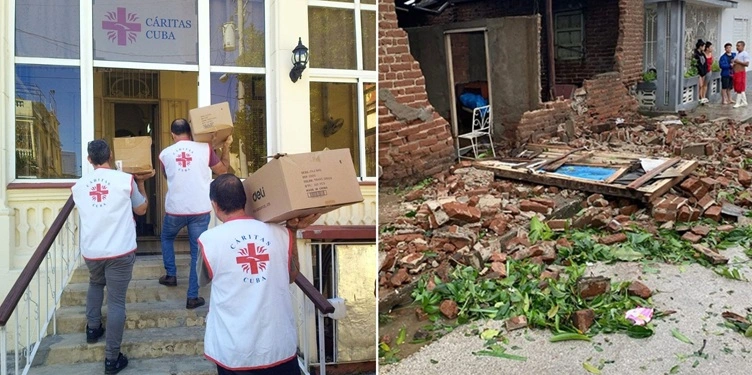
The Conference of Catholic Bishops of Cuba confirmed that, together with Cáritas, it manages with the United States the delivery of aid for those affected by Hurricane Melissa.
MADRID, Spain.– The Catholic Bishops and Cáritas Cuba reported this Sunday that they are taking the necessary steps and holding “useful and positive conversations with all parties” to finalize the delivery of the humanitarian aid offered by the United States Administration, valued at three million dollars, intended for those affected by Hurricane Melissa in the east of the country.
The statement of the Conference of Catholic Bishops of Cuba (COCC) was released a few hours after the US Department of State, through its Office of Western Hemisphere Affairs, announced on the social network X that it is coordinating with the Catholic Church in Cuba the distribution of that assistance.
In their message, the bishops recognized that the communities of eastern Cuba are experiencing a “catastrophic, very painful and sad situation,” and reiterated their call to prayer and solidarity with the dioceses of Santiago de Cuba, Guantánamo, Bayamo and Holguín.
The COCC also asked to accompany the ongoing efforts with prayers, “so that all the aid that is being offered to our people, through various means, reaches a satisfactory result and contributes to the well-being of those affected and generates the hope that Cuba longs for and needs.”
The statement concludes by invoking the protection of the Virgin of Charity of Cobre, patron saint of Cuba, and her message of unity: “All your children cry to you, Virgin Mambisa, that we may be brothers!”
The United States Department of State specified that the three million dollars in humanitarian assistance will go directly to the hardest hit sectors.
Days before, the organization had reaffirmed its willingness to offer immediate help to the Cuban people affected by the hurricane, expressing that this support “is directed directly to Cuban citizens, not to the regime.”
The announcement coincided with statements by the Secretary of State, Marco Rubio, who assured on social networks that Washington was “prepared to offer immediate humanitarian aid to the Cuban people affected by the hurricane,” a proposal that was rejected by senior regime officials.
Melissa’s impact on eastern Cuba
Hurricane Melissa, which impacted the eastern region of Cuba as a category three between the early morning and afternoon of October 29, left a devastating panorama: destroyed homes, communities under water, total losses and emergency evacuations. The tragedy adds to the serious economic crisis that the country is going through, marked by prolonged blackouts, shortages of fuel, medicine and food.
The United Nations World Food Program (WFP) warned that around 700,000 people—more than 7% of the Cuban population—require urgent humanitarian assistance after the hurricane, which caused serious damage to homes, crops and basic supply networks.
Despite the emergency, the Cuban Observatory for Human Rights (OCDH) denounced on Friday that the regime authorities are preventing the entry of humanitarian aid organized by churches and independent organizations to the most affected areas. According to the OCDH, the government has established checkpoints at the exit of Las Tunas and the entrance to Granma to block the passage of people transporting food and supplies, especially from Christian communities.
The OCDH demanded that the Cuban government allow the flow of aid from civil society and refrain from controlling solidarity initiatives. Testimonies collected by the organization indicate that the authorities seek to maintain control of distribution, even when the resources come from religious or non-governmental entities.