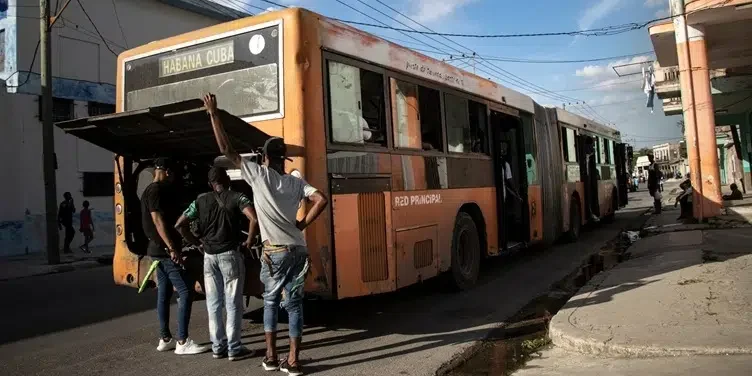
The shortage of buses has reached such an extreme that the same car has had to be used for different routes, changing its identification sign between routes.
HAVANA.- “After not having food to give your children, there is nothing more desperate than having to get somewhere and there being no transportation.” This is how a neighbor lamented yesterday after having spent a few pesos and much of the day going to and from a task in another municipality. And the deterioration of the public transport on the island it is already reaching alarming levels. As unlikely as it may seem, in Cuba arriving on time to work, school, a doctor’s appointment or a procedure is a feat bordering on the impossible and almost totally out of our control.
The old resource of getting up early has long been no longer effective; No matter what time you are at the stop, the panorama will always be the same: hours of waiting and fierce competition with dozens of other individuals as rushed, desperate and frustrated as you. Aspiring passengers who, without a trace of education – or compassion, for that matter – will honor the law of the strongest to get us out of the way and thus get that coveted little place that will allow them to complete, or at least start, their plan for the day. That is, if the bus comes, which happens less and less frequently.
It couldn’t be any other way. To start, the available park has been reduced by 48% since 2019: according to the president of the Automotive Transport Business GroupOscar Carbajal, of a fleet of 464 vehicles, by December 2024 there were only 239 left, making it practically impossible to face breakdowns and other unforeseen events. In Havana alone there are more than 90 lines paralyzed. The shortage of buses has reached such an extreme that the alternative of using the same car for different routes has had to be applied, changing the identification sign between routes. As for other provinces such as Granma, Guantánamo and Santiago de Cuba, most of the important lines have been reduced to two departures a day: in the morning and in the afternoon.
On the other hand, the vehicles that are still operational are in such an unflattering state that sometimes it borders on suicide to dare to travel in them. And it does not matter how many new acquisitions are announced with great fanfare, if the constant non-payment by the island’s government ruins the subsequent acquisition of essential supplies and spare parts. The government’s disinterest is reflected in figures: between January and September 2023, only 14.1% of national investment was allocated to transportation, storage and communications. In 2024, only 8.7%. Add to this the terrible conditions of streets and highways and you will have the perfect recipe for the subsequent increase in accidents. As a result, the anxiety of not arriving on time is added to the anxiety of not arriving on time, period.
As an insufficient alternative to state transportation, some turn to private carriers, whose (official) prices usually range between 150 and 500 pesos in national currency. Something that not many can afford, although it may seem otherwise judging by the competition to access them, generally as fierce as the one we face to get on the bus.
Against this backdrop, the government provisions supposedly aimed at alleviating the situation continue to be insufficient (not to mention apparent) and, furthermore, ineffective. This is the case, for example, with the one hundred fourteen-seater minibuses destined this year for public transportation with a fixed fare of $20.00, of which 50 began to circulate in the capital, 20 in Santiago de Cuba, and the rest would be destined for Holguín (10), Camagüey (10), Ciego de Ávila (5) and Santa Clara (5). As it is easy to deduce from these figures, its inclusion, in practice, rather than being noticed, is condemned to be lost in urban traffic.
However, other times there is less “luck” and the measures remain empty promises. On Monday, March 31, 2025, the official newspaper Granma announced the repair of none other than one hundred buses “designed to reinforce Havana’s vehicle fleet.” However, so far (December of the same year) its incorporation into urban public transport has not been observed. Quite the opposite.
Although, to be honest, the island’s public transportation has never functioned as it should after 1959. With availability eternally lower than demand (as is characteristic of almost all sectors in a pseudo-communist totalitarian regime), under the command of the Castros the sector has done nothing more than alternate periods of passably mediocre service with others of frank precariousness. “Walk on roller skates or on a bicycle,” the comedian Virulo recommended back in the 1980s. Of course, he had never before shown such a level of abandonment. And while inefficiency rules freely in the largest of the Antilles, everything seems to indicate that Cubans will have no choice but to get used to traveling on the San Fernando bus: a little while on foot and another while walking.