While between January and October there is a 20% drop in international visitors, according to data from the ONEI.
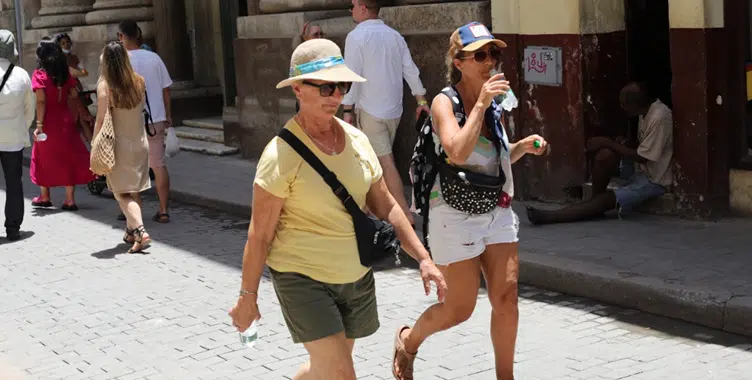
MADRID, Spain.- Cuba received 2,132,680 travelers in total between January and October 2025, a figure equivalent to 85.6% of the record reached in the same period of the previous year, which represents 357,981 fewer travelers, according to data published by the National Office of Statistics and Information (ONEI).
Within this general volume, international visitors, a key indicator to measure the performance of tourism, totaled 1,477,892 people, just 80.1% of the 2024 level, a year-on-year drop of 19.9% that confirms the stagnation of the sector and definitively moves away from the official goal of 2.6 million visitors for this year.
The decline is even more evident in October, when the Island received only 111,172 international visitors, the worst record for that month since 2021. In addition, the disaggregated data show a general decline in almost all issuing markets.
According to the ONEI, Canada, the main country of origin, went from 727,254 to 596,644 travelers, while the Cuban community abroad fell from 244,058 to 194,745. The Russian Federation, one of the most affected markets, fell from 156,614 to 99,908 arrivals, and those from the United States fell from 118,038 to 95,337. There were also falls from Mexico (from 53,205 to 47,867), Spain (from 55,774 to 40,053), France (from 41,430 to 31,580) and Portugal (from 32,512 to 28,751).
In parallel, the group of other countries contracted from 350,534 to 271,953 travelers. In contrast, only two markets showed growth: Argentina, which went from 38,622 to 41,741, and Colombia, from 26,767 to 29,313, becoming the only exceptions within a panorama of strong declines.
While Caribbean destinations have managed to recover after the pandemic to reach historic figures, Cuba continues to move away from pre-2020 levels. After having exceeded 4 million annual tourists during the thaw period with Washington, the Island has not achieved a sustained recovery for several years. At the current pace, it will hardly even exceed the 2.2 million reached in 2024, which was already the lowest figure in 17 years outside the critical period of the pandemic.
The drop in visitor arrivals is accompanied by other indicators. Hotel occupancy during the first half of 2025 fell almost seven percentage points compared to the same period in 2024, and arrivals by air fell by around 20%, according to official figures and sector reports.
Specialists link this contraction to structural factors, including the loss of air connectivity, the deterioration of tourism infrastructure, deficiencies in essential services, the economic and energy crisis, and growing competition from other Caribbean destinations that have accelerated their recovery after the pandemic.
Tourism, one of the main sources of foreign currency for the regime – along with the export of professional services and remittances – continues without recovering in a scenario of internal instability. Despite this, the Government continues to allocate resources to the remodeling and construction of hotels, a strategy questioned by economists who point out the low occupancy levels in existing facilities and the urgency of prioritizing the serious housing deficit, marked even by landslides that have caused fatalities.