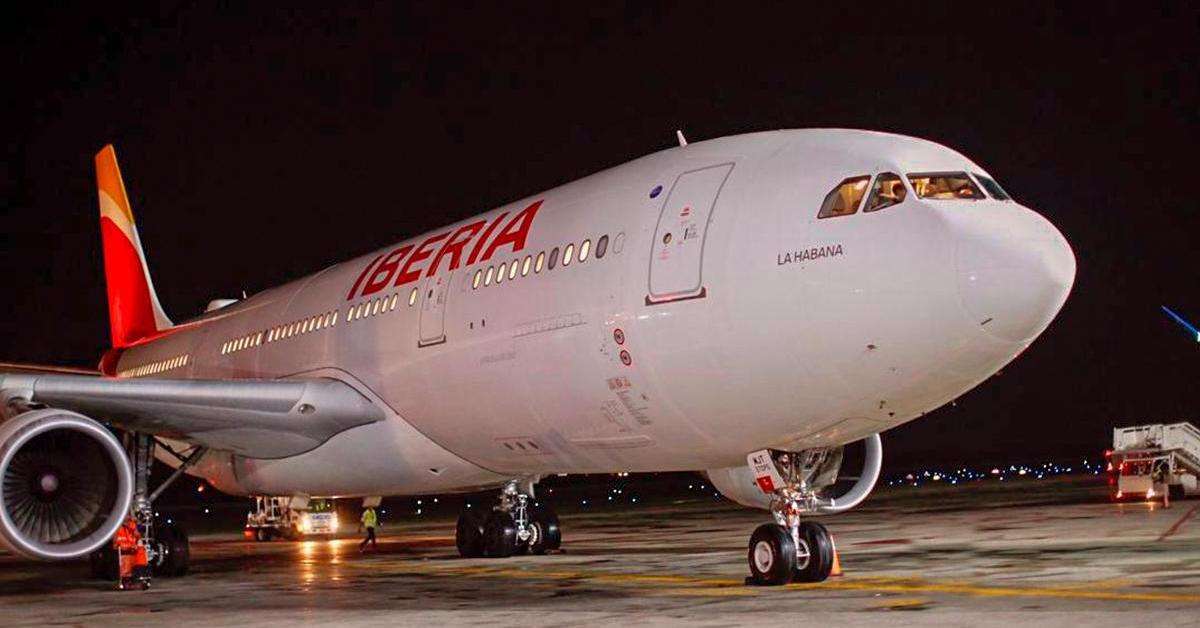
Madrid/The Cuban Government warned international airlines that operate on the Island that as of this Monday the country will run out of aviation fuel due to the United States oil siege, as confirmed by EFE with two sources.
The official Notam message (notice to aviators) from the Cuban authorities to pilots and controllers specifies that the kerosene deficit affects all international airports in Cuba. The validity period of the notification is for one month, from February 10 to March 11.
“JET A1 FUEL NOT AVBL” (fuel for A1 aircraft not available), says the encoded Notam message as it currently appears in the database of the US Federal Aviation Administration (FAA).
The validity period of the notification is for one month, from February 10 to March 11
The nine airports affected are José Martí in Havana, Juan Gualberto Gómez in Varadero, Jaime González in Cienfuegos, Abel Santamaría in Santa Clara, Ignacio Agramonte in Camagüey, Jardines del Rey in Cayo Coco, Frank País in Holguín, Antonio Maceo in Santiago de Cuba and Sierra Maestra in Manzanillo.
A Havana Terminal worker who requested anonymity told 14ymedio that since this Saturday the kerosene supplied to the planes was being controlled and that the employees had to leave the operation perfectly recorded in their name. In addition, it was requested to fill the warehouses with “the essential minimum.”
For the moment, the affected airlines – mainly American, Spanish, Panamanian and Mexican – have not communicated how they are going to face this situation, which could generate alterations in routes, frequencies and schedules, at least in the short term.
However, this fact is not new in Cuba. In previous similar situations – both in the Special Period in the 90s and in temporary bottlenecks in recent months – airlines had saved the problem by rearranging their routes out of the Island with extra stops to refuel in Mexico or the Dominican Republic.
The majority of flights that connect the Island with the outside world cover routes to Florida, in the United States (Miami, Tampa, Fort Lauderdale), to several cities in Canada – the main source of tourism for the Island –, Russia, Spain (Madrid), Panama and Mexico (Mexico City, Mérida, Cancún). Cuba also has regular connections with Bogotá (Colombia), Santo Domingo (Dominican Republic) and Caracas (Venezuela), among other Latin American capitals.
In addition to the consequences that it may have for a punished tourism sector, there are already repercussions in more areas, such as commercial areas. Cubamax has been the first company that has taken measures and has notified through from your social networks that it cancels shipments of some products. “We inform our customers that, due to the current fuel situation in Cuba, Cubamax temporarily suspends shipments of frozen products, with the aim of always guaranteeing the quality and safety of each shipment,” he said this Sunday.
Cubamax has been the first company that has taken measures and has notified through its social networks that it is canceling shipments of some products
This measure “seeks to avoid any deterioration in the products and ensure that our services maintain the standard that you deserve. We will keep you informed as soon as the conditions are reestablished to resume this service,” the message adds.
The announcement has generated a heated dispute between those who ask them to cancel all their business areas to “end the dictatorship” and those who regret that families are going to be left without a livelihood, although there are those who are unable to decide. “On the one hand, I want them to continue pushing and for everything to fall over there. But on the other, I think about my family and that I will no longer be able to send them anything,” lamented one user. Another argued that it is just the frozen matter and it is not that serious.
The population fears that this is the first of many other similar decisions, although for the moment it is the only company that has commented on the matter.
The Cuban Government announced this week a tough emergency plan to try to survive without imports of crude oil and derivatives, a package of restrictions that included the end of the sale of diesel, the reduction of hours in state offices, the suspension of surgeries in hospitals and the closure of some hotels.