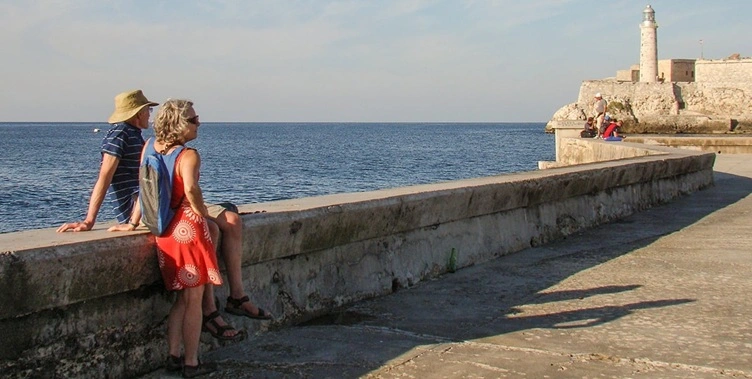
Cuba received 1,629,787 international visitors until November, a figure that confirms the failure to meet official goals and the sustained deterioration of the tourism sector.
MADRID, Spain.- Cuba received a total of 1,629,787 international visitors between January and November, which represents a drop of close to 19% compared to the same period in 2024, according to data published this week by the National Office of Statistics and Information (ONEI). The contraction confirms the deterioration of the tourism sector, one of the regime’s main sources of income.
According to the official report, the decline was accentuated in November, when 151,895 international travelers arrived on the island, one of the lowest monthly figures since 2021, a year marked by the closure of borders due to the Covid-19 pandemic.
In the accumulated of the first eleven months of the year, the total number of travelers – including national and foreign – reached 2,343,944 people, 13.8% less than in the same period of 2024. The drop is even more pronounced if only the flow of international visitors is considered, which stood at just 81.3% of the volume registered the previous year.
Canada remained the main source market, with 664,621 visitors, although with a year-on-year decrease of 14.8%. They were followed by the Cuban community abroad, with 210,255 travelers (-21.1%), and Russia, with 115,968 (-32.4%). Other traditional markets also recorded significant declines, such as the United States, Spain, France and Germany, the latter with a contraction of more than 48%.
Only some Latin American countries showed increases, among them Argentina and Colombia, although without the capacity to compensate for the general losses.
The Cuban regime recently recognized that tourism is going through a particularly adverse stage and that it will not reach the official income or international visitor goals planned for this year. During a speech before the plenary session of the National Assembly of People’s Power, the Minister of Economy and Planning, Joaquín Alonso, indicated that the sector’s income will be 917.4 million dollars, which represents 75.8% of what was planned. Likewise, the arrival of around 1.9 million tourists is expected, just 73.1% of the state estimate, which would make 2025 the worst tourism year since 2003, excluding the period of the Covid-19 pandemic.
Specialists link this contraction to structural factors, including the loss of air connectivity, the deterioration of tourism infrastructure, deficiencies in essential services, the economic and energy crisis, and growing competition from other Caribbean destinations that have accelerated their recovery after the pandemic.
In the last decade, tourism in Cuba was consolidated as the country’s main economic engine, under the almost absolute control of the military conglomerate GAESA and its flagship company Gaviota SA, which massively expanded the hotel network with the expectation of earning foreign currency after the thaw of relations with the United States.
According to one recent research of Miami Heraldthe Cuban authorities continued to build and promote luxury hotels even when tourist income decreased, allocating a good part of the foreign currency that could have been invested in essential sectors such as food production, electrical infrastructure or healthcare to this expansion. This approach, added to the deterioration of basic services and the lack of maintenance in other sectors of the economy, contributed to the worsening of the internal crisis and the loss of Cuba’s attractiveness as a tourist destination.
The journalistic report highlights that, although Gaviota managed to register profit margins above the global average, the concentration of resources in the militarized hotel industry did not prevent the sustained decrease in visitor arrivals. Meanwhile, the rest of the Cuban economy has been affected by blackouts, food shortages and the collapse of basic services, factors that, in turn, have further reduced the flow of tourism and deepened the humanitarian crisis facing the population.