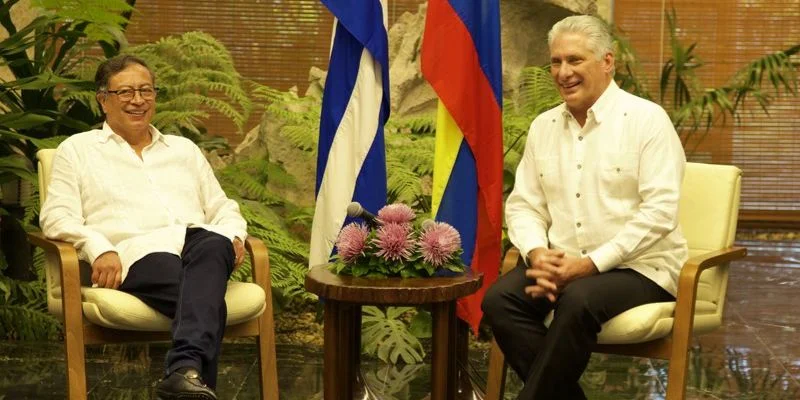
MIAMI, United States. –The president of Colombia, Gustavo Petro, stated in X that he does not agree with “blocking a country” and asked the United States “to change its policy towards Cuba,” while proposing to “unleash the solar energy program throughout the island.” His message, published this Sunday, provoked a wave of critical responses from Cuban activists and researchers who demanded that he omit the lack of freedoms on the island and the existence of political prisoners.
The discussion escalated because, along with his publication, Petro shared a tweet from union leader José Félix Lafaurie that linked to an investigation by The Time on the ship Ocean Marinerheld or escorted by the United States Coast Guard in the Caribbean with fuel whose final destination was under suspicion. Lafaurie described the matter as “very serious and delicate” and published the headline about “the evidence” that the shipment had been shipped in a Colombian port.
According to the Investigative Unit of The Timean email that began circulating on January 31 among Colombian authorities warned about the presence of the Ocean Mariner in a port on the Atlantic coast. The newspaper indicated that its investigation established that the fuel transported by the ship was acquired in Colombia and that it had access to reports and photos of an inspection carried out before it set sail on its declared course to the Dominican Republic and was then intercepted by US authorities.
The reconstruction of the case indicates that the ship set sail on February 5 from the Sitio Nuevo Port Society, in Palermo (Magdalena), near Barranquilla. Before its departure, the ship was subjected to controls by the DIAN, the Tax and Customs Police and a representative of Ecopetrol. The product shipped, according to the documents consulted in the investigation, was fuel oil for a value close to 6.9 million dollars.
Although the destination indicated in the export papers was Río Haina, Dominican Republic, subsequent monitoring fueled doubts about the true destination of the shipment. The Colombian reported that satellite tracking showed an abrupt change in trajectory towards the south of Haiti and that on February 11 the United States Coast Guard intercepted the ship and escorted it with the USGC Stone, and then directed it towards the Bahamas.
Even The New York Times reported that the Ocean Mariner was escorted by the Coast Guard after a “sudden turn” when its declared destination was the Dominican Republic, and that the ship had previously docked in Barranquilla.
Peter recognized that a private Colombian company had loaded oil onto the Ocean Mariner. Citing the report of The Timewrote that there was “no Colombian irregularity, either public or private,” and that the reported destination was the Dominican Republic.
1. Complicit in what?
The person loading the ship is a private company and that private oil company is given documents of the ship that buys the oil and they say that it is going to the Dominican Republic.
There is no Colombian irregularity, public or private, ma’am… https://t.co/SMgD9sANBO
— Gustavo Petro (@petrogustavo) February 22, 2026
On January 29, United States President Donald Trump signed an executive order that threatens to impose tariffs on countries that sell or send crude oil to Cuba.
And the repression on the Island?
The controversy was inserted into the broader thread that Petro published about Cuba: in his publication, the Colombian president attributed the origin of the “current blockade” to an alleged “falsehood” by former president Iván Duque, thanked Cuba for its role alongside Norway in the Colombian peace process and described the Island as “a jewel in the Caribbean.”
In addition, he proposed replacing oil with solar energy and called for resuming dialogue between Washington and Havana, in a message that combined political arguments with cultural references and even suggested that the Cuban singer-songwriter be heard. Silvio Rodriguez in the White House.
Cuban activist Magdiel Jorge Castro he didn’t take long to respond: “The problem arises when you choose the wrong enemy, ignoring those who for 67 years keep the people subjugated under a single-party regime.” For his part, the Colombian researcher Sergio Ángel, from the Cuba Program, asked him That, if he talks about “understanding between different people,” he demands that Havana release “more than 1,000 political prisoners” and questions state spending on hotels.
Cuba is a prison guided by an irrational and violent communist oligarchy that has oppressed and abused the Cuban people for decades.
Politicians, bureaucrats and academics around the world have been complicit and have benefited from this injustice.
— Luis Daniel Benavides (@dnielben) February 22, 2026
The CeroLabiaEC account (@CeroLabiaEC) also reacted with a critical tone: “Silvio Rodríguez singing in the White House to cure the blockade? The plena: 70% of this testament is pure poetic yapa and hurricanes. Petro blames Duque for the blockade (which has existed since the 60s) and invents that Colombia is already an export power of solar panels. A lot of Cuban art, but zero historical rigor. (…) Less romantic trova and more history books, presi.”
For his part, the Colombian lawyer Rómulo Torrado (@TorradoRomulo) focused his questioning on the shipment of fuel: “All this as a distraction from the fact that the ship was loaded in Colombia! What needs to be clarified is where the resources came from to load the ship with fuel? From the taxes of the Colombians? (…) Cuba needs energy, but it also needs a change of regime! Worrying how you support dictatorial regimes, particularly just before the elections!”
Finally, the political analyst Alberto Sierra (@AlbertoSierrave) wrote: “Neither trova, nor poetry, idealizing Cuba and the Caribbean while ignoring rights and freedom is hypocritical and cynical.”