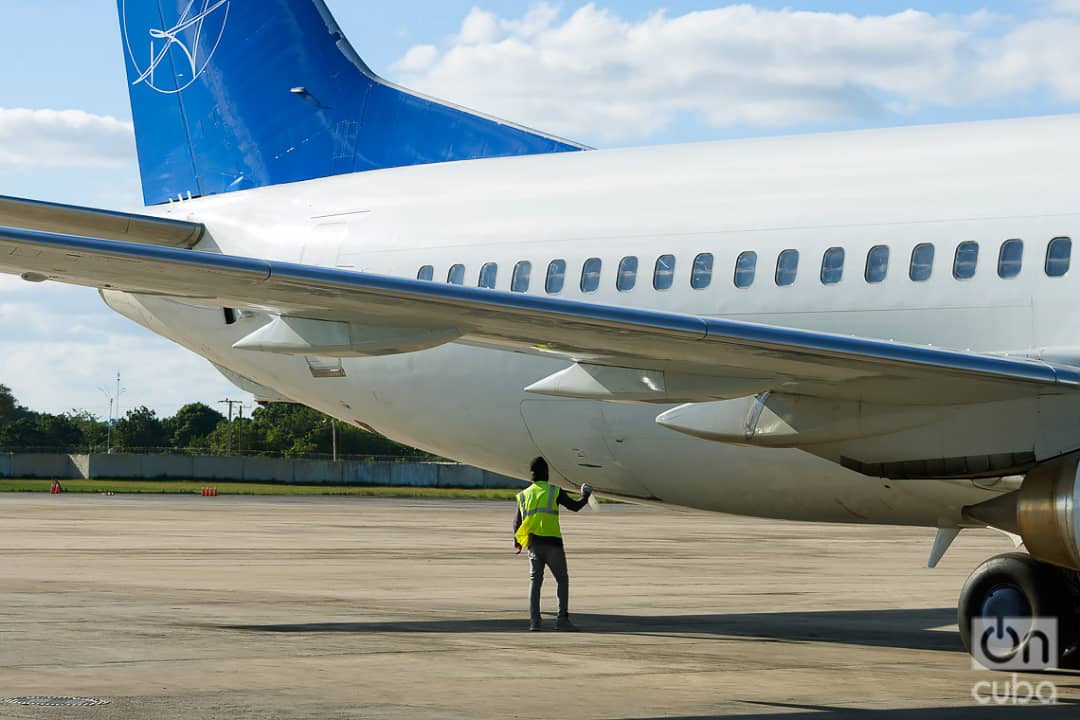
The Government of Cuba warned the international airlines that operate on the island that as of this week the country will be left without fuel for aviation due to the United States oil siege, as confirmed EFE with two sources.
The official Notam message (notice to aviators) from the Cuban authorities to pilots and controllers specifies that the kerosene deficit affects all international airports in Cuba. The validity period of the notification is for one month, from February 10 to March 11.
“JET A1 FUEL NOT AVBL” (fuel for A1 aircraft not available), says the encoded Notam message as it currently appears in the database of the US Federal Aviation Administration (FAA).
The affected airports are José Martí in Havana, Juan Gualberto Gómez in Varadero, Jaime González in Cienfuegos, Abel Santamaría in Santa Clara, Ignacio Agramonte in Camagüey, Jardines del Rey in Cayo Coco, Frank País in Holguín, Antonio Maceo in Santiago de Cuba and Sierra Maestra in Manzanillo.
The Government of Cuba warns international airlines that operate on the island that as of this Monday the country will run out of aviation fuel.https://t.co/TieA0D4viI
— EFE News (@EFEnoticias) February 8, 2026
Airlines have not yet commented
For the moment, the affected airlines – mainly American, Spanish, Panamanian and Mexican – have not publicly communicated how they are going to face this situation, which could generate alterations in routes, frequencies and schedules, at least in the short term.
However, this fact is not new in Cuba. In previous similar situations – both in the so-called Special Period in the 1990s and in temporary bottlenecks in recent months – airlines had saved the problem by rearranging their routes out of the island with extra stops to refuel in Mexico or the Dominican Republic.
Most flights that connect the island with the outside world cover routes to Florida, in the United States (Miami, Tampa, Fort Lauderdale), Spain (Madrid), Panama (Panama City) and Mexico (Mexico City, Mérida, Cancún).
Cuba also has regular connections with Bogotá (Colombia), Santo Domingo (Dominican Republic) and Caracas (Venezuela), among other Latin American capitals.
The announcement may affect the already battered national tourism sector, stranded in a crisis since the pandemic due to the consequences of COVID-19, US sanctions and the country’s economic problems, which hamper the quality of the offer and service.
Several countries had recently warned their citizens about the risks of traveling to Cuba in the current circumstances, due to the blackouts – and their consequences – and the escalation of tensions with the United States.
The escalation of tensions with the US motivates new alerts for travelers to Cuba
Oil siege
On January 29, US President Donald Trump signed a presidential order threatening tariffs on countries that supplied oil to Cuba, after alleging that the island was a national security danger for his country.
The decision is one more twist to the energy pressure on Cuba that began on January 3, when after the military operation that concluded with the capture of the president of Venezuela, Nicolás Maduro, Washington announced the end of oil supplies from that South American country to the island.
Trump then urged Havana to negotiate “before it is too late.” The Cuban Government has assured that it is open to dialogue with Washington, although it has denied on several occasions that they are already immersed in talks.
Cuba produces only a third of its energy needs. For the rest, it resorted to imports from Venezuela (which in 2025 accounted for around 30% of the total) and, to a lesser extent, from Mexico and Russia.
The Cuban Government announced this week a tough emergency plan to try to survive without imports of crude oil and derivatives, a package of restrictions that includes the end of the sale of diesel, the reduction of hospital and state office hours and the closure of some hotels.
Cuba faces this new US escalation from a very disadvantaged position, since it has been mired in a deep economic crisis for six years, with high growth and inflation, a deficit of basic goods (food, medicine and fuel), prolonged daily blackouts and massive migration.