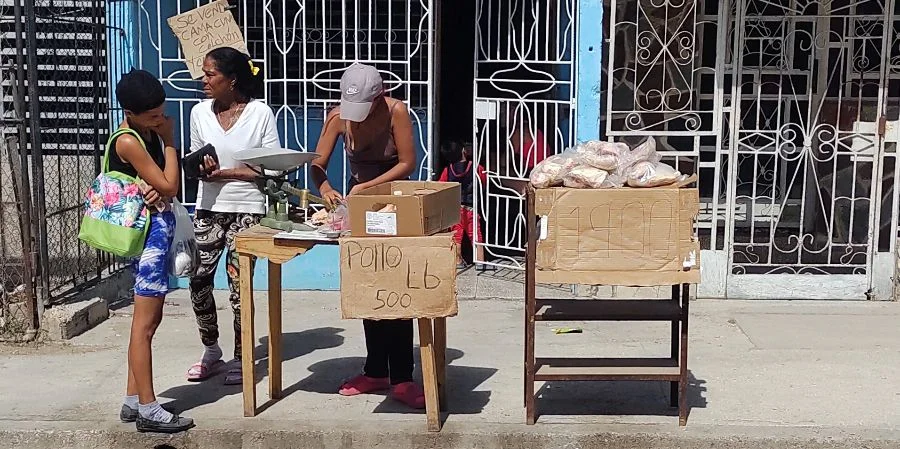
HOLGUÍN, Cuba. – “The bill doesn’t add up anywhere. A small, poor quality pizza on the street went up from 150 to 200 pesos overnight. Prices did not double, they multiplied suddenly. Now buying a toothbrush, soap or a packet of detergent has become a luxury,” complains María del Carmen Rojas from Holguín, who is alarmed by the sudden rise in prices in a few days.
Wrong administrative decisions, the paralysis of national production and almost total dependence on imports have caused inflation that prevents the vast majority of the population from meeting their food needs.
On the other hand, Holguin native Roberto Domínguez points out that the hoarders take advantage of the people’s needs: “They hide the oil, rice and sugar, and when there is a shortage, they release the products at a more expensive price. It is the first time I have seen prices rise so quickly.”
The value of foreign currency in the informal market is what determines the prices of essential products in Cuba. “Before, prices took a while to rise and now, from one day to the next, everything is more expensive. The price of the dollar rises very quickly. In December it was at 450 and now it is at 515. And, if the dollar goes up, everything else goes up,” says Ricardo Villamil.
This loss of purchasing value of the national currency causes a general rejection of official banking mechanisms. For Kevin Expósito, inflation here has only one cause: the system is in crisis and the rulers do not know how to fix it. “There is no trust in the Cuban peso, that’s why everyone takes refuge in the dollar or the euro,” he says.
On the other hand, workers in State entities receive their salaries in Cuban pesos, while consumer goods are sold in dollars or according to the exchange rate. A full month’s work day is insufficient to support a family.
“The problem in this country is that we do not produce a single pin, everything has to be brought from outside. MSMEs bring food, yes, but they sell it at whatever the dollar is in the informal market,” laments Laura Cárdenas.
For their part, private entrepreneurs face their own complications in maintaining their businesses under exchange rate instability. Osvaldo, who asked to be identified to avoid retaliation, tells the reasons why he has had to increase the prices of the products he sells.
“People look at me badly and call me ‘abuser’ because I raise prices, but I have to buy flour and yeast on the street, paying for them at whatever the clandestine dollar is, because the State doesn’t sell me anything. If the dollar goes up 10 pesos today, I have to raise the price of pizza. We are cannibalizing among Cubans themselves; those who don’t ‘invent’ or resell don’t survive.”

Faced with this critical scenario, Holguín residents suggest alternatives to reduce the economic burden on customers. “The Government should lower taxes on MSMEs that sell food so that they can work without that pressure. This way it could require them to lower prices and not sell wholesale,” says Joel Cordoví.
The lack of agricultural products is also due to failures and errors in management. “The leaders themselves have recognized that they have made a mistake with the measures in food production. The production of rice and beans decreased, and now the few dollars that come in have to be spent importing them. Crops were lost because they were not harvested on time. The fields are uncultivated; there is not enough production of pork or milk, and the people pay for those mistakes that have been made for more than 60 years,” laments Lorenzo Varona.
The sugar industry and fruit harvesting also show prolonged setbacks. Holguin native Frank Recio compares the sugar production methods of other decades with the losses that occur today.
“They destroyed the sugar mills to the point that, in colonial times, with oxen and sugar mills, more sugar was made than today. In the 70s and 80s you went to the fields, chopped the cane by hand and things worked. Also, there is a tremendous disaster with the mango crops, which are being lost and rotting in the ground due to poor work, lack of control and irresponsibility,” he summarizes.
From the Government, managers confirm the failure to meet production goals. When evaluating the progress of the “Program to correct distortions and re-boost the economy”, Prime Minister Manuel Marrero admitted that the objectives had “still” not been achieved, which, he added, implied “failures in the design, implementation and control of previous measures.”
Likewise, in your most recent report to the National Assembly of People’s Power, the Minister of Economy of Cuba, Joaquín Alonso Vázquez, identified problems that reflect macroeconomic and sectoral management errors.
The official linked inflation to the supposed excess of national currency in circulation, to the chronic shortage of foreign currency, fuel and energy. In addition, he alluded to productive failures in mining and production of honey, coal and biopharmaceuticals due to a deficit of inputs, energy, fuel and logistical problems.