Holguin/While Cuba boasts of exporting the best tobacco in the world, the majority of local smokers have had to settle for decades with harsh cigarettes, filled with stems and disposable powder, which popular ingenuity long ago baptized as “partepechos.” What is truly curious and revealing is that one of the country’s main factories not only seems willing to continue lowering the quality of its products, but is also publicly proud of doing so.
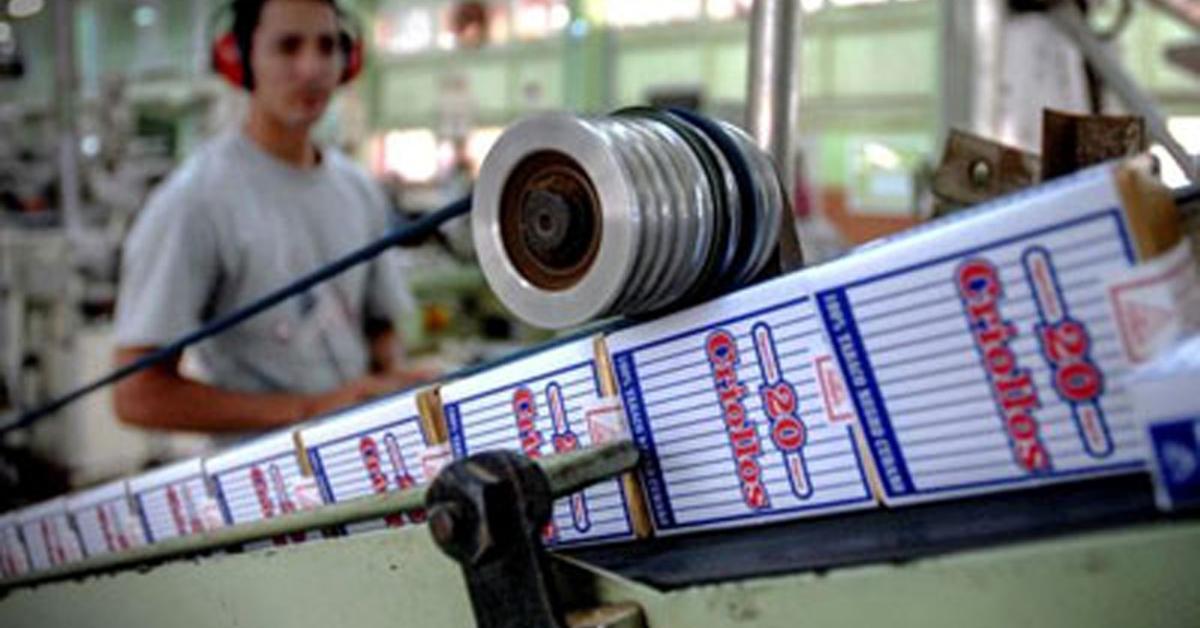
This was reflected in the Holguín newspaper Now! in a recent article which deserves to be read as a piece of unintentional humor. At the Lázaro Peña Cigar Company in that province they are determined to “diversify productions and reduce costs,” a formulation that, translated into smoker’s language, is equivalent to making more cigarettes with less tobacco.
The note explains without filters – cigarettes do not have them either – that, under the umbrella of the “circular economy”, the use of dust and the central vein of the leaf will increase, those wastes that the text itself admits were considered “industrial waste”, but which are now useful because “they add weight and volume”.
The text would be read as a joke if it had appeared on social networks. But in the official environment of the single Party, it takes on a more disturbing connotation. Cigarettes stop being a sensory experience and become an obvious punishment. And “innovation” basically consists of making official what the smoker already suspected every time he found fragments in his pack that seemed more suitable for lighting a stove than for a puff.
The note boasts of recycling the leftover paper from the production process to manufacture “teaching material” for the Los Criollitos Children’s Casita
It was already common, especially among lower-income smokers, to discover pieces of sticks in cigarettes, real splinters that in the context of blackouts could almost be reused as firewood. The novelty now is that this experience is no longer a shameful failure and is now presented as a productive virtue, as an example of business resilience. In the stalls of each neighborhood, the customer will see how the quality is lost in the smoke even before lighting the match.
All this happens in a country where tobacco has been part of the national culture long before bearded men became official models for brands. Ever since Christopher Columbus set foot on these lands, he was perplexed by some Tainos who “drank the smoke” of “dry leaves.” Over time, tobacco not only became a trade and trade, but it helped finance our independence wars. José Martí himself, who wrote about almost everything in this life, knew that world well and was an occasional smoker, although he avoided becoming a propagandist for consumption.
In contrast to this ethic, the workers and managers of the Lázaro Peña company do not seem to have qualms about stretching their story of “excellence” to frankly uncomfortable terrain. The note boasts of recycling the leftover paper from the production process to manufacture “teaching material” for the Los Criollitos Children’s Casita. And here the humor becomes darker. Because naming a children’s establishment after a cigarette brand is already debatable; Furthermore, associating it with a production famous for “breaking lungs” borders on cruelty. Calling it “Future Breastplate” would have been a more honest translation of the message.
The problem is not only the low quality of the national cigarette, nor even the high price of a pack in the informal market, but the triumphalism with which it is managed and counted. While the official speech celebrates awards, innovation and sustainability, the smoker continues to light up pressed powder and recycled stems. Cuba exports myth and smokes waste. And in that contradiction, shrouded in smoke and rhetoric, a good part of the daily absurdity is summarized.