
The Senate Parliamentary Commission of Inquiry (CPI) on Organized Crime questioned, this Tuesday (24), the company Meta – owner of Whatsapp, Facebook and Instagram – about the economic gains that the United States (USA) multinational would have from committing crimes on digital platforms.
The CPI rapporteur, senator Alessandro Vieira (MDB-SE), highlighted that profits from advertisements for scams and frauds carried out on the internet generate billions of dollars in revenue, money that would encourage the maintenance of this content on the platforms.
“It seems that Meta has deliberately been making it difficult for the authorities to act, because, by inadvertently encrypting content, even with internal reports that this encryption will encourage crime, it did so,” stated the rapporteur.
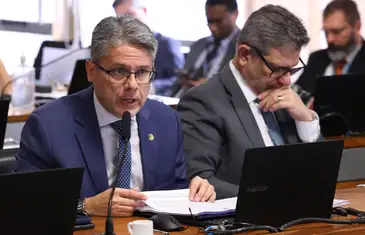
Senator Alessandro Vieira – Archive/Lula Marques/ Agência Brasil.
End-to-end encryption is the mechanism that prevents third parties from accessing the content of Whatsapp or Facebook and Instagram Messenger conversations, which are the private chats on these platforms.
Present at the hearing, the director of economic policies for Latin America at bigtech, Yana Dumaresq Sobral Alves, denied that the company has economic interests in the announcements of fraud and scams.
“[Temos] interest in keeping our platforms away from malicious actors and fraudulent content; saying that this is not aligned with our commercial interests, having them and hosting them on our platforms. That’s why we adopt robust, proactive and real-time measures to detect and block fraudulent campaigns”, he stated.
For Vieira, the company can act in this way because it reduces the risk of having to pay compensation, since the courts do not have access to content that harmed victims, for example, of sexual exploitation.
The senator says he believes that Meta’s choice to allow the dissemination of criminal content is done without damaging the company’s image, as it is a global giant without competitors.
“It’s a communications megamonopoly, and, in fact, we’re going to have to reach some point of regulation here, via law. We have specific disagreements regarding adjustments, content, but the fact is that we have a very serious problem in this digital advance in society”, he pondered.
The Meta platform faces legal action in the United States (USA) for allegedly facilitating the sexual exploitation of children and adolescents and promoting illegal content to profit from it. The technology giant denies the accusations.
The use of social networks for sexual exploitation affects other platforms, such as X. The European Union opened an investigation, in January this year, into the use of Artificial Intelligence (AI) Grok, from the X platform, to create sexualized images of real people, including children and adolescents.
Senate hearing
At the CPI on Organized Crime in the Brazilian Senate, rapporteur Alessandro Vieira had requested the hearing of the general director of Meta in Brazil, Conrado Leister, to obtain more information about press reports that would reveal that bigtech would have billions in profits from fraud and crimes committed on the internet.
“Such documents indicate that Meta had revenues of approximately US$16 billion in 2024, resulting from the broadcast of advertisements for scams and prohibited products. This value would represent around 10% of the company’s total annual revenue”, explained the parliamentarian from Sergipe.
In place of Meta’s general director, the company sent director Yana Dumaresq Sobral Alves to the CPI, who pointed out that the company had results recognized by public security authorities and the Judiciary in combating internet fraud, “with decisions dismissing requests for conviction due to alleged omission”.
According to the director of Meta, the company’s teams dismantled almost 12 million accounts on Facebook, Instagram and WhatsApp that were associated with criminal scam centers, in addition to removing 134 million fraudulent advertisements worldwide in 2025.
“Trust in our platforms is an absolute condition for the success of our business. Our objective is to protect users and companies against misleading practices”, he concluded.
Leaked internal documents
Senator Vieira questioned Yara about news from the Reuters agency, from December 2025, which states that Meta’s internal documents instruct the company’s managers to avoid state regulation that seeks to take down scam advertisements on the internet.
“I have been working on this topic within the company for more than two and a half years, I have never seen any document, and I don’t remember seeing any document that brought this type of interest or approach”, replied Yara, director of Meta for economic policy for Latin America.
Sexual exploitation of children and adolescents

Meta Logo – Goal/Disclosure
The CPI rapporteur, Alessandro Vieira, also wanted to know whether Meta has the capacity to detect and prevent the dissemination of images of sexual abuse of children and adolescents on social media. The senator cited studies that show the use of platforms to groom children.
“In 2020, a report from the NGO Human Trafficking Institute says that Facebook was the platform most used by sex traffickers to groom and recruit children: 65% of cases of grooming and recruitment of children took place through your platform”, highlighted the senator.
The director of Meta Yara Alves was unable to answer, precisely, whether the company can identify child pornography content, avoiding the dissemination of this type of content.
“I don’t know how to explain to you whether our proactive detection tools, based on metadata, etc., are sufficient to prevent the transfer of photos, as you specifically said, but I want to make the Meta team available to this Commission,” he said.
At the same time, the head of Meta highlighted that combating the sexual exploitation of children and adolescents is a priority for the multinational, which has taken steps to have parents control teenagers’ accounts.
“The issue of children and adolescents within Meta is a topic of the highest priority and has several dedicated teams in the product area, in the area of compliancein the area of legal, public policy, operations”, he stated.
Unanswered questions
The director of the technology giant was also unable to answer questions presented by senators on specific topics, such as the limits of encryption or the use of algorithms on social networks to favor certain political content.
The lack of control over some issues led the CPI rapporteur to request that the general director of Meta in Brazil, Conrado Leister, be called again.
“The company informed, when requesting the replacement of the general director by your excellency, that you would be able to perfectly meet [a CPI]. Again, in benefit of this principle of good faith, which is so good in relations, we will understand that it was an error of assessment and we will reiterate the summons of the director general”, said the Commission rapporteur.