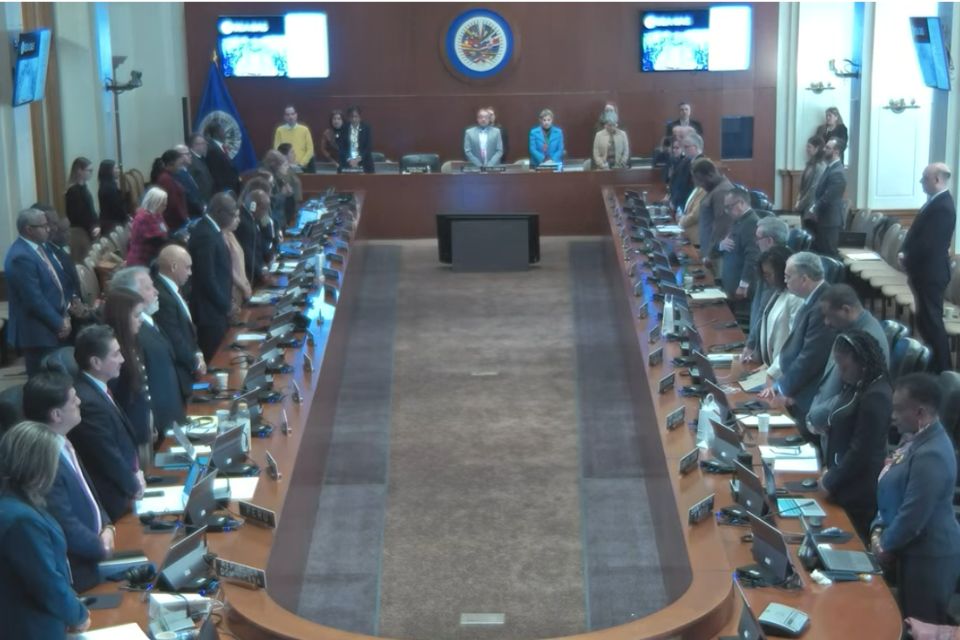
The Secretary General of the OAS, Albert Ramdin, assured that the organization is prepared “to assist, build bridges, facilitate agreements, monitor processes and offer solutions, including electoral processes,” in favor of a transition in Venezuela.
The Permanent Council of the Organization of American States (OAS) discussed this Wednesday, January 21, the situation of political prisoners in Venezuela and the different delegations asked for the full freedom of all those detained for their way of thinking. Some of the delegations also asked the Venezuelan authorities to allow a representation of the Inter-American Commission on Human Rights (IACHR) to visit on site the country to verify the situation.
The Secretary General of the OAS, Albert Ramdin, insisted that it is urgent that the IACHR visit Venezuela. “I call on the Venezuelan authorities to allow the visit,” he said.
Ramdin also condemned the fact that people continue to be detained for thinking differently and rejected the repression. He assured that with these conditions “there is no negotiation possible.”
Secretary General of the OAS, Albert Ramdin
In this sense, he celebrated the recent releases that have occurred in Venezuela, but assured that “it is not enough because there are still hundreds of people who are in the dungeons”; Therefore, he demanded that the authorities, led by Delcy Rodríguez, representative of the Executive, “accelerate the release and not only for reasons of humanitarian rights, but for political reasons” and demonstrate that “they are ready to participate in a process that leads to political stability; “This would be a good sign for democracy.”
In the opinion of Ramdinthe transition process in the country must “be led by the Venezuelan people and with the support of allies, of hemispheric countries.” He also asserted that the OAS is prepared “to assist, build bridges, facilitate agreements, monitor processes and offer solutions, including electoral processes.”
*Read also: Between tents, vigils and threats, families of political prisoners do not abandon hope
Releases for all
Peru, Chile, Paraguay, Uruguay, Dominican Republic, Colombia, Argentina, the United States, Guatemala and other countries agreed that all people arbitrarily detained must be released, without conditions or subsequent restrictive measures.
Peru demanded complete, updated and verifiable information, as well as guarantees about their physical and psychological identity and respect for due process. He also demanded facilities for the repatriation of foreigners released from prison in Venezuela.
Chile and Uruguay described the arbitrary detentions as serious violations of human rights and argued that there cannot be a democratic transition with political prisoners, while Paraguay warned that many of the released people remain under house arrest or other unacceptable restrictions.
The Dominican Republic denounced that there are still more than 800 prisoners for political reasons in Venezuela, many held incommunicado, without access to public information about their cases or procedural guarantees.
Argentina condemned the “drip” release and the lack of official information, which it assured “deepens the suffering of the families.” At the same time, he urged the release of Nahuel Gallo and asked for an official list of political prisoners. For this country it is imperative that freedoms be granted so that democracy returns to Venezuela.
Visit of the IACHR
Other points of greatest agreement between the States was the call to the Venezuelan authorities, currently headed by Delcy Rodríguez, to authorize a visit by the Inter-American Commission on Human Rights to the country. Paraguay recalled that this access was requested in 2025, without receiving a response, and Guatemala considered it essential that the organization directly verify human rights violations and verify the conditions of detention.
The last time the IACHR visited Venezuela was in 2002.
Colombia also expressed its support for a visit by the IACHR “under mutually agreed terms”, with the intention of evaluating the human rights situation and formulating recommendations. This country also urged Venezuela to return to the Inter-American Human Rights System.
The United States, Dominican Republic and Argentina also explicitly supported this mechanism, noting that independent verification is key to ensuring transparency and trust.
For its part, the Inter-American Commission on Human Rights, in the voice of the rapporteur on Venezuela Gloria Monique de Mees, presented a diagnosis on Venezuela. He indicated that the situation is not about isolated events, but about a persistent and systematic pattern of political persecution, through the use of criminal law to silence those who dissent.
The IACHR also denounced the lack of judicial independence, prolonged detentions, indefinitely deferred hearings, obstacles to private defense, as well as degrading detention conditions; including torture, isolation, lack of medical care, restrictions on visits and forced disappearances.
According to data from the Penal Forum, shared by the Commission, as of January 19 in Venezuela there were around 800 political prisoners and they had only been able to confirm 143 releases. Since 2014, they report that there have been more than 18,700 detainees for political reasons.
“Human dignity cannot be suspended or negotiated,” the IACHR reiterated, demanding the immediate and unconditional release of all political prisoners, both national and foreign, in Venezuela.
*Journalism in Venezuela is carried out in a hostile environment for the press with dozens of legal instruments in place to punish the word, especially the laws “against hate”, “against fascism” and “against the blockade.” This content was written taking into consideration the threats and limits that, consequently, have been imposed on the dissemination of information from within the country.
Post Views: 209