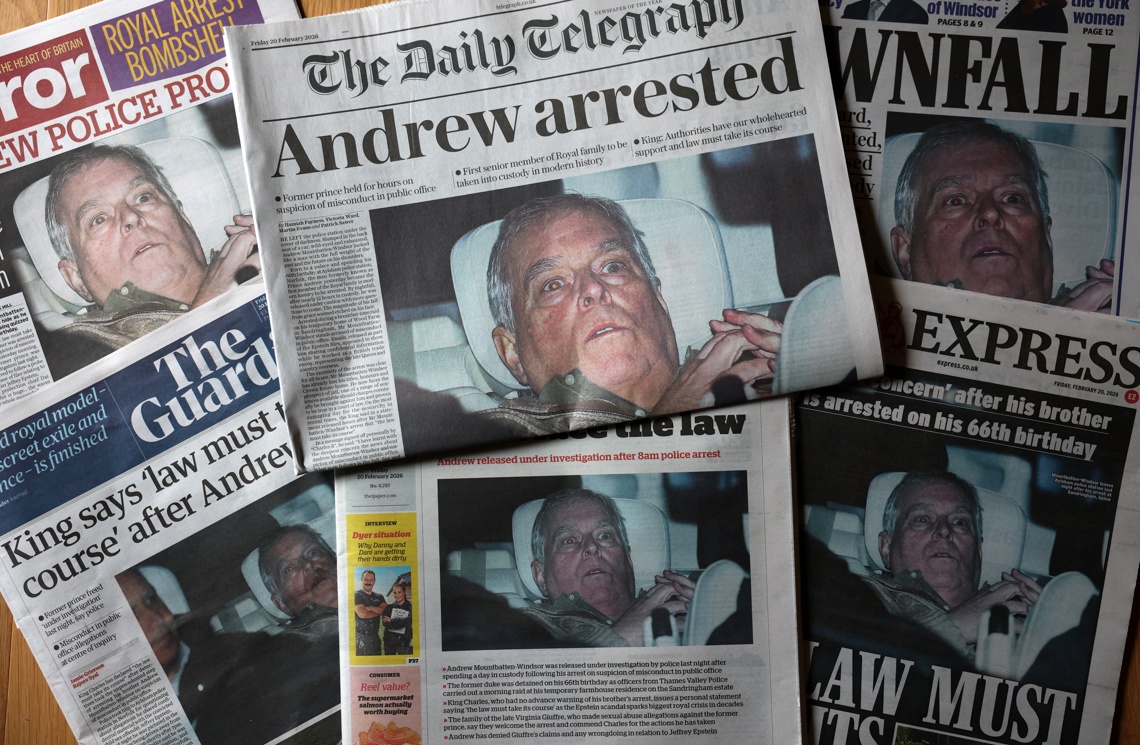
When a royal comes under scrutiny, it can seem like a break with tradition. However, over the centuries, members of the British royal family have repeatedly come under suspicion. What makes the arrest of Andrew Mountbatten-Windsor so striking is that you have to go back to the 17th century to find anything comparable.
The royals are no strangers to scandals, but accusations of breaking the law are quite another matter. Former Prince Andrew’s fall from grace will have huge repercussions for the British royals and also gives us an insight into how the treatment of royalty has changed since the death of Queen Elizabeth.
When the crown fell
This is not the first time that the British royals have been involved in legal problems. In 1483, Richard III was involved in the disappearance of his two nephews, the so-called princes of the Tower. Both princes were legitimate heirs and therefore a direct threat to Richard’s right to the throne. He was never tried in court, and historians still debate the evidence.
The most dramatic confrontation between the monarchy and the law occurred with Charles Iaccused of treason during the English Civil War. He was arrested in 1649, tried and executed publicly. This act shocked Europe and shattered the belief that royalty was above the law.
As a result, England abolished the monarchy and became a republic under Oliver Cromwell. So, the last time a member of the royal family was arrested and tried, the crown itself fell.
That precedent is important because it underscores how rare arrests of royals are. For more than three centuries, the monarchy has avoided that spectacle. The fact that Andrew’s arrest forces a comparison with Charles I reveals how exceptional this moment is.
Reputation as a real strategy
In the 19th century, the monarchy survived less by force and more by reputation. Under the reign of the queen victoria (1837-1901), the crown cultivated domestic virtue and moral seriousness as a shield against instability. Respectability became a strategic defense against scandal.
However, fame and power inevitably lead to great public interest, and scandals made their way into print culture and, later, the mass media. The prince Alberto Victorgrandson of Queen Victoria, was accused of being Jack the Ripper. It is a claim that historians have largely rejected as a conspiracy theory, but one that persists because it reflects fears about the monarchy’s cover-ups.
James II He was dethroned in 1688 during the Glorious Revolution amid accusations that he undermined Protestant laws and promoted Catholic officials. His apparent abuse of power, more than a single prosecutable crime, cost him the throne.
In the 20th century, Edward VIII generated a different kind of concern. After his abdication in 1936, evidence emerged of his sympathy towards Nazi Germany, followed by a meeting with Adolf Hitler in Germany in 1937. Although there was no judicial process, this caused serious damage to Eduardo’s reputation and public trust.
The collapse of deference
For much of the 20th century, the monarchy operated within a culture of respect. The press refrained from reporting on the royals’ private lives and indiscretions were managed discreetly. That agreement isolated the royal family from continued media exposure. However, the panorama began to change after a series of scandals in the 1990s. This eventually led Elizabeth II to classify 1992 as her annus horribilis.
The rise of sensational journalism eroded the old boundaries, and digital media completely dissolved them. The silence now intensifies suspicions rather than calming them, as was the case with the royal silence over the health of the princess of wales in early 2024, forcing him to go public with his fight against cancer.
Influence, access and perception
Even before his arrest, the perception of former Prince Andrew was negative.
The arrest occurs in this change of mind. During his tenure as the United Kingdom’s special representative for international trade and investment, cultivated relationships with political leaders and wealthy business figures from all over Middle East and Central Asia. The critics They questioned whether it had blurred the line between official commercial promotion and private networks.
The 2010 episode “cash for access” (money for access) which involved Andrew Mountbatten-Windsor’s wife, Sarah Ferguson, deepened that perception. Sarah was filmed offering access to Andrés in exchange for a substantial payment. Although she apologized and the former prince denied his participationthe image of monetary manipulations in the crown environment was corrosive.
In 2021, a undercover investigation suggested that Prince Michael of Kent, the queen’s cousin, was willing to use his royal status to help a fictitious company in exchange for remuneration. He denied any wrongdoing, but the damage had been done.
A brand without insulation
Under the reign of Elizabeth II, longevity conferred authority and stability, often softening scandals. Under the reign of Charles III, the institution seems more exposed. The arrest of the former prince disturbs and exposes the royal family to reputational damage. Although he was later released, the scandal still has a long history.
Charles is a constitutional monarch. He cannot interfere in police investigations or prosecutorial decisions without provoking a constitutional crisis. His authority is symbolic more than executive.
But it may further distance Andrés’ inner circle, including his daughters, from public life. He has already stripped him of his royal titles and told him to leave his home, Royal Lodge.
However, even that has its limits. Carlos’s power is now based less on control than on credibility. In a permanently vigilant society, judgments are not passed in private, but in public view.
The precedent that lasts
The last time a reigning monarch was arrested, England abolished the monarchy and became a republic. The historical echo is impossible to ignore: it reminds us that when the crown is involved in a criminal process, the consequences transcend the individual.
The arrest of Andrew Mountbatten-Windsor underlines how fragile that trust can be and how decisively it is shaped by the court that really matters, that of public opinion. Although the former prince is not the king, the scandal could have been softened if his brother Charles had acted more decisively and quickly to remove him from the circles closest to the monarchy.
The royal scandals They undermine the sense of mystery that has long protected the crown. The monarchy survives not because it has real political power, but because it represents stability, dignity, and something slightly removed from everyday life.
When royals become embroiled in scandal, that sense of distance fades and the institution can begin to seem more fragile than untouchable.
Jo CoghlanAssociate Professor, Humanities, Arts and Social Sciences, University of New England; Huw NolanAnimal Welfare Scientist and Pop Culture Researcher, University of New England and Lisa J HackettSenior Lecturer, Cultural History, University of New England
This article was originally published in The Conversation. Read the original.