Costa Ricans voted this Sunday to elect president, with the ruling party Laura Fernández as the big favorite for her promises of a tough line against drug trafficking violence that, according to her rivals, will push the country towards authoritarianism.
The polls closed at 6:00 p.m. local time (00:00 GMT), after a 12-hour day in which 3.7 million Costa Ricans were called to also elect deputies in this country recognized for its democracy, but plagued in recent years by crime.
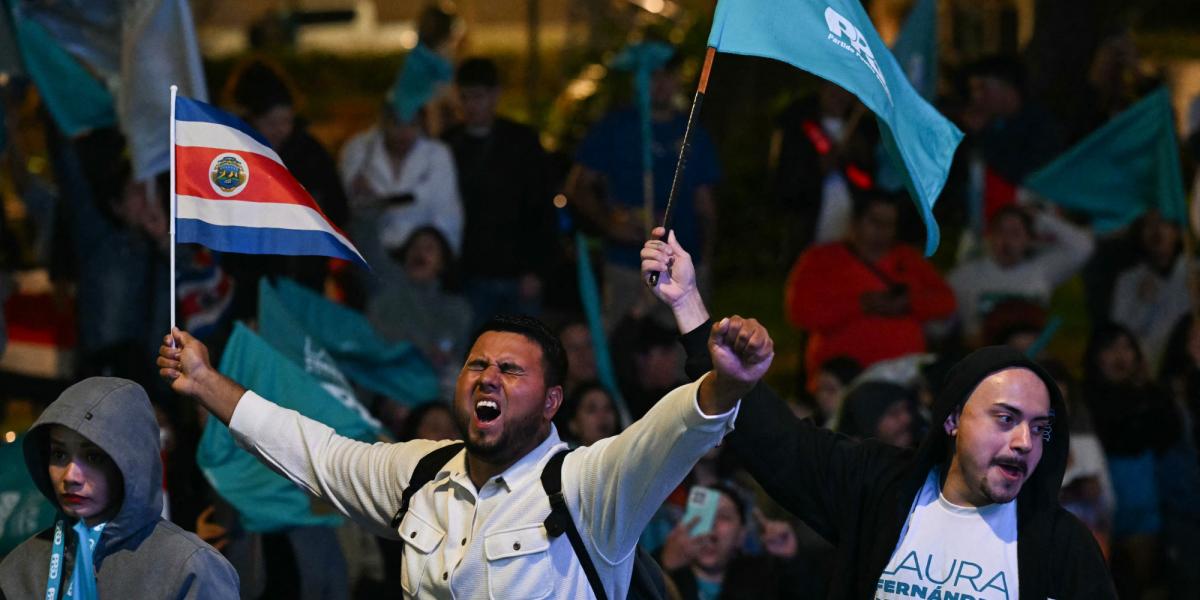
As night fell, thousands of people waved their party flags and sounded horns in San José and other cities, waiting for the first results to be released by the electoral court around 9:00 p.m. local time (03:00 GMT on Monday).
“Unlike countries like Nicaragua or Venezuela, here we have the privilege of voting (freely). The most important challenge is to combat drug trafficking,” Diego Araya, a 25-year-old bank teller in the southeast of the capital, told AFP.
Fernández, a 39-year-old right-wing political scientist, reiterated that her goal is to “win in the first round,” which requires the 40% that the polls have given her. An eventual second round would be on April 5.
Political heir to the popular president Rodrigo Chaves, the former minister also aspires to win 40 of the 57 seats in Congress to reform the Constitution and the powers of the State.
Sileny Fernández, a 39-year-old human resources advisor, says she supports “continuity” because “the economy is doing well and Laura is going to hit the drug traffickers hard.”
A victory for the ruling party to govern as of May 8 for four years would strengthen the right in Latin America, after recent victories in Chile, Bolivia and Honduras.
Unlike Honduras, the United States, whose government Chaves is an ally, did not mention preferences for a candidate but rather expressed its “respect for Costa Rica’s democratic process.”
The Bukele factor
Although during his government the murder rate was a record of 17 per 100,000 inhabitants, Chaves blames the judiciary because, according to him, it promotes impunity for criminals.
Seven out of every ten homicides are linked to drug trafficking, which turned this country, considered for decades one of the safest on the continent, into a logistics and drug export center, according to authorities.
“The drug trafficker enters and leaves as if it were his patio and there is no government to stop him. We have time to rescue our country,” said Bernarda Marín, a 70-year-old cook, after voting for the opposition economist Álvaro Ramos, second in the polls with 10%.
Fernández offers to finish the construction of a prison inspired by the megaprison for gang members of the Salvadoran president, Nayib Bukele, increase sentences and states of exception in conflictive marginal areas.
“I like their prison project. The violence exploded because they are touching the ringleaders, like getting the rats out of the sewers,” justified Jéssica Salgado, a 27-year-old office worker.
His sister Kenia, 24, who voted for the opposition, regretted that the president said that drug traffickers kill “each other,” without seeing that “innocents are dying.”
Fear of authoritarianism
Opponents assure that the ruling party wants to imitate Bukele, who has absolute power and established indefinite reelection, and that, if he wins, Chaves will govern this country of 5.2 million inhabitants behind the scenes.
They call Fernández a “populist” and a “bad copy” of Chaves for adopting his confrontational rhetoric, and they say she seeks to change the Constitution so that her mentor returns to power in four years. Currently he could only apply after two terms in government.
“I will always take care of democratic stability,” the candidate guaranteed at her voting center.
When voting, former president Oscar Arias, Nobel Peace Prize winner in 1987, assured that he is “risking the survival of democracy”: “The first thing dictators want is to reform the Constitution to stay in power.”
“There are no dictatorships here,” said the president after voting, who unleashed criticism for making mocking gestures against voters who shouted “Chaves out!” outside a voting center.
The opposition, which is betting on a second round or a legislative bloc that acts as a counterweight, dispersed its proposals among 19 candidates, including Ramos and the centrist former first lady Claudia Dobles.
Although poverty fell from 18% in 2024 to 15.2% in 2025, Costa Rica is among the six most unequal Latin American countries on the Gini index and is the second most expensive after Uruguay.