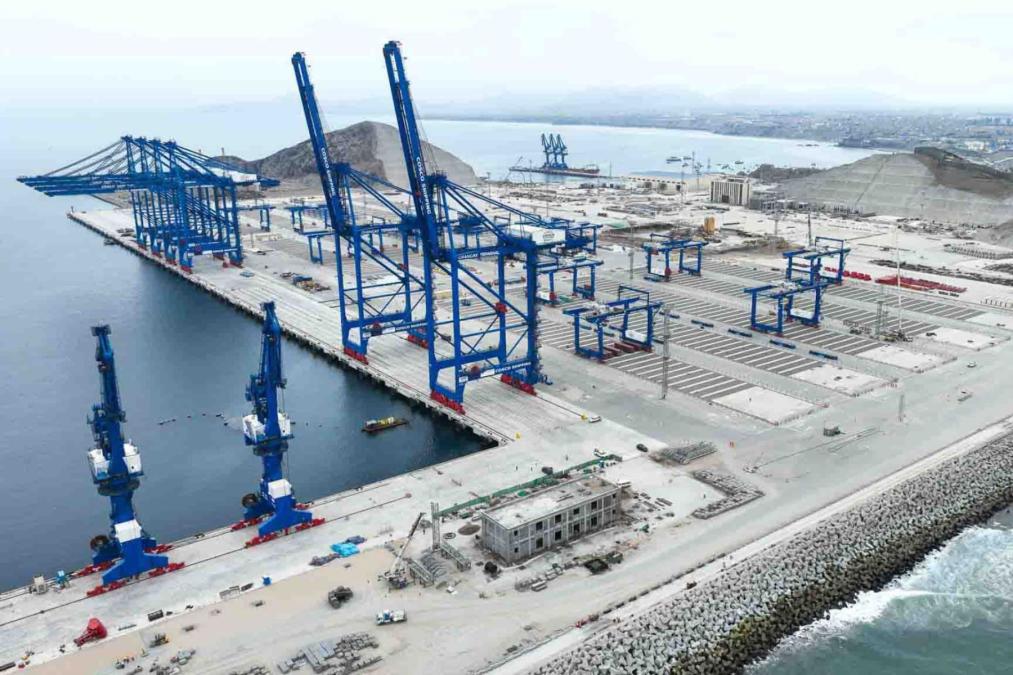
Cosco Shipping, the Chinese state company, which controls the Port of Chancayissued a statement regarding the ruling of the Judiciary that ruled in its favor in the amparo action it filed against Ositran and the Presidency of the Council of Ministers; and which the State Department of the United States Government has also commented on, describing that “cheap Chinese money costs sovereignty.”
The company in its message highlighted that the private nature of the Port of Chancay “does not mean any impact on national sovereignty,” arguing that the port terminal lacks any “political, administrative, tax and regulatory extraterritoriality.”
In the statement, the port company explained that the court ruling “recognizes the current regulations, as well as the legal framework of state control and supervision on the matter.”
He stated that it is a fallacy that the port lacks the supervision of the Peruvian authorities. He explained, on the contrary, that the authorities not only exercise all their control and supervision powers through the corresponding state entities, but they also do so with the facilities that the port has provided them within its infrastructure.
He explained that within the Port of Chancay there are present: “Customs, the National Port Authority including a Joint Control Unit (multisectoral), the National Agrarian Health Service, various entities of the Interior Sector (Migrations, National Anti-Drug Directorate, Fiscal and Environmental Police), health authorities and the National Forestry and Wildlife Service.”
The core of the problem
Cosco Shipping explained that the Peruvian law of the Port System, which regulates activities and services in ports, both those of public initiative, management and provision, as well as private ones, establishes the competence of national entities for the purposes of port control and supervision.
And within that aspect, Ositran’s specific framework is assigned to “supervise compliance with concession contracts and regulate the tariff system in markets in which there is no free port competition for public use.”
But he highlighted that Ositran maintains that in addition to the above, it is responsible for the “function of defending the interests of port users”, which, according to the company, is not in accordance with current laws, since this would correspond to the National Port Authority.
“However, the National Port System Law attributes specific functions to the National Port Authority, including ensuring respect for the rights of users in ports within the scope of its jurisdiction,” he stated.
For this reason, he explained that within the framework of the legal stability enjoyed by investments in Peru and under which the investment was made, the company resorted to judicial instances to assert its rights in relation to the specific supervision of Ositran.
And he said that this “does not mean that the State loses any capacity for control and oversight, as well as ensuring the protection of user rights,” because, currently, it is supervised by many authorities as detailed previously.
Finally, he indicated that while the judicial process initiated by Cosco Shipping in defense of legality is developing, it has been making the regulation contribution to Ositran “under protest.”
“Cosco Shipping reaffirms its firm commitment to respect and comply with national regulations, as well as the mandates derived from judicial processes, maintaining at the service of the country a modern and efficient port infrastructure according to the highest international standard, which becomes a contributing tool to the progress and development of the country,” they concluded.
Peru needs us informed to make decisions. Subscribe for free to the Perú21 newsletter: THE TOP 5 NEWS YOU SHOULD KNOW TODAY. Click on the next link.
RECOMMENDED VIDEO