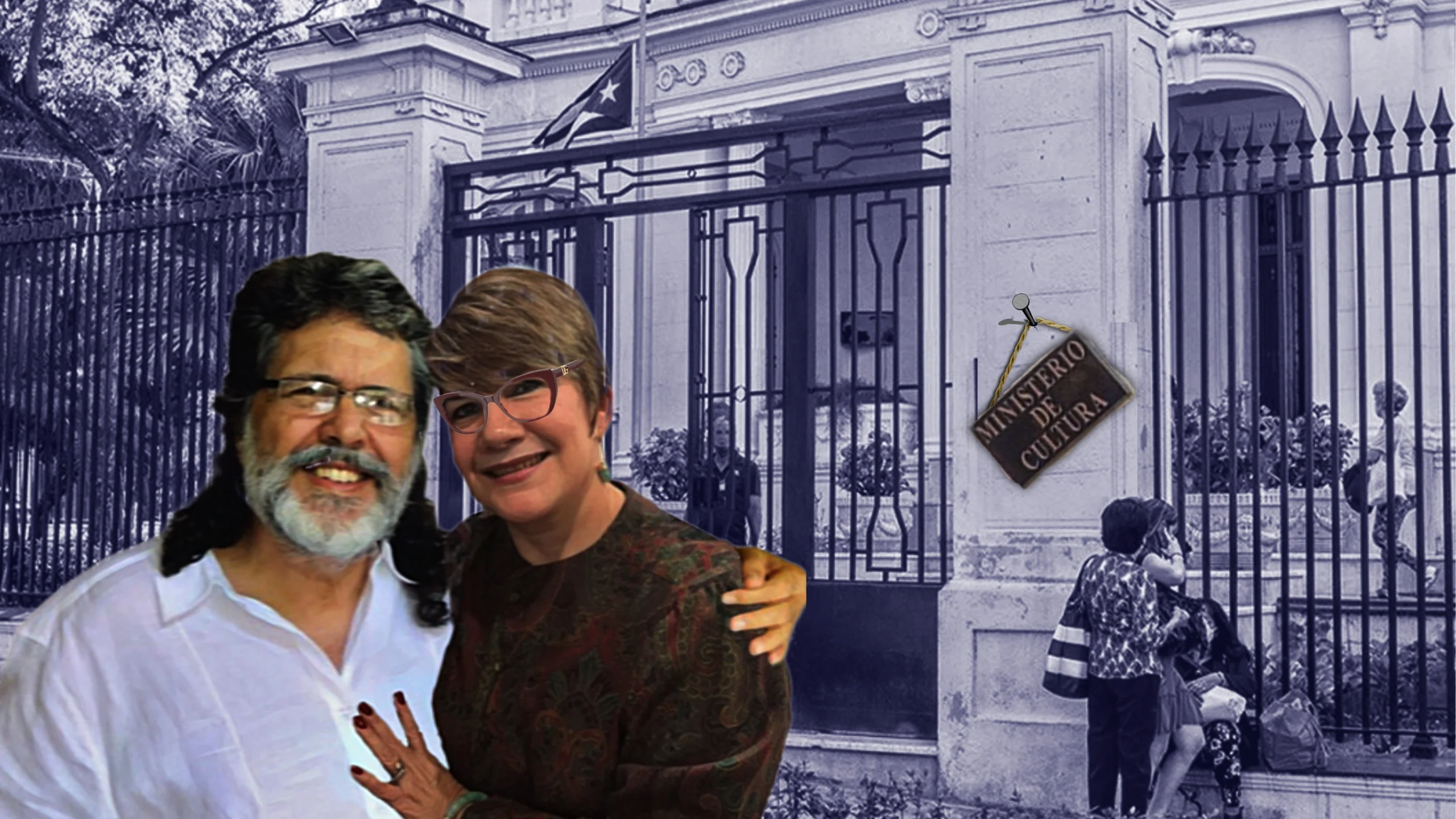
In the MINCULT, perhaps the most corrupt of all the ministries and probably the only one where the practice of almost all variants of corruption is “officially” allowed.
HAVANA-. If there is an institution of the Cuban dictatorship that, as it was conceived, has survived all times, both Fidel Castro’s “rectifications of errors” and Raúl’s political purges; to the audits and to the intolerances and prejudices of the “historical” ones, it is without a doubt the Ministry of Culture.
Despite the corruption scandals that have shaken it at all times, the censorship of artists and other crimes committed, since Armando Hart even the phone snatcher Alpidio Alonsohas never been shaken by a deep cleaning, beyond the festive removal of some official, always replaced by another who has known how to “bathe” as much or more than the previous one, but keeping his clothes well.
In MINCULT, perhaps the most corrupt of all ministries and probably the only one where the practice of almost all variants of corruption is “officially” permitted, it only survives when it is maintained as a kind of “pact of silence” between officials (at all levels) and subjects (artists, writers and cultural curators). The latter, in exchange for certain privileges, put their work and tasks at the service of the dictatorship. Although this service is limited to either signing a UNEAC “declaration” or maintaining a falsely “apolitical” position behind which to hide complicity.
When one stops to review the various “institutional” channels of the MINCULT, through which it is possible to “launder” this corruption, one realizes that it is probably the only governmental structure expressly designed to be sustained through official mechanisms that convert this corruption into something “legal” or at least morally acceptable, and that therefore institutionalize it, turning it into a “politically acceptable” practice.
Thus, for example, based on the material deficiencies that the regime uses as its best method of political control, the so-called “Department of Attention to Personalities” is in first place. Which annually handles million-dollar sums of money, coming from both the State budget and external aid, supposedly with the purpose of channeling them to all the artists on the official payroll who require some type of “social assistance” but which, in practice, rarely becomes effective or arrives on time.
Or what is worse, under the fallacy of “cultural hierarchies” (a kind of “white” list drawn up as a counterpart to a more extensive black list) ends up favoring the same group of privileged people – musicians and actors who are a constant presence at political events, spokespersons for the regime, personal friends of this or that leader, children and grandchildren of these who, by dint of support and nepotism, make a career in culture – where there are fewer who really need it.
There are thousands of examples, more horrendous than scandalous, of how ineffective this “attention” is: actors who have been forced to turn to social networks to expose their cases of abandonment and get help. For example, he recently did Jorge Losada. Let us also remember the house that Elena Burke never managed to enjoy when, due to a medical need, she requested to move to an apartment with better access to the street. Let us think about the total abandonment in which the musicians Carlos Embale and Celeste Mendoza, as well as the actors José Antonio Rodríguez and Samuel Claxton, spent their last days; in contrast to routine changes of cars and houses that, among other MINCULT curiosities, ended up turning Amaury Pérez and Abel Prieto into “door to door” neighbors.
While many celebrities die of hunger and disease in Cuba, forgotten by the MINCULT and UNEAC departments that were supposedly created to help them, others who do not require assistance found their businesses on the basis of this institutional aid.
From literary workshops, artistic foundations, “local initiatives”, to cultural events, fairs and projects, all impossible to audit, to control, to monitor. The material with which they supposedly work and the final product are neither inventoriable nor countable. Which is ideal for the “diversion of resources,” which is what they call robbery when it is botched by professional thieves like those from MINCULT.
The bundles of meats, wines, pastas and other “royalties” from the Minister of Culture, which arrived punctually every week at Carilda Oliver Labra’s house in Matanzas, are known to have rarely ended up in her stomach; although in the clandestine basket of her neighbors, who knocked on the poet’s door not to hear her declaim but to find out how much a pound of beef or a package of coffee sold for.
Although “Attention to personalities” has rarely fulfilled its objectives of helping those who really need it, it has instead served to help (and actively participate) with the businesses of more than one artist who, as payment for his services to the dictatorship, goes to the department with the total certainty that it is his responsibility, due to his political “hierarchy”, to be “attended”.
It is not the only one, but it is the exemplary case of Arnaldo Rodríguez (Talismán), whose “private” business receives the protection of MINCULT, including legal advice and even arrangements for supply and other logistical support.
The company Mambo SRL, and the Habana Mambo Festival as a product, emerged under the financial protection of the Ministry of Culture, and as a proposal precisely from the Events Directorate of MINCULT itself, which, not by chance, directs Lis Cuesta Peraza —wife of Miguel Díaz-Canel Bermúdez—, who already has business experiences in matters of cultural commercialization, linked as an official to Bis Music and Artex, as well as the Cuban Book Institute. The latter from the times when she was director in Holguín, where she shared complicities with Alexis Triana, director of Culture when the current Cuban president was First Secretary of the PCC of the province.
Currently, according to information collected from sources in MINCULT itself, Mambo SRL receives, from the Personality Assistance Department alone, annual financing of around 150 thousand dollars in supplies, added to the nearly 20 million Cuban pesos that it receives from the Events Directorate, for organizational expenses for the Habana Mambo Festival. This is without counting other income associated with collections from concerts, theoretical events and presentations, product sales, promotional trips abroad, tourist packages, accommodations for participants and guests, and other “courtesies.”
Expenses that, according to MINCULT’s own accounting, are not compensated by the scarce income generated but that, even so, are justified in the “work to promote Cuban culture as a strategy against the blockade”, according to fragments of the reports on expectations and results of the event in 2025, to which we had access, although they have not been published by the institution.
If the “Attention to Personalities” department was conceived as a relief mechanism that simulated “social assistance” parallel to the official one, since its inception it has always served as a channel to “divert resources” and to justify them “politically.”
Under this “Attention to personalities”, which has its own version in the Union of Writers and Artists of Cuba, perhaps the deepest network of corruption of the Ministry of Culture is hidden, although far behind the corruption already institutionalized in the departments of International Relations (with the power to manage foreign aid, donations, “cultural exchange”, among other shortcuts) and the Department of Events, from which not only “cultural programming” but also financial and logistical support is managed (that is that is, political) that will receive each of the activities that comprise it.
Knowing these details, if Abel Prieto comes out to deny the most recent accusations of corruption that weigh on the Ministry of Culture, then we must begin to take them very seriously because everything this old peon publishes on his social networks goes in one direction: falsifying reality when they leave them too exposed. We saw that a few days ago when, despite enormous unpopularity, he tried to sell us a Miguel Díaz-Canel loved by the people, with no other arguments than his lackey nonsense.
If the former Minister of Culture and mediocre writer – who today is trying to rebuild at least his political career as a “thinker” of the ruling party with crazy theories, the demonization of the internet and, above all, the “bogeyman coming” of “cultural imperialism” – launches denials against those who point to him as the architect of that empire of corruption that has always been the MINCULT, it is because he suspects that some very close to them could have broken that “pact of silence” that always exists between the dictatorship and its accomplices