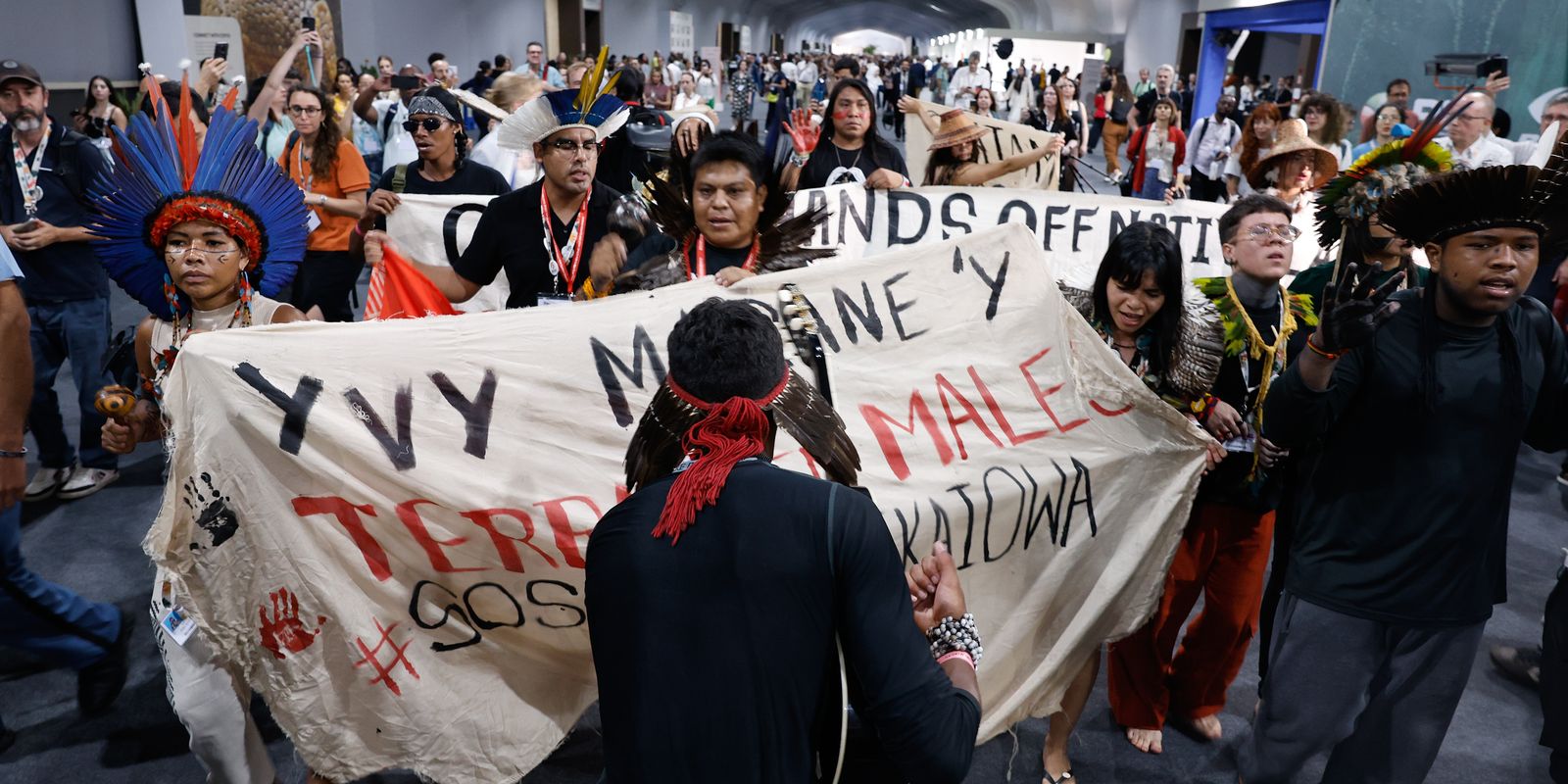
While the negotiations are not over, the The 30th United Nations Conference on Climate Change (COP30) was marked by protests by indigenous people in the Blue Zone, this Friday (21). They protested for land demarcation, in favor of the Guarani Kaiowá and against mining promoted by Canadian companies, in several countries on the American continent, including Brazil.
The demonstration took place at moment of resumption of negotiationsafter the fire that affected part of the country pavilions this Thursday (21). (), also in the Blue Zone.
Chanting, the indigenous people walked along the central corridor of the Blue Zone, attracting the attention of negotiators, observers and those circulating around the conference. With posters, they called for the departure of Canadian companies from indigenous territories and the revocation of Decree No. 12,600/2025, which provides for the privatization of federal public enterprises in the waterway sector on the Madeira, Tocantins and Tapajó rivers.
The protest was held after the end of the People’s Plenary, organized by the Climate Action Network – International, which brings together more than 1,300 non-governmental organizations from around 130 countries, which promote actions against climate change.
Demonstrations at COP30
COP30, in Belém, received numerous popular demonstrations. The organizers estimate that the conference brought together around 50 thousand people, with the presence of representatives of traditional communities, farmers, indigenous people, riverside dwellers, quilombolas, among others.
They claimed, among other points, greater participation in decision-making spaces.
In one of them, held on November 12th, the second day of the conference, Munduruku indigenous people even entered the Blue Zone, but were removed by event security. They demanded an end to the privatization of projects on the Tapajós River.
Another criticism was against the construction of Ferrogrão, a railway that will connect Mato Grosso to Pará to transport agricultural production, and which will impact the indigenous people’s way of life and put pressure on their lands.
Days after the demonstration, leaders of the Munduruku people were received by the president of COP30, André Corrêa do Lago.
The minister of the General Secretariat of the Presidency, Guilherme Boulos, said that the federal government will carry out a prior consultation with the people on the Tapajós waterway project.
Belém also hosted the People’s Summit, held in parallel to COP30 and one of the main spaces for mobilization, which brought together around 20 thousand people from 1.3 thousand social movements and civil society to discuss and present demands. At the opening of the Summit, a barqueata took more than 200 boats and around 5 thousand people to the waters of Guajará Bayfor climate and social justice.
In a political act, members criticized the lack of greater popular participation at COP30 and defended Palestine. For organizations and movements, countries and decision-makers have been omitted or presented absolutely inefficient solutions, putting at risk the goal of limiting global warming to 1.5°C, in accordance with the Paris Agreement.
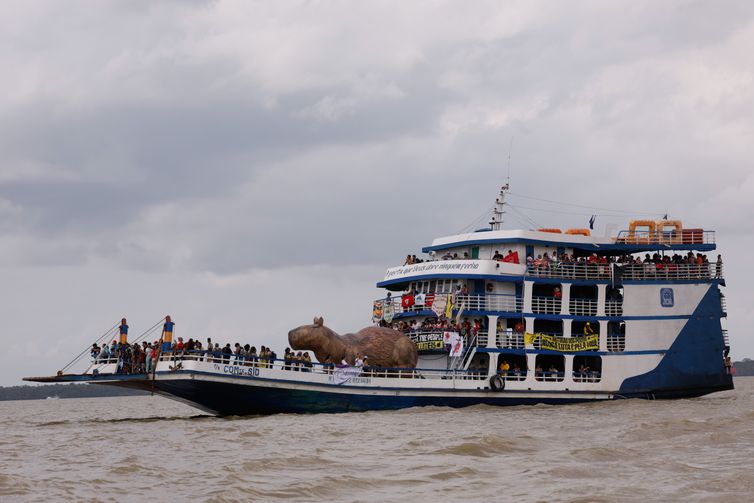
Belém (PA), 12/11/2025 – Boat launch of the Peoples’ Summit, led by the “Caravan of Response”. Photo: Tânia Rêgo/Agência Brasil
Another event, on the campus of the Federal University of Pará (UFPA), promoted the “Funeral of Fossil Fuels”, to denounce the climate impacts caused by the use of fuels derived from petroleum, natural gas and mineral coal.
The Boiuna, from Amazonian culture, was used as a symbol of opening paths for the struggles and demands of the traditional populations of the Amazon.
The biggest mobilization was the World Climate March, which occupied the streets of Belémon Saturday (15) with around 70 thousand people, showing the significant cultural and social diversity of the Amazonian people. Indigenous peoples from all South American countries also joined the march, uniting voices to ask for their rights to be respected and traditional territories are demarcated.
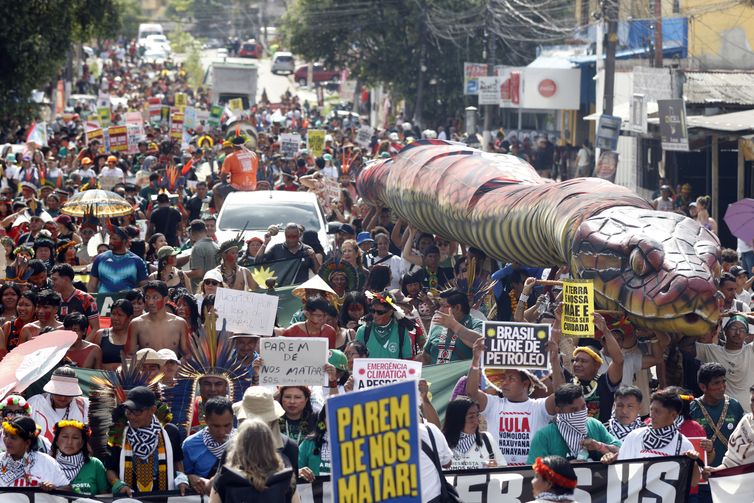
Belém (PA), 11/17/2025 – Global March of Indigenous Peoples – The Answer is Us, parallel event to COP30. Photo: Bruno Peres/Agência Brasil
On the same day, the Autonomous and Permanent Tribunal of the Peoples against Ecogenocide, a symbolic body set up during COP30 by social movements, released a sentence that condemns States and large companies for systematic violations against indigenous peoples, quilombolas, traditional communities and nature.
At the end of the Peoples’ Summit, the Final Declaration classified the measures presented to face the climate emergency as “false solutions”. The letter points to the capitalist mode of production as the main cause of the growing climate crisis and highlights that peripheral communities are the most affected by extreme weather events and environmental racism.
Chief Raoni Metuktire encouraged participants to continue the fight. In a letter to participants, President Luiz Inácio Lula da Silva said that the The Peoples’ Summit was fundamental in making COP30 viable.
The indigenous people also had space at AldeiaCOP, which housed around three thousand people and hosted presentations, a bioeconomy fair, debates and a spiritual house for the practice of healing rituals and indigenous ancestral medicine. Indigenous peoples made a march through the streets of the capital of Pará, where they charged punishment for the murder of Vicente Fernandes Vilhalva Kaiowá36 years old, shot in the head during an armed attack in the municipality of Iguatemi, Mato Grosso do Sul.