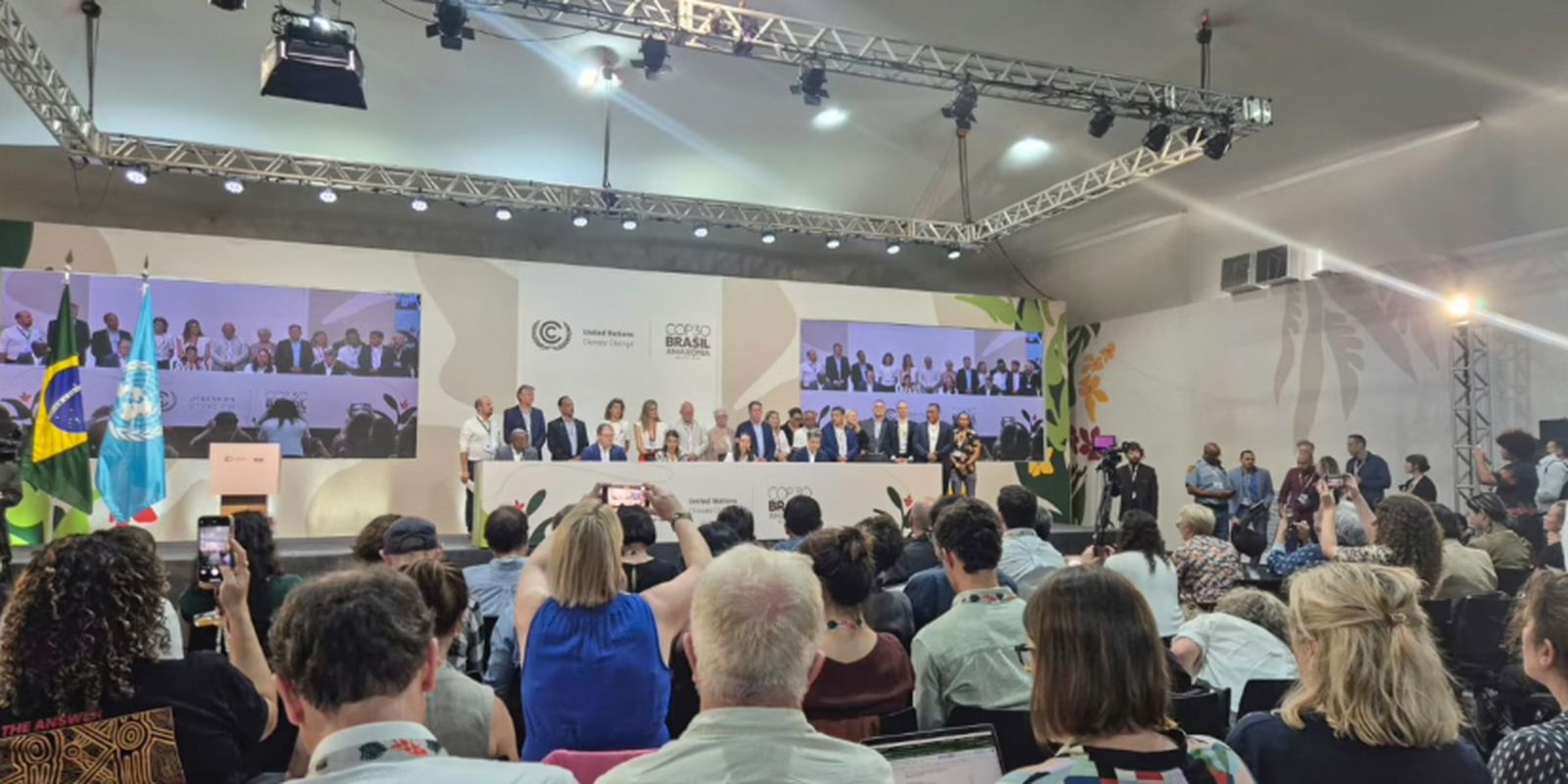
The draft final charter of the 30th United Nations Climate Change Conference (COP30) brings together a series of recommendations to accelerate global climate action and try to limit the planet’s warming to 1.5°C. The text reinforces that the goal established in the Paris Agreement in 2015 remains “alive”, but requires efforts defined by calendars and implementation mechanisms, especially with regard to the end of fossil fuels.
Governments, civil society, indigenous peoples and experts point out that, to break cycles of inequality and environmental destruction, it is necessary to combine science, climate justice, adequate financing and effective participation of those who live in the most affected territories.
The document highlights that COP30 must deliver an agreement that puts the world “on the path to net zero emissions” by mid-century, aligned with the scientific horizon of the Intergovernmental Panel on Climate Change (IPCC). To this end, it advocates that countries move forward with clear trajectories to reduce the production and use of fossil fuels, including targets for the progressive elimination of coal and a substantial reduction in oil and gas. The proposal includes international cooperation mechanisms to ensure a fair transition in regions dependent on these sectors.
The text reinforces that limiting warming to 1.5°C depends on a new global pact based on equity. In particular, it highlights that countries historically responsible for emissions need to increase their targets and provide accessible and adequate financial resources.
Follow EBC’s complete coverage at COP30
Expanding climate finance is treated as a priority, including mechanisms for adaptation, mitigation, losses and damages, and support for local initiatives led by indigenous peoples and traditional communities. The draft indicates that “without predictable and sufficient financing, there is no way to make the transition that the planet demands viable.”
The document also points out that COP30 should strengthen the recently created Loss and Damage Fund. The goal is to ensure that communities hit by extreme events — such as droughts, floods and climate-induced disasters — have simplified and direct access to resources.
The text notes that current financing regimes are slow, bureaucratic and incompatible with the magnitude of the impacts already occurring in the world. COP30, according to the draft, must move towards “a global protection system that recognizes that loss and damage are already part of the climate reality”.
Climate adaptation, according to the document, needs to occupy the same political space as mitigation (term for reducing greenhouse gas emissions). Belém’s proposal suggests building a more robust global framework, with clear metrics to measure progress and instruments that guide strategic investments in resilient infrastructure, water security, health, food systems, coastal protection and disaster risk reduction. The text indicates that adaptation policies must prioritize vulnerable regions and incorporate traditional knowledge.
The draft pays special attention to indigenous peoples, quilombolas and traditional communities, highlighting that their contributions are essential to keeping forests standing, protecting biodiversity and strengthening climate resilience. The document proposes to expand the participation of these groups in the formal spaces of the United Nations (UN) and reinforces that climate decisions cannot ignore their territorial rights. Among the guidelines, it states that “free, prior and informed consultation must be respected as a non-negotiable principle and as a pillar of climate justice”.
Click here and find out more about the subject on TV Brasil
Another point emphasized is the strategic role of fair energy transitions. The document proposes expanding investments in renewable energy, transmission networks and decentralized energy access systems, especially in regions such as the Amazon. The text also highlights the need to support workers and regions whose livelihoods depend on the fossil fuel chain, to ensure that the transition reduces inequalities.
The international trade agenda also appears as a key element of the transition. The text recommends greater coherence between trade, climate and biodiversity, to ensure that trade flows do not encourage deforestation, predatory exploitation of natural resources or socio-environmental violations. It also points out that trade policies should support developing countries to access sustainable markets, clean technologies and value-added opportunities.
The document includes guidance on food systems, sustainable agriculture, ecological restoration, nature-based solutions and green finance. For the draft writers, COP30 needs to demonstrate that multilateralism is still capable of responding to the climate emergency, especially in a context of strong pressure for concrete results. He states that “it is no longer possible to postpone structuring actions”, calling on countries to make commitments that can be translated into real public policies.
According to the report, Belém should mark a turning point for the global climate regime. The city that symbolizes the Amazon rainforest and is home to people who are guardians of biodiversity is seen as the ideal stage to reaffirm that the climate crisis can only be faced with justice, equity and popular participation. COP30 is presented as a historic opportunity to “rebuild the world’s relationship with nature” and guarantee a safe and dignified future for all generations.