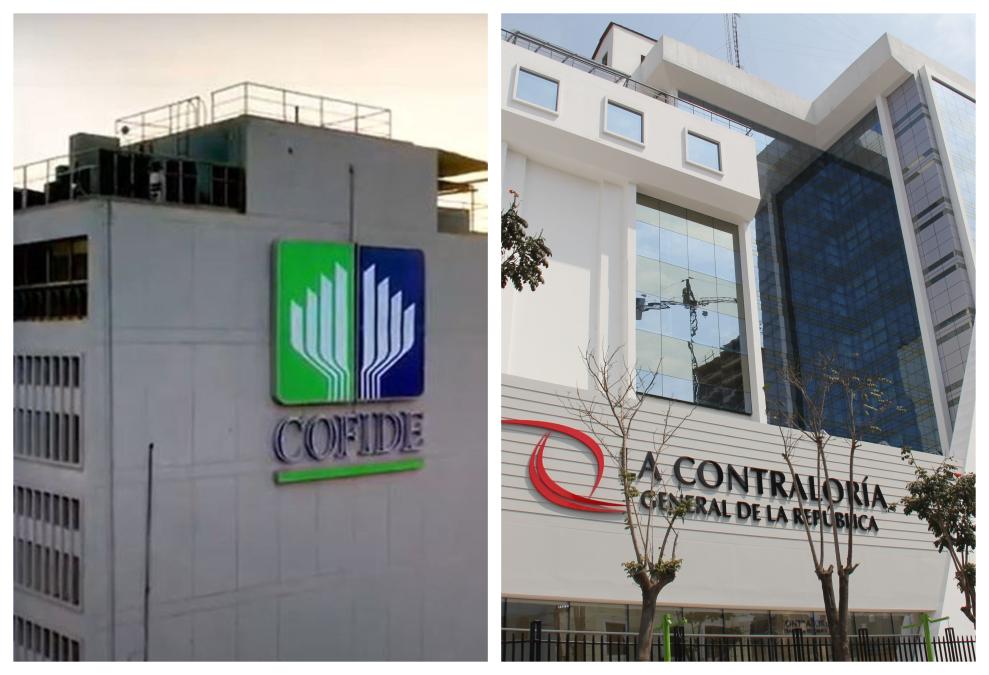
Cofide stated that the payment made by the beneficiary debtors of the Reactive Program It reached around S/51,000 million, which represents 89% of the total loans granted; Therefore, the outstanding balance is less than 11% of the total program. With this announcement, the entity would seek to put a damper on the controversy that the Comptroller’s Office has unleashed on the program.
“Cofide clarifies to public opinion that the information disseminated by some media about the Audit Report of the Comptroller General of the Republic (CGR), referring to the Reactiva Perú Program, does not conform to the official conclusions of said document,” the entity indicated in a statement. However, the controversy was not generated by the media as Cofide points out, but by the Comptroller’s Office itself.
Last Friday, the supervisory body published a press release with the headline: “Peru reactivates: Only 6% of the S/6 billion that the State transferred to the financial system was recovered.” However, the title does not correspond to reality. The correct amount transferred by the program to the financial system was S/58,000 million.
Those S/6,000 million referred to in the press release correspond to the disbursement that the State made to financial entities for guarantees, due to non-payment by the beneficiaries.
According to Cofide, the State granted around S/6.1 billion to financial entities, which would not constitute “definitive losses”, but rather the beginning of recovery processes provided for in accordance with the current regulatory framework, within the regular operation of a public guarantee scheme.
For this reason, he asserted that it is incorrect to affirm that he failed to fulfill functions related to the review of the eligibility of the credits granted under the Reactiva Perú Program. He said that, in accordance with the current regulatory framework, said evaluation was and is an exclusive function of the participating financial entities, an aspect that is not questioned by the Comptroller’s Office.
Questioning of the Comptroller’s Office to Cofide
According to the press release from the Comptroller’s Office, Cofide did not carry out the supervision work subsequent to the guarantee honoring operations to confirm that the loans granted met the eligibility requirements, in order to otherwise manage the restitution of the transferred amounts.
He argued that Cofide only verified that the financial system company attached the files sent regarding the credit granting process and failed to review the consistency of its content and validate that the credits paid by the State meet the requirements.
“Cofide also did not supervise that the entities of the financial system apply their internal collection policies to debtor companies, despite the fact that the Reactiva Perú program requires that financial entities give guaranteed credits the same treatment as their own client portfolio,” said the supervisory body.
Approach the topic seriously
Reactiva is a credit program conceived by the Central Reserve Bank (BCR) during the pandemic, as part of its mandate to preserve monetary stability in the face of a large-scale adverse event such as the health crisis. Therefore, in the interests of seriousness with public opinion, it is necessary to put all the elements on the balance.
The BCR’s current scheme to maintain price stability is to respond with measures that address economic cycles caused by significant adverse events such as the pandemic: for example, confinement caused the economy to enter a cycle of contraction. GDP fell 39.3% in April 2020.
Thus, monetary policy influences the demand of the economy and finally inflation, through the spending decisions of companies and families. Therefore, Reactiva played a fundamental role in providing credit in a countercyclical manner.
By avoiding the massive closure of companies, the program not only preserved the payment chain, but also sustained aggregate demand, benefiting even those companies that did not access the program and, ultimately, households.
The objective was to allow the participation of the greatest possible number of companies, therefore, unlike the usual liquidity injection operations in which the funds are granted to the financial entities that offer the highest interest rate for them, in the Reactiva auctions the resources were assigned to those entities that committed to charging the lowest interest rates on the loans they were going to grant.
This modality allowed credits for working capital to be channeled at minimum rates, consistent with the expansionary stance of monetary policy, which had taken the BCR’s reference rate to a historical minimum of 0.25%.
According to the book “Reactiva: design and results” published by the BCR, Reactiva Perú loans benefited a total of 501,637 companies, covering a wide range of economic sectors.
“This support was crucial to achieve a rapid recovery of the productive system, especially in the sectors with the highest concentration of micro and small businesses (mype). Of the beneficiary companies, 482,899 corresponded to micro and small businesses, which represented more than 96% of the total,” the BCR reports in its book.
Therefore, we must not lose sight of the objective and the circumstances in which the program was executed. It was always known that, like any credit, there was both the risk of non-payment and the risk that debtors would not use the resources for what they initially said they were going to use them for.
For this reason, the program had projected a loss of S/15,000 million, 25% of Reactiva’s total resources. The urgency and benefit of injecting liquidity was at that time more important than the cost of the program. That does not mean that the State must do its homework to recover the money.
According to the Comptroller’s Office, more than S/3,512 million could not be recovered, which would constitute a loss for the State. However, if this is achieved, the program would recover 93.1% of the resources that were allocated and not only 6% as suggested by the supervisory body’s press release.
Another no less important issue is the controversial arguments with which the Comptroller’s Office questions Cofide. This entity had the task of managing the program’s guarantees, but it is a second-tier bank, that is, it does not have direct dealings with the public. Therefore, it was not their job to review the documentation that each beneficiary debtor provided to the financial entities to corroborate whether or not they met the requirements.
Receive your Perú21 by email or WhatsApp. Subscribe to our enriched digital newspaper. Take advantage of the discounts here.
RECOMMENDED VIDEO