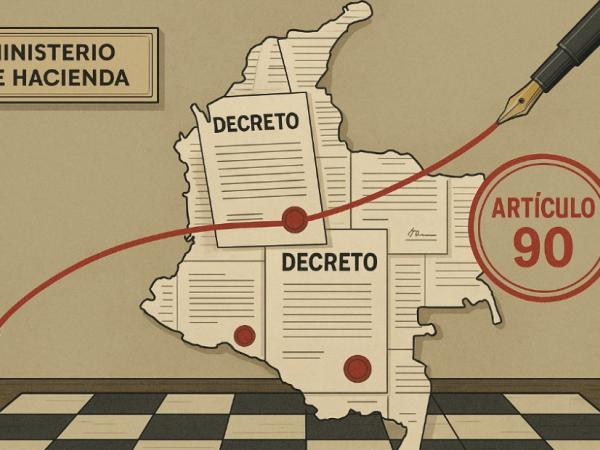
Once all the procedures for the General Budget of the Nation for 2026 have been completed and how much Gustavo Petro’s government will spend in its last six months of mandate, a new controversy has opened in recent days, due to an article, which some political sectors described as a monkey that puts The pension savings of Colombians are at risk if they are not correctly delimited.
This is article 90 of this law, which has become the new epicenter of a political debate, high-voltage fiscal and legal, since what for the Government represents a technical tool to guarantee the implementation of the pension reform, if the Constitutional Court endorses it, for the opposition and several experts in the sector it is a dangerous door open to discretion in the management of the resources of the pension system.
More information: Colombia is emerging as the main coffee exporter in the US.
The text, approved by Congress last week, establishes that the Ministry of Finance and the National Planning Department (DNP) may, by decree, make any budget modifications that may be applicable, between the Labor and Social Inclusion sectors, for the implementation of the reform.
Simply put, it is a mechanism that would allow the Government to rearrange items without legislative processing, that is, without going through Congress, with the argument of guaranteeing the financing of the new pillars of the system, especially the solidarity and semi-contributory ones.
The Constitutional Court is close to defining the fate of the pension reform.
Image from ChatGPT
“In 2026, once the suspension of the effects of Law 2381 of 2024 is lifted and in order to guarantee the resources required for the implementation of articles 3 and 17 of the aforementioned Law, the Ministry of Finance and Public Credit in coordination with the National Planning Department will carry out, by Decree, the budget modifications between the Labor and Social Inclusion sectors that may arise,” the article says verbatim.
Adverse reactions
For broad sectors of Congress, this provision represents an institutional and fiscal risk. and figures such as Senator Enrique Cabrales warn that “Article 90 gives the Government the power to transfer or reallocate resources in 2026 without going through Congress. It is an open letter to play as they want with the pensions of Colombians.”
Check here: Will Transfiya disappear with the entry into force of Bre-B? This is what ACH Colombia says
For the congressman, this is a “direct blow to democracy and the economic stability of the country,” since in his reading this article blurs the constitutional principle that only the Legislature can approve modifications to the national budget.
Along the same lines, the senator and presidential candidate, Efraín Cepeda, described the provision as a direct threat to workers’ savings, emphasizing the part that “says that the Government can take over the pension resources of Colombians. Those who are watching us have their retirement in danger because the Government is going to spend it.”

The Constitutional Court is close to defining the fate of the pension reform.
Image from ChatGPT
For the legislator, the funds could end up covering part of the operating expenses, which will increase by $37 trillions of pesos by 2026; while denouncing that the legislative process lacked sufficient debate.
“There was no discussion of any kind here. A proposition was explained, but this budget was not discussed. I am sure that there will be a rain of lawsuits,” he anticipated, while recalling that, if the Constitutional Court were to declare the norm unenforceable, the budget could remain in limbo, “as the pension reform is today.”
You may be interested in: Government issues decree that limits the cost of electrical energy in Colombia
You have to know how to delimit
It should be said that the criticism is not limited to the political field. Pension sector experts consulted Portafolio explained that although the Government already makes contributions to cover the shortfalls in the system, especially in the public regime, what is worrying is the door that the article opens to discretionary use of resources.
According to their perspectives, the possibility of making budget modifications by decree without clear rules of the game could lead to an opaque or politicized management of the solidarity pillar, a key component of the new architecture of the pension system that seeks to guarantee basic income to older adults without a pension.

The Constitutional Court is close to defining the fate of the pension reform.
Image from ChatGPT
Likewise, they stated that this type of transfers are already being made, since the Government must constantly make up for the pension gaps in the average premium regime. However, it is striking that a mechanism is enabled without prior control by Congress; warning that in a scenario where the system is in transition and depends on trust, any ambiguity can be costly.
Experts add that the risk is not immediate, but institutional, given that if the Executive ends up defining by decree the budget details or the regulation of the article, it could generate a precedent of “regulation by administrative means” on social security issues, which would displace Congress from its natural role of spending control, running the risk of eroding the legitimacy of the pillar system even before its implementation.
Other news: ‘Gas is our biggest concern’: Acerías PazdelRío
It must be remembered that the pension reform, approved by Congress in 2024, is currently under study by the Constitutional Court, after complaints were filed about alleged irregularities in its legislative process and that Judge Jorge Enrique Ibáñez is in charge of presenting the report that will determine whether the project complies with the principles of constitutionality, consecutiveness and democratic deliberation.
That is why in the approved budget, article 90 acts as a contingent bridge that will only come into force if the Court endorses the reform. However, this conditional nature has not been enough to calm the alarms and that is why analysts say that close attention should be paid to how budget transfers are regulated in the Ministry of Finance and National Planning.

The Constitutional Court is close to defining the fate of the pension reform.
Image from ChatGPT
In contrast, the Government maintains that the rule has a strictly operational purpose; arguing that, if the Court lifts the suspension of the pension law, it will be necessary to act quickly to guarantee the administrative and financial continuity of the reform, without subjecting the country to a new cycle of legislative debates that could delay its implementation.
With all this, while the future of the pension reform is defined, article 90 remains a reminder of the tensions that persist between the technical and the political, between fiscal urgency and institutional prudence, and although not a single peso has yet moved, the debate has already made it clear that the true capital at stake is the confidence of citizens in the management of their pensions.
DANIEL HERNÁNDEZ NARANJO
Portfolio Journalist