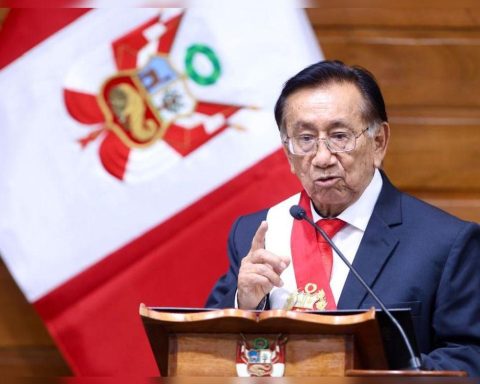
He Constitutional Court (TC) has declared unfounded the demands that requested the annulment of Law 32107, the rule that specifies when crimes against humanity and war crimes should be applied in Peru.
This means that the aforementioned Law remains in force and is constitutional, since the magistrates failed to reach the five votes necessary to declare it unconstitutional.
Judges Luz Pacheco Zerga, Francisco Morales Saravia, César Ochoa Cardich and Pedro Hernández Chávez voted in favor of its constitutionality, with interpretative criteria. While judges Helder Domínguez Haro, Gustavo Gutiérrez Ticse and Manuel Monteagudo Valdez voted for its unconstitutionality.
What does this Law 32107 establish?
This Law establishes that crimes against humanity and war crimes will only apply to events that occurred after July 1, 2002, the date on which the Rome Statute of the International Criminal Court came into force in Peru.
For acts committed before that date, the rules and prescription periods (the time limit for prosecuting a crime) that were in force in the 1991 Penal Code must apply.
The majority of the TC judges based their decision on the fact that international regulations (such as the Rome Statute) prohibit punishing someone for conduct that was not a crime or was not clearly defined at the time it was committed.
As is known, Peru acceded to the Convention on the Impredictability of These Crimes with the condition of applying it only to events after accession (July 2003).
This clause seeks to prevent trials for very old facts from violating the right to a reasonable period of time and the personal freedom of the defendants.
The Constitutional Court has urged the Congress of the Republic to modify the Penal Code so that it formally and clearly incorporates the figure of the crime against humanity with all its elements.
RECOMMENDED VIDEO