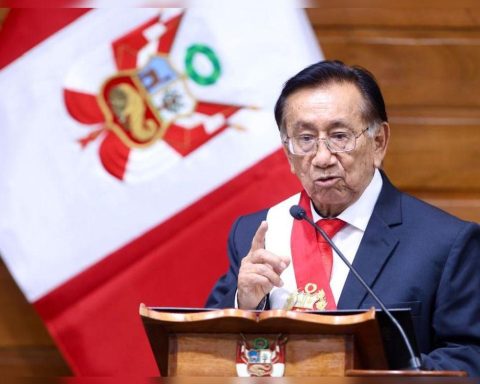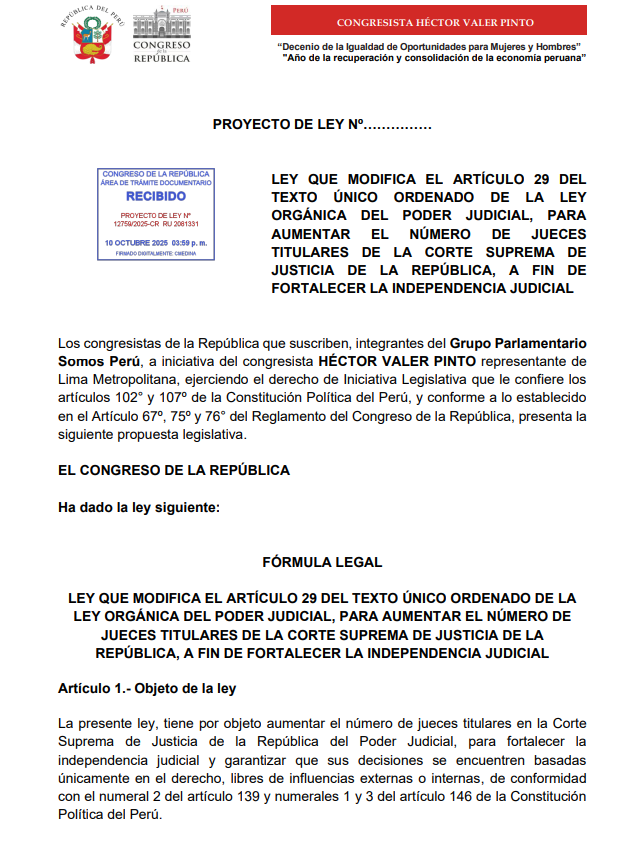
The Congress of the Republic, at the initiative of the congressman Hector Valer Pinto of Somos Perú, presented the bill No. 12759/2025-CRwhich proposes to modify article 29 of the Organic Law of the Judiciary to increase the number of titular supreme judges from 20 to 59.
The initiative, received by the Congressional Document Processing area on October 10, 2025, is justified by indicating that would strengthen job stability and independence for provisional judges. However, they do not detail the economic impact it would have on the annual budget of the Judiciary.
High provisional rate
The main argument of the proposal is the “excessive provisionality” that would currently affect the Supreme Court of Justice of the Republic. The current law (modified by Law 29755 in 2011) establishes that the Supreme Court is made up of 20 titular supreme judges.
However, the document indicates that, as of the date of the official letter sent by the Judiciary (August 10, 2025), the total number of supreme judges (regular and provisional) amounts to 59.
Of these, only 20 are startersand 39 are provisional supreme judges. The provisional nature of judges who perform jurisdictional functions reaches 70.90%.
The congressman argues that this high provisional rate undermines the impartiality, independence and suitability of the system, by generating vulnerability in judges who do not enjoy the job stability that an incumbent has. This would call into question the validity and legitimacy of the judicial system before society.
Proposed new number
The justification for setting the figure at 59 titular supreme judges comes from the need to formalize the real number of magistrates operating in the Court.
According to the information available on the Judicial Branch portal, there are 55 judges in permanent jurisdictional functions (composed of 16 regulars and 39 provisionals) and 4 judges without jurisdictional functions, but who enter the rank of supreme holders (president of the Supreme Court, two advisors of the Executive Council of the Judiciary, and a representative before the National Elections Jury).
The sum of the judges in permanent functions (55) plus the non-jurisdictional judges (4) results in the 59 titular supreme judges that the project seeks to establish.
The project also proposes eliminating from the composition the numeral that designates the head of the Office of Control of the Judiciary (OCMA) as supreme judge, given that said office was replaced by the National Control Authority, whose head is no longer a supreme judge.
Economic impact on the budget of the Judicial Branch
The Bill maintains that its approval would not imply additional spending for the State. The justification is that the salaries of 59 supreme judges (between permanent and provisional) are already financed with the budget assigned to the Supreme Court.
However, the salary difference between a supreme judge and a tenured judge is abysmal. The monthly remuneration for a regular supreme judge is approximately S/42,000 soles per month, while a provisional supreme judge earns around S/18,573.77, which registers a difference of 43,426.23. This last figure multiplied by 39 would be the extra expense that would be applied in the budget of the Judiciary for 2026.