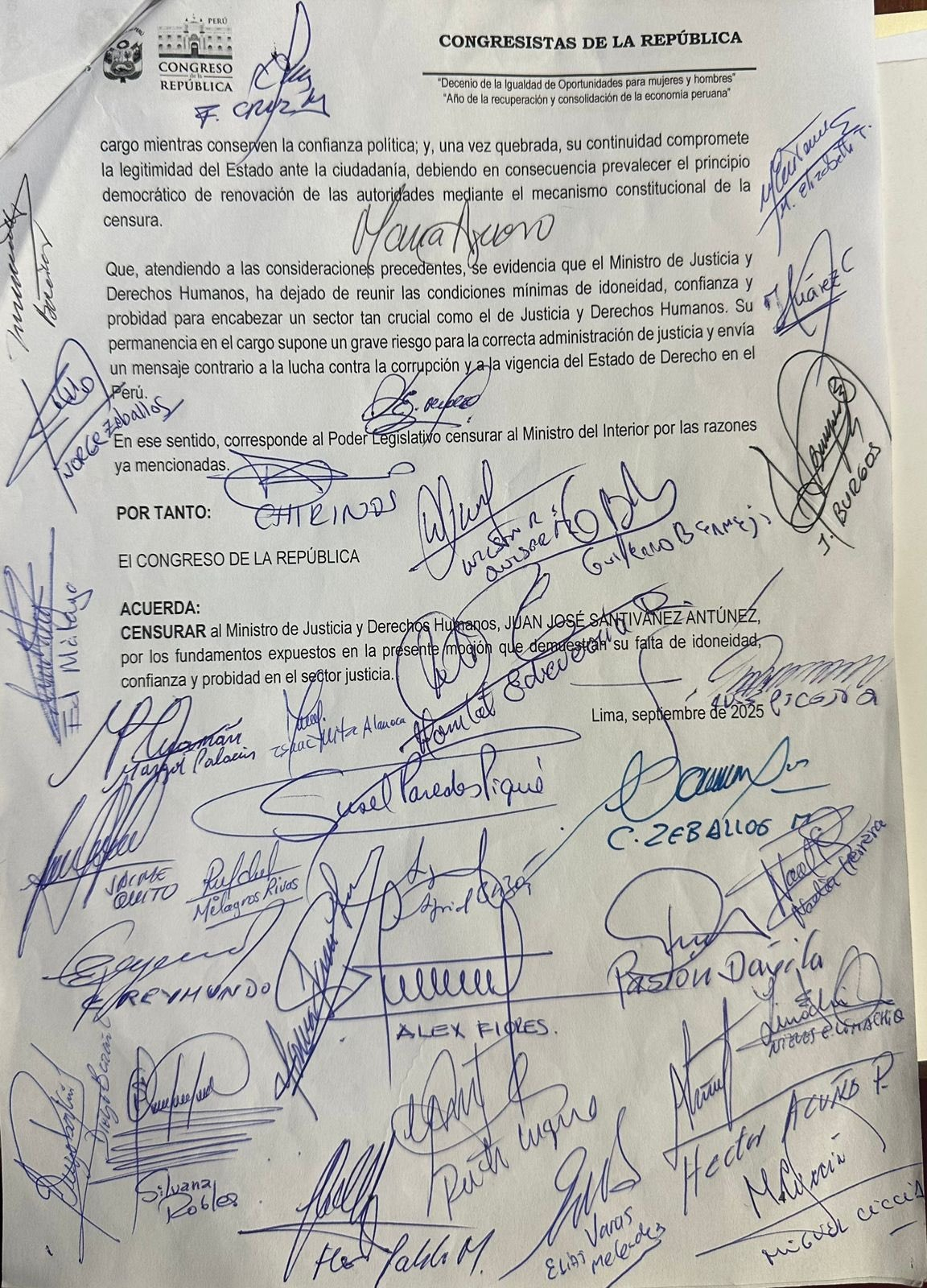
With 34 firms of congressmen of various banks, the motion of censure of the parliamentarian was presented by the walls against the Minister of Justice, Juan José Santiváñez For the audios that revealed the alleged influence peddling in favor of the criminal Miguel Salrrosas, nicknamed ‘El Diablo’, which was sentenced for belonging to the criminal gang “the octopuses”.
While the motion was promoted prior to the dissemination of the audios against Santiváñez, the revelation of these was the trigger for the necessary signatures to be reached for censorship to be admitted to the plenary. Now, this must be debated in the Hemicycle, where for approval it will be necessary to have 67 votes in favor. According to legislative estimates, this process could occur in October, after the week of representation.
Arguments for the motion of censure against Santiváñez
The motion of censure against Juan José Santiváñez, Minister of Justice and Human Rights, questions his suitability for the position. One of his arguments is that during his management as Minister of the Interior, he is attributed a lack of effectiveness in the fight against insecurity, with a significant increase in crime rates. The situation worsened to such an extent that Congress censored it in March 2025 due to the inability of its management to face the growing wave of crime.
In addition to its operational failed, Santiváñez faces serious judicial accusations, including influence peddling, abuse of authority, and its involvement in an alleged criminal organization linked to acts of corruption such as the addressing of public contracts, the influence on promotions and permanence of generals of the National Police, the protection of illegal mining operations and covering up illegal acts in the public administration. The minister is being investigated for several serious crimes and faces a series of judicial processes that include an impediment to exit from the country. This accumulation of charges, together with the lack of political and ethical trust, has eroded its ability to lead the Ministry of Justice, crucial sector for the fight against corruption and the defense of human rights.
The motion of censure highlights the contradiction of its appointment after being previously censored in another position and considers that its permanence in the position represents a risk for the administration of justice in the country. It is argued that its position at the head of anti -corruption and human rights policy affects the integrity of the rule of law and the transparency of the government.