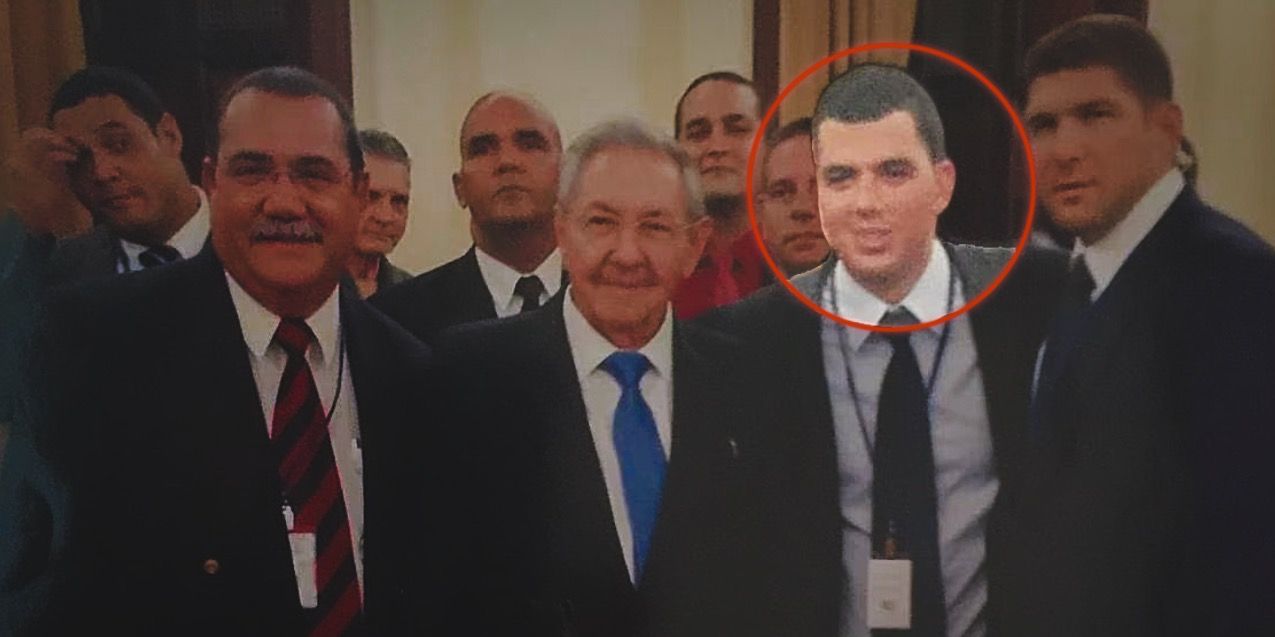
This Monday it emerged that Jorge Javier Rodríguez Cabrera had disappeared from the ICE Detainee Locator, despite the fact that his asylum case was still marked as “pending.”
MIAMI, United States. – The former official of the Cuban Ministry of Foreign Affairs (MINREX) and current businessman Jorge Javier Rodríguez Cabrera, close to Raúl Castro’s grandson, Raúl Guillermo Rodríguez Castro, “The Crab”regained freedom in the United States after several months in the custody of the Immigration and Customs Enforcement Service (ICE), thanks to a habeas corpus granted by a federal judge in Nevada at the beginning of November, as confirmed this Tuesday Martí News.
According to court documents cited by that medium, Judge Richard Franklin Boulware II, of the District Court of Nevada, even considered granting permanent residence (green card) to Rodríguez Cabrera under the Cuban Adjustment Act, but the Department of Homeland Security (DHS) objected.
In a live broadcast this Tuesdayjournalist Mario J. Pentón specified that Rodríguez Cabrera is currently free, in Las Vegas, where he would be awaiting the continuation of his immigration process. The reporter recalled that, before the release, the case was progressing in the Las Vegas Immigration Court as a political asylum file, and that Rodríguez Cabrera’s defense had chosen to go to the habeas corpus considering the extension of his detention arbitrary.
Criminal defense and immigration lawyer Mayron Gallardo, interviewed by Pentón, explained that Rodríguez Cabrera’s legal itinerary has been “a fairly extensive legal process.” According to the lawyer, after his arrest the former official had a bail hearing before an immigration judge, who set a bond of $2,500, but the DHS appealed that decision. “You have to be clear, when giving you bail, the judge takes two things into account: if you are a danger to society, or if you are a flight risk,” Gallardo explained.
The lawyer also pointed out that, according to the file, Rodríguez Cabrera “did not have any background criminal, nothing that would make him a danger to society” and presented family ties in the United States: “He supposedly has two children who are permanent residents, the mother of the children (…) is a permanent resident.”
In that context, “the immigration judge determined that yes, he was eligible for bond, and gave him a bond of $2,500.” However, the Government’s appeal prolonged the detention until the defense presented a habeas corpus before the federal court.
The federal judge concluded that the defense team had already exhausted ordinary avenues to obtain the release of their client, so he granted the appeal, according to Gallardo. From now on, he noted, a new immigration judge in Las Vegas must decide whether Rodríguez Cabrera can benefit from the Cuban Adjustment Act.
this monday transcended that the young Cuban had disappeared from the ICE Detainee Locator, even though his asylum case was still marked as “pending” in the records of the Las Vegas Immigration Court.
On September 9, CubaNet verified that the Automated Case Information System (EOIR) maintained Rodríguez Cabrera’s file in “pending” status and that his individual asylum hearing was set for October 2 before Judge Glen R. Baker, in Las Vegas. That same day, the ICE Detainee Locator confirmed his stay in custody at the Nevada Southern Detention Center.
The Boulware II decision, adopted on November 4 according to the documents cited by Martí Newsdrastically changes the procedural scenario, but does not yet imply a definitive resolution on asylum or an eventual adjustment of status.
In the documentation reviewed by that meansICE described Rodríguez Cabrera in its form I-213 as a citizen “with close ties to the Government of Cuba”, due above all to his career as a diplomatic courier for MINREX and his closeness to the Castro family.
The former official’s lawyers allege, however, that that stage ended almost eight years ago and that his diplomatic passport, then accepted by the State Department as part of his accreditation, expired in 2017.
Luis Domínguez, researcher at the Foundation for Human Rights in Cuba, he told Pentón this Monday that, when he worked as a diplomatic courier for MINREX, Rodríguez Cabrera “lived in a very well-off place in the city of Havana” and that, when he crossed the southern border of the United States, “he said that he was afraid of socialism, of communism.”
After arriving in the United States in 2022, Rodríguez Cabrera settled in Las Vegas and worked in small businesses and in pool cleaning, before appearing, in November 2024, as manager of Gran Azul LLC, a shipping and tourist services company based in Nevada and present in several cities in the country.
Gran Azul LLC offers door-to-door shipping, logistics, car and food sales, as well as tourist packages to Cuba, with branches in cities such as Miami, Orlando, Houston, Phoenix and Fort Myers. The combination of this rapid business growth and Rodríguez Cabrera’s diplomatic past has raised alarms about the possible penetration of capital linked to the Castro leadership into businesses based in exile.
The legal defense of the former official is in the hands of Kurzban Kurzban Tetzeli & Pratt, PA, one of the most influential immigration law firms in the United States. Three of its lawyers – John Pratt, Edward Ramos and Elizabeth Montano – requested special authorization to litigate in Nevada, while local lawyer Anthony D. Guenther leads the formal representation before the federal court.
The firm is led by renowned attorney Ira Kurzban. His wife, the Cuban-American Magda Montiel Davis, was involved in a notorious scandal in Miami in 1994 when, during a visit to Cuba, she kissed Fidel Castro and called him “teacher,” a gesture that provoked a strong reaction in exile, as she recalls. Martí News.
In his legal analysis, Gallardo recalled that membership in the Communist Party of Cuba or organizations such as the Union of Young Communists can make an applicant inadmissible under US immigration law, both in the Cuban Adjustment Act and in other means of adjustment of status. He clarified, however, that “it is not known” what exactly Rodríguez Cabrera declared in his application and whether the immigration judge is aware of possible partisan militancy, so that factor remains an unknown in the case.
Pentón concluded his broadcast by reminding that, beyond the legal outcome, the case will continue to be under scrutiny in the Cuban-American community and in Washington. “I know that the Cuban-American congressmen are also very attentive,” the journalist warned.