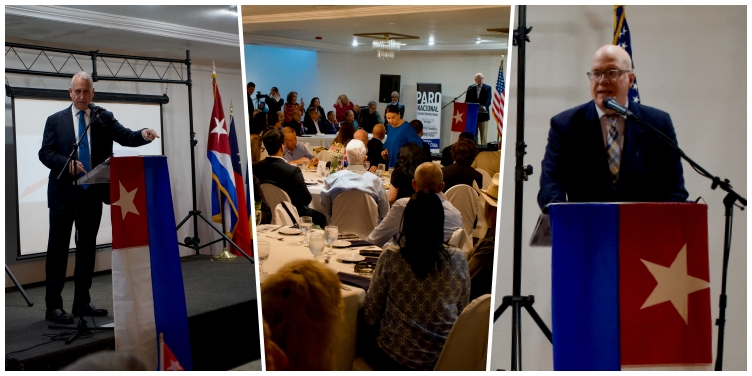
The appointment hosted recognized political, social and community leaders who created a space for reflection and commitment to the future Cuba.
Lima, Peru – Important figures of Cuban exile gathered this Saturday at the Big Five Club of the city of Miami during the “Save to Cuba” conference, an event framed in the 35th anniversary of the Cuban Democratic Board of Directors (DDC).
The appointment also hosted recognized political, social and community leaders who created a space for reflection and commitment to the future Cuba, combining voices and efforts in favor of the release of the island.
At the beginning of the conference, Orlando Gutiérrez-Boronat, coordinator of the DDC and the Cuban Resistance Assembly (ARC), highlighted the role of the Board of Directors as the product of an exiled nation “that has not been given.”
The manager emphasized that it is an exile that not only fought with weapons and risked his life to overthrow the Castro system, but also founded schools, educated his children, maintained his faith, and has struggled to preserve his culture and tradition.
“The fact that we are here, that one generates to the other, to continue that struggle for the freedom of Cuba, is an expression of something to which communism has great fear and they call the historical block,” said Gutiérrez-Boronat.
The historical block, said the leader of the DDC, is a series of institutions, people and beliefs identified with an ideology and values that do not yield in the struggle for the freedom of Cuba.
The conference program was attended by personalities such as Mario Díaz-Balart, president of the National Security Subcommission of the State Department; María Elvira Salazar and Carlos GiménezCuban American congressmen committed to the fight against the Cuban regime; and the opponent Rosa María Payáfounder of Cuba decides.
Together with the Flag of the Demajagua and the First War of Independence in Cuba of the nineteenth century, the speakers denounced the economic and humanitarian crisis on the island, the excesses of the Communist Party and the repression of activists and political prisoners.
“This is the flag of our first constituent that represents a Cuba founded in the Republic for the freedom and the right of their children. There is no other Cuban nation. What the communists have created is a lie, a secondary reality to deceive. Brothers and sisters who are listening to us on the island, here is the voice of the true Cuba that the regime could not defeat,” said Gutiérrez-Boronat.


The event included discussion panels, spaces for dialogue with the public and interventions of Special guests as Damian Wilson, president of the National Fund for Democracy; Julián Obiglio, president of the Union of Latin American Parties (UPLA); Björn Söder, Swedish parliamentarian who has promoted the suspension of the financing of the European Union to the Castro dictatorship; and the director of the Economic and Cultural Office of Taipei, Charles Chou.
During the Björn Söder meeting he was worthy of the Pedro Luis Boitel Freedom Fighter award, awarded by the Cuban Democratic Board of Directors. In social networks, also the leader of the Swedish Democrats said he was “deeply grateful and honest” to receive the distinction.
“Save Cuba” also included proposals for a free Cuba once the Castro regime has finished and the process of transition to democracy initiated. They resonated ideas in education and security in the words of the president of Miami Dade College, Madeline Pumariega, and Manny Morales, head of the Miami Police, respectively.
35 years of struggle for freedom and human rights
The Cuban democratic directory is a non -governmental organization founded in 1990 during the International Cuban Youth Congress by a free Cuba, held in Miami Beach. It emerged as a group of students and young professionals determined to contribute to the fall of the socialist system in Cuba through non -violent civic struggle.
In the beginning, the organization adopted the name Cuban Democratic Revolutionary Directory in tribute to the student directories created in Havana in the 20s to defend citizen freedoms. In March 2002, the group changed its name to Cuban Democratic Directory to more clearly reflect its commitment to democratic values.
Based in the United States, the DDC provides material and humanitarian support to opposition organizations within the island, facilitates contacts between foreign journalists and Cuban sources, and promotes international solidarity with the opposition movement. It is a signatory to the agreement for democracy in Cuba, a 10 -point document originally written in 1998 that advocates free elections and the release of political prisoners.
The Board of Directors is part of the Christian Democratic Organization of America and is an associated member of the Democratic International Union.
Among its main activities are the international representation of the Cuban opposition movement before human rights organizations and foreign governments, as well as the dissemination of reports on civic resistance on the island, including the annual report Steps to freedom.
Likewise, the Opera Radio República directory, a broadcaster that transmits daily to Cuba by short wave and AM, with content focused on internal social reality and opposition activism.
The organization has supported campaigns such as “I do not cooperate with the dictatorship”, launched by political exprisioneros Jorge Luis García Pérez Antúnezand José Daniel Ferrer Garcia In 2005, and the electoral boycott “not to the electoral farce” in 2007.
The DDC actively collaborates with agencies such as Amnesty International and the Inter -American Commission on Human Rights, which reaches reports of violations on the island.