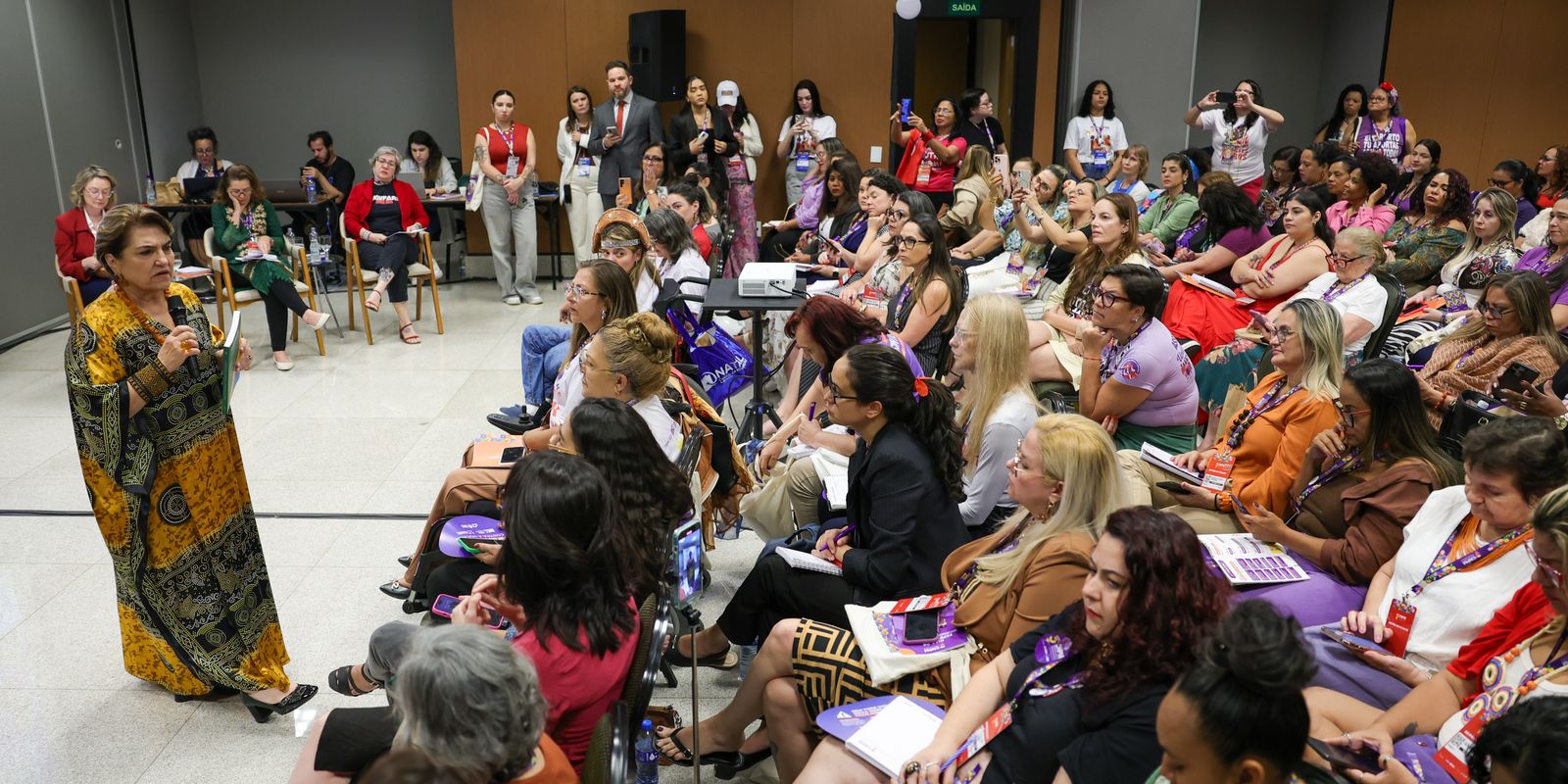
Participants of the 5th National Conference on Women’s Policies (5th CNPM), in Brasilia, proposed, on Tuesday (30), the creation of the National Federative System for Women to strengthen the formulation and execution of public policies of women’s rights across the country, articulated between the Union, States, Federal District and Municipalities.
For the continuous and stable financing of the actions to promote rights, eliminate women’s discrimination and confront violence across the country, several delegates of the 5th CNPM claim the institution of a National Fund for women.
Women’s Minister Márcia Lopes considers the claim to create a kind of unique policy system for women important.
“A system [assim] independent of the mandate. It is constitutional, permanent, continuous, as well as the Unified Health System [SUS]the Unified Social Assistance System [SUAS]the Unified Public Security System [SUSP]the National Culture System [SNC]”He stressed.
However, the minister points out that it is necessary to wait for the deliberations of the 5th Conference and if approved by the majority of the delegates, the Ministry of Women will continue the debate. “From the deliberation of these proposals, this is a debate that we will continue. The important thing is that women are convinced.”
National fund
Federal Deputy Maria do Rosário (PT-RS) reinforces the demand. “If we articulate the federative national system, we will have public policy at the local level and the articulation of policy in the federative level with states, municipalities and the Union itself.”
Regarding the creation of a National Fund for women as part of a national policy, Maria do Rosario understands that the federative financing of public policies for women’s rights will be the responsibility of all. “It has to be in the law: all municipalities, all state governments, as well as the federal government, regardless of those who govern, have the responsibility of having a specific body and the Secretariat of Support for Women. And then, we will have a policy that is not sectoral, because it is necessary to give equal power, as Minister Marcia has, to be with the other ministers, defining government policies,” explained the Parliamentary Gaucho.
Minister Marcia Lopes said the creation of the fund is more complex than a sectoral policy. “You [atuais] Funds will continue to function in their policies and we will have to think if the fund for women will be to ensure management, the organization of policy management sectors, as it is at the Ministry of Women, the states and municipalities. “
Interfederative relationship
The political leaders participated in the 5th CNPM panel with the theme The challenge of implementing public policies for women in the interfederative relationship To discuss coordination between the different levels of government in the execution of actions aimed at the female public.
Minister Marcia Lopes explained that in a federative pact the structure of the Government of Brazil, whether at the federal, state and municipal level, must be intertwined, integrated and articulated.
“It is no use we have wonderful laws, if we do not have this ability to understand the logic of what an intersectoral policy is, how we will dialogue with states and municipalities and how we will qualify our attributions.”
The minister argues that there must be a dialogue in all spheres. The Executive, the Legislature, Social Control. “Social movements are fundamental.”
The debate was also attended by the governor of Rio Grande do Norte, Fátima Bezerra, who recalled the pioneering of the state that rules in the struggle for women’s rights.
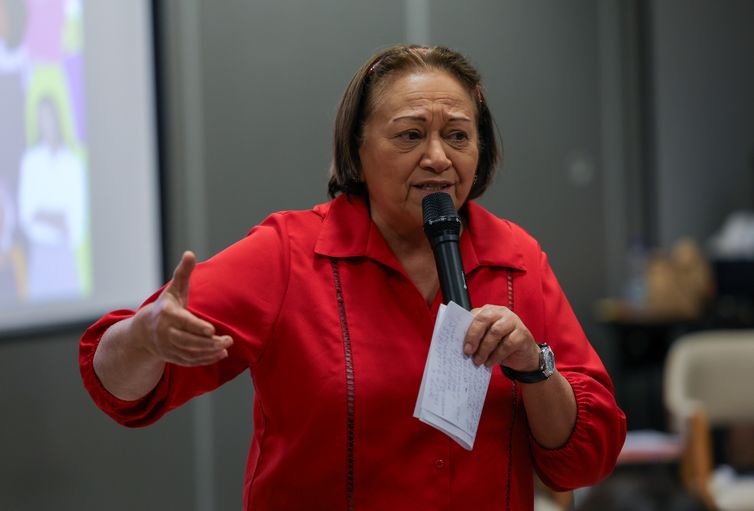
Fatima Bezerra remembered the pioneering spirit of Rio Grande do Norte in feminism – Fabio Rodrigues-Pozzebom/ Agência Brasil
Fatima pointed out federative dialogue between Union, states and municipalities to ensure the effectiveness of actions aimed at women. “It is narrowing this dialogue that we can advance the implementation of concrete and transforming policies.”
Faced with the conference delegates, former Count’s mayor (PB), Márcia Lucena, encouraged the social participation of debates about women’s policies “our participation as women is the needle and the line that will sew this fabric of the interfederative process.”
Representing the municipal level, the mayor of Juiz de Fora (MG), Margarida Salomão, argued that thinking of public policies that ensure women’s rights and expand their possibilities is fundamental and unavoidable. The mayor invited women to apply for elective positions in 2026 to occupy spaces for power and decision. “We will march until we are all free.”
Advice and Secretariats
Márcia Lopes reported that, in July, she was in Rio Grande do Sul to articulate, together with representatives of social movements, the creation of the State Department of Policies for women and said that she will travel other states and municipalities to raise awareness of local managers about the need to implement these specific bodies.
The minister also suggested society strategies to raise the number of municipal policy councils for women. Low number prevents broad scope and social control of women’s rights.
“It is the mobilization of women, it is our organization, it is the daily conviction for the performance of the councils, using the media, the community radios, asking for public hearing in the municipal councils, the legislative assemblies, is voting next year, in women and men who defend policies for women and voting in quota laws. Women. Just like that, women will have political space.