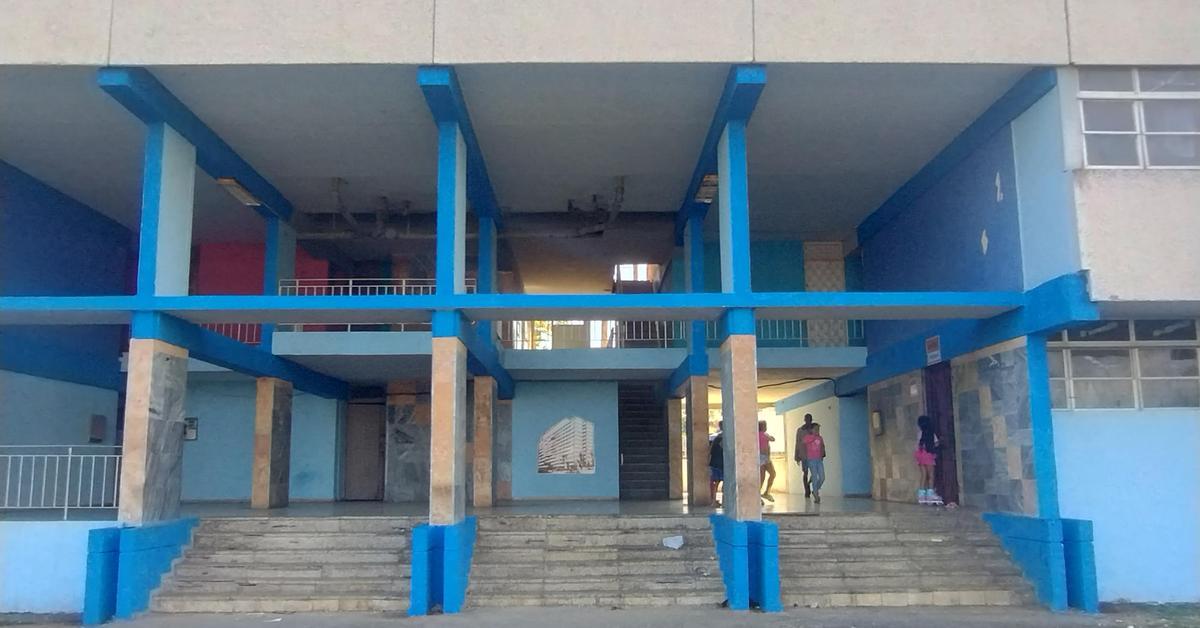
Matanzas/The residents of the popular 13-story buildings in Matanzas are exhausted. Literally, even. Of the four there are, three of them currently have elevators with serious breakdowns, and some have even been stopped for years and those that remain in operation suffer constant failures. “The elevator hasn’t worked for months, and it’s not that old. We have contacted Housing, but they only give us half answers,” says a neighbor who lives on the 11th floor.
Inaugurated in the eighties, these buildings on the way to Varadero that were once a point of reference, are today an inexhaustible source of problems due to lack of maintenance, and affect a large number of families who suffer from insecurity and a decrease in their quality of life.
“I’ve had cancer surgery for a few years now and I can’t exert any strength. Before, with the elevator, despite the blackouts, we could stick to the schedules, but now I spend weeks without being able to get out of the house. Added to this is the poor condition of the stairs, and like me, there are many elderly neighbors who suffer too. No one responds, no one gives a solution,” adds the woman.
“My job is difficult, and the lack of responses from Housing to the problems makes it even more complicated. I have 154 apartments under my responsibility, in addition to this one”
Dasiel, in charge of the administration of the building known as El Polinesio, is also desperate due to the lack of responsibility of the authorities. “My job is difficult, and the lack of responses from Housing to the problems makes it even more complicated. I have 154 apartments under my responsibility, in addition to this one,” he explains to 14ymedioalthough, according to its description, it is far from the only one. “As you can see in this area, being close to the sea, there is always wind, and the green areas are full of garbage that flies from the nearby micro-landfills. We also have problems with the handrails and stairs, and as has been in the news, the façade of the building is falling off right in front,” he adds.
El Polinesio has a restaurant on its roof that has now been leased to a private business, which has created new problems. “In the past, it had its own elevator for customers and cargo. When ours broke down, the neighbors on the upper floors used it, and thus several floors were saved. It is not the same to go down four floors from El Polinesio as to go up eight from the ground floor. But now, that the restaurant was rented to individuals, they decided not to deal with the repair of the elevator and created a small store in the place. Now there is not even an elevator for customers and the worst thing is that the merchandise is going to go up in the elevator of the neighbors,” says Dasiel, who fears “Housing responses,” that the problem will be solved in the coming years.
The history of the elevator in these buildings is not new. After more than two years without an elevator in the 13 floors of Las Panaderías, as another of these buildings is known, and after the mobilization of many neighbors, who even appeared before the Council of State, the installation of a new one was achieved. Almost a decade later, the machine still works, but with regular failures due to initial errors.
/ 14ymedio
“I have been working on this elevator since it was installed. I only interrupted my work during the Covid pandemic. Although I do not live in the building, I am a resident of the area and I know the difference having or not having an elevator makes for those who live here,” explains Ramón.
“With the blackouts, the button to mark the floors has problems, it does not stop until the 4th floor. Fortunately, on the upper floors it does, but when calling to see if they could change it, the technicians reported that there was no other available. Ramón says that the only brigade that serves all the elevators in the province spends most of its time attending to the hotels in Varadero. “It seems that the comfort of foreigners has more priority,” he protests.
Furthermore, their working conditions have little to do with those of the paradise promised by the Revolution to the workers. “I only charge 2,100 pesos and I have to spend 12 hour shifts inside the elevator. Now, with the blackouts, it is worse because I have to calculate the time to avoid being trapped inside. I am already 72 years old and it is very difficult for me to get out when the elevator stops between two floors. On occasions, several neighbors have had to help me out. I know that it will not be long before I will not be able to continue with this work, and although what I earn is not much, it seems like a symbolic salary, something It’s something,” he says with resignation.
Ramón says that the only brigade that serves all the elevators in the province spends most of its time serving the hotels in Varadero. “It seems that the comfort of foreigners has more priority”
Life in the 13-story buildings continues to be a daily struggle for its residents, who face poor housing planning, a lack of parts and the apathy of the authorities. Additionally, the idea of calling the fire department to try to escape an unexpected breakdown can be worse. “The firefighters are the relief for people who are stuck, because their priority is to get them out of there as soon as possible, but they are the terror of the mechanics, who know that they will often act with excessive force and in a hurry to extract the individuals without thinking much about the damage they will cause to the device,” says a neighbor from another of these blocks.
“In our building – he points out – the firefighters broke down with an ax, weeks ago, the wooden door that gave access to the elevator machine room, which is located on the roof. At the time they arrived at the building, the person who had the key was not reachable. The result: to this day there is no door that protects that room from vandalism and theft or from the entry of unauthorized personnel. Something that puts the operation of the elevators at risk,” he says. The energy crisis also constantly strains the machinery.
The continuous disaster also causes some to throw baskets with ropes from the balconies to save the effort of going down; others, resigned, climb at their own pace, carrying everything from furniture to gas cylinders, while counting the steps that separate them from their home. And those steps make no distinction between young and old, between healthy and sick.