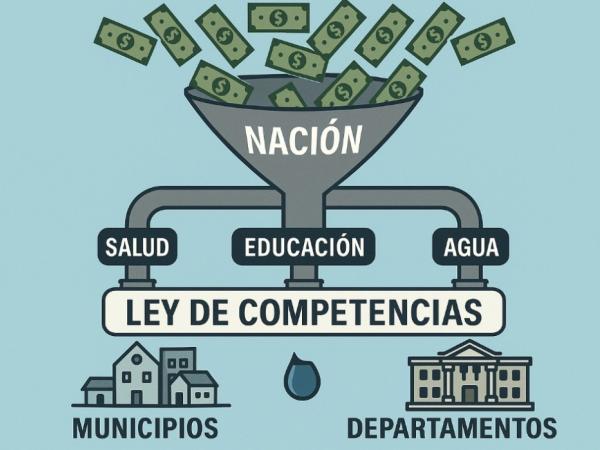
The draft of the Law of Competencies, the norm called to redefine the distribution of functions and resources between the Nation and the territorial entities, opened an intense debate that faces analysts and the technical team in charge of their writing, in the prelude to define how the other half of the reform to the General System of Participations will be.
While some experts warn about legal gaps and fiscal risks, the editors of the proposal defend gradual and initial targeting in the health, education and drinking water sectors. In the midst of all this, the key point does not revolve only around silver, but of the capacities and responsibilities of the territories.
See here: Why is Greca’s redness so expensive in Colombia?
And it is that the discussion is not less if it is taken into account that it is the regulation of the legislative act approved in 2024, which increased by 50% the resources of the General System of Participations (SGP) for departments, districts and municipalities, but with the condition that each additional weight is accompanied by the transfer of a function today at the head of the central government.
Criticism by empty in the proposal
Portfolio spoke with the analyst Mauricio Cabrera, analyst and connoisseur of the fiscal issue, who assures that the draft presents gaps that call into question his coherence with the constitutional mandate; warning that “what is at stake here is a change of the State’s functioning model towards a more decentralized one. But the law should clearly say which functions that the central government assumes today will go to departments and municipalities. And that is not defined.”
This project promises to generate a strong debate in Congress and regions.
Chatgpt image
For Cabrera, this is a nerve point and explains that constitutional reform He established that the additional $ 40 billion that the territorial entities will receive in the next twelve years must be financed with the equivalent reduction of spending at the central level, so “it is not about increasing public spending, but that it changes who signs the checks. And the rule must leave in writing what functions they move so that the fiscal deficit does not increase. If it does not, the Constitutional Court could lie.
This expert also puts on the table the need for a more precise categorization of the territories, pointing out that “today there are more than 950 municipalities at level 6 of the current classification. Bogotá is not the same as I accused, and yet they remain in the same sack.”
Also read: The pension: what is happening with the pensions of Colombians?
That said, it emphasizes that the law should establish mechanisms to strengthen institutional capacity and associativity, because otherwise you run the risk of waste resources or spend them without control.
In addition, he argues that in all this there is a underlying political problem on behalf of the richest territories could end up assuming new obligations that were previously at the head of the central government, questioning if there would be any governor or mayor who will accept to spend less on their priorities to finance issues such as tertiary roads or primary health care that are national obligations.

This project promises to generate a strong debate in Congress and regions.
Chatgpt image
In his vision, the draft contains good intentions, but a pec of optimistic And he concludes that “that is the story of the milk company.
The defense of the technical team
For his part, Darío Indalecio Restrepo, former director of the decentralization mission and member of the technical team that elaborated the draft, responds to these criticisms with a message of context and precision in which he explains that the process has been long and complex, in part by the recent changes in the key ministries such as the Treasury, Interior, Planning, but also because the Government decided to carry out a broad social dialogue before the proposal.
Other news: ‘We have reached the balance in cash flow point’: Wom
“We meet with nine fundamental interlocutors: from the prior consultation with indigenous peoples to FECODE, the federations of municipalities and departments, assocapitals, the United Nations and the National University. We receive valuable proposals that we are incorporating to deliver a text adjusted to the government, who will decide the time to file it, ”he explained.
On the categorization, Restrepo clarifies that it is not about maintaining the scheme of Law 617 as it is, since “that classification remains in force only for the affairs of the 617, as the top of debt and salaries. But this law does adopt new categories, combining management capabilities and structuring attributes of the territories. A large city cannot be treated the same as a rural municipality dispersed with environmental wealth or high ethnic density. differentiation is contemplated. ”

This project promises to generate a strong debate in Congress and regions.
Chatgpt image
Regarding criticism about the lack of definition of competencies, Restrepo recalls that the Constitution itself set priorities such as health, education and drinking water and that due to this, the draft develops these three sectors thoroughly.
“For others, what is created is a governance system between Nation and territorial entities that will allow, during the 12 years of gradualness, to specify how functions are distributed in agriculture, culture, transport, security and others. It is not a vacuum, it is a decision to advance step by step and not try to restructure the entire state of a single blow,” he said.
More information: Project that adjusts methodology for calculating oil reserves arouses suspicions
The academic defends this logic as an advantage, not a weakness, stating that “it is better that three successive governments build decentralization in a agreed manner, to do it with a single conjunctural majority. That guarantees sustainability and national consensus. ”
The territorial criteria
Another of the recurring criticisms is that the law would be too sectoral and not territorial, a point in which Restrepo Discrepa, clarifying that it is true that it is organized by sectors, but with a closing approach of territorial gaps and that due to this, silver will not be distributed with the historical criteria that perpetuate inequalities, but with positive discrimination towards the most marginalized territories.

This project promises to generate a strong debate in Congress and regions.
Chatgpt image
“In that list the departments and municipalities with greater poverty, high rurality come Dispersa, environmental prevalence, ethnic density, presence of development programs with territorial approach (PDET) or areas most affected by the conflict (Zomac), and those of lower category and population. The combination of these six criteria will allow us that the additional investment really closes the gaps, ”he insisted.
Restrepo also defended the associativity chapter and although he acknowledges that administrative and planning regions (RAP) are not direct beneficiaries of the constitutional reform, he assures that the draft includes incentives for joint projects of water, environment and productivity.
It may interest you: Unreal: the subway stations considered the most beautiful in the world
With these two positions as a sample, the discussion promises to be one of the most relevant debates of the legislative year; While not only the decentralization and strengthening of the territories is at stake, but also the fiscal sustainability of the country in which, as Restrepo warns, there will be an “inevitable dosed frustration” of the different actors who ask for more recognition of resources for their own sector, But it is clear that the challenge is to distribute resources with equity and efficiency.
Daniel Hernández Naranjo
Portfolio journalist