However, the plan was buried months later, after the citizen consultation held last Sunday, December 14, the result was overwhelming: the majority of participants voted “no.”
Behind this rejection is a history of mistrust, community organization and a territory that, as its inhabitants say, “can no longer tolerate one more environmental impact.”
For years, environmental groups and residents have reported health problems, persistent pollution and a high incidence of serious diseases.
“In many diseases we are above the national average. For example, in leukemia there are up to five times more chances that a person in this region will acquire it than in any other part of the country,” commented René Romero, a resident of Tula and representative of the Río Tula initiative: Restoration and Socioecological and Hydrological Justice.
(Francisco Villeda/ Cuartoscuro)
An announcement that set off alarm bells
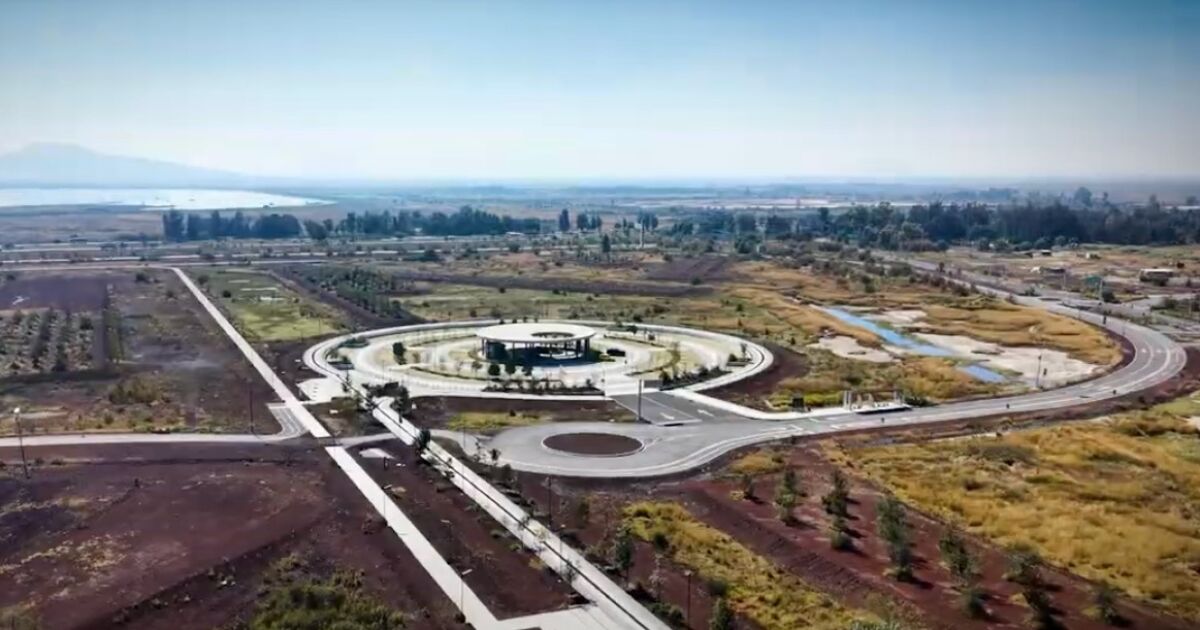
The announcement of the park, presented in the official speech as a circular economy and environmental restoration project, came as one of the 100 commitments that Sheinbaum assumed on October 1, 2024.
After the project was announced, the opposition began to demonstrate against it, until at the end of last November the authorities called for a citizen consultation to define the future of the complex, which was held after the General Law of Circular Economy was approved in the Congress of the Union.
For the groups and organized inhabitants who opposed the project, the Parque dissemination and consultation process was far from being a neutral exercise of citizen participation.
Citlali Martínez Reyes, member of the San Gerónimo Atlamaco Ecologist Union and resident of the community of Tlamaco, municipality of Atitalaquia, assured that since the announcement of the project and during the consultation, multiple irregularities were observed.
“From the beginning we saw that it was a simulation, a rigged consultation, because there was not enough information about the project. They never presented us with an environmental impact statement, which is the minimum that a megaproject of this magnitude needs,” he said in an interview.
According to his testimony, the information meetings held by the Ministry of Environment and Natural Resources (Semarnat) were selective and aimed mainly at officials from the three levels of government.
“They were not calls open to the population. Suddenly they were already broadcasting that there was a meeting or later they published that they had been in a certain community, but it was their own workers who were there,” he explained.
René Romero agreed that the official information was always partial and explained that, although the name spoke of recycling, the technical details that began to become known raised alarm bells.
“They said it would be a metropolitan project, for Mexico City, the State of Mexico and Hidalgo. They talked about processing up to 1,000 tons of garbage a day, when the municipalities said they would generate only 500. Obviously, the garbage was going to come from somewhere else,” he said.
“They showed beautiful, green renders, they talked about an ecological park, research centers, even a daycare, but they never explained what the negative impacts of the plants to process waste would be or why they intended to do it on a metropolitan scale,” he added.
Concerns grew when, in conferences and public spaces, it was mentioned that the complex would receive waste not only from Hidalgo, but also from Mexico City and the State of Mexico.
Romero said that these advertisements talked about processes such as the incineration of sludge from treatment plants, handling of tires, industrial waste and technologies such as pyrolysis, that is, the decomposition of organic materials through high temperatures and without direct combustion.
“That set off alarm bells for us, because the region cannot tolerate one more environmental impact. First we need to resolve what is already there, the historical contamination and the damage to health,” he said.
For the groups, the environmental justice discourse was contradictory. They claim that the narrative of the ecological park was just a “hook.”
“We asked for a green lung, a real ecological park. They took that narrative and used it for their campaign, but how are they going to clean our air by bringing garbage?” questioned Citlali Martínez.