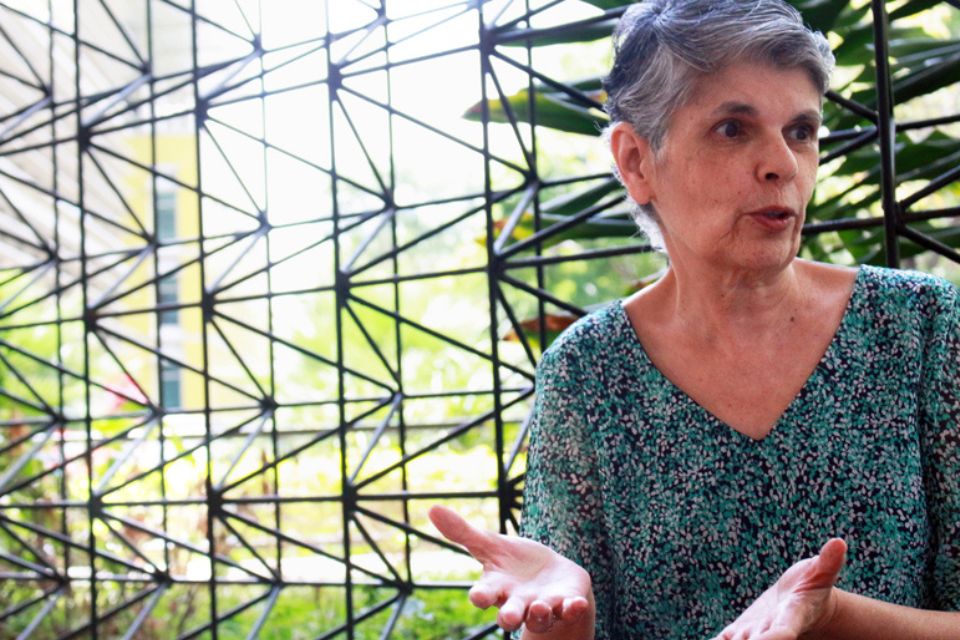
Human rights defender Ligia Bolívar denounces that her visa was inadmissible due to an arbitrary change in immigration rules in Colombia, a situation that she claims affects thousands of Venezuelans who fled the humanitarian emergency and political persecution.
The human rights defender and coordinator of the NGO Alerta Venezuela, Ligia Bolívar, was left in an irregular condition in Colombia, after the Foreign Ministry rejected her visa renewal application, which expired on October 31, under the argument that she “did not show interest” in the process.
The Venezuelan researcher, who has lived in that country for six years, denounces that the decision lacks support and responds to an arbitrary change in immigration rules. «I started the application for the new visa on September 18, a month and a half before. I sent all the receipts. Afterwards there was a very long silence. With 15 days left until the current visa expires, I contacted the Ombudsman’s Office because there is no response,” he details.
Through an email, Bolívar was informed that in order to continue with her M Worker visa I had to have a different employment contract “because I can’t get that visa with that contract, but I have four years with that visa, with that contract. It is a change in the rules of the game that has no logical explanation and that generates legal uncertainty in me.«he alleges.
Bolívar highlights that the email received from the Foreign Ministry said in bold: “Do not answer this email.” Since that notification, the human rights defender contacted the Ombudsman’s Office to present her case and to seek mediation with the Foreign Ministry, but there were no responses either; But on October 31 in the afternoon, the Foreign Ministry notified the Ombudsman’s Office that the visa “has been inadmissible due to withdrawal. “I want you to show me at what moment I gave up, when I have been managing the process for a month and a half,” he explains.
Ligia Bolívar continues her efforts before the Ombudsman’s Office to explore the next actions to defend her rights, although she is aware that a visa is not a right.
The inadmissibility of Bolívar’s visa has immediate consequences: he was left without a valid immigration card, which prevents him from carrying out notarial or administrative procedures, his employment contract cannot be executed because he is in an irregular condition. «If I don’t have a visa, I can’t work. If I don’t have a contract, I lose the health coverage that allows me to continue my cancer treatment,” he explains.
Despite the situation, Ligia Bolívar received a call from the national health superintendent, who assured her—that on instructions from President Gustavo Petro—her medical treatment will not be interrupted; However, the human rights defender insists that this response does not resolve the root of the problem. «The bottom line is that they denied me a visa due to a change in rules and claiming something false: that I did not show interest. The same thing has happened to hundreds of people in Colombia,” he says.
Bolívar, who was the founder of Provea, of the Human Rights Center of the Andrés Bello Catholic University (UCAB) and is recognized for her work in the defense of Venezuelan migrants, questions whether these types of decisions become frequent in Colombia: “I have seen many cases where the visa is denied with ridiculous arguments, such as asking for things that are impossible to comply with, like what they want to do to me now. Example: people who come for less than three months for an academic exchange are asked for apostilled degrees.
*Read also: Colombia has left thousands of Venezuelans in legal limbo and risk of deportation
Harsh policy against Venezuelans
Ligia Bolívar has also denounced that Colombian immigration policy “has hardened” towards Venezuelans, which she claims reflects that the official narrative reduces displaced Venezuelans to simple economic migrants.
«Unfortunately, President Petro has assumed the Venezuelan government’s narrative that those of us who are here are because of the sanctions. I am not here because of the sanctions. The vast majority of Venezuelans who are in Colombia is as a consequence of the complex humanitarian emergency, which precedes the sanctions, and due to political persecution.. “You don’t need sanctions to torture or disappear people,” he says.
“The Venezuelan population is not migrants, the population, including me, are people in need of international protection,” emphasizes the human rights defender.
For now, Bolívar is still accompanied by the Ombudsman’s Office, which is evaluating the legal actions to follow on her behalf. «I cannot take action directly against the Colombian government because with the expired ID I cannot do anything. “I can’t even go to a notary office,” he said.
The researcher claims to have received a wave of solidarity from colleagues, organizations and citizens. «People I don’t even know write to me to offer legal or technical support. But beyond my personal case, this is a worrying message. What is happening with me is not new; “It has happened to many Venezuelans,” he says.
According to data from the Interagency Coordination Platform for Refugees and Migrants of Venezuela (R4V), until September 2024, 2,808,968 Venezuelans lived in Colombia. Of these, 2,351,663 have a regular status, 1,936,251 have their PPT issued, 340,875 were in process and 457,305 Venezuelans were in an irregular situation.
*Journalism in Venezuela is carried out in a hostile environment for the press with dozens of legal instruments in place to punish the word, especially the laws “against hate”, “against fascism” and “against the blockade.” This content was written taking into consideration the threats and limits that, consequently, have been imposed on the dissemination of information from within the country.
Post Views: 418