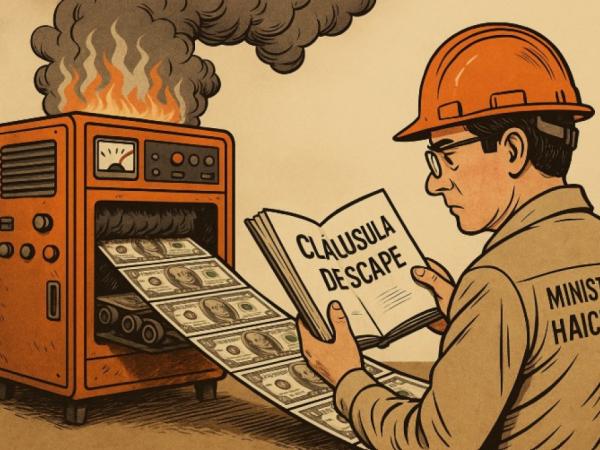
The Autonomous Committee of the Fiscal Rule (CARF) recently presented its consolidated analysis of the medium -term fiscal framework 2025 – 2035, in which He categorically reiterated that Colombia has entered a high fiscal landsince, for them, the measures raised by the Ministry of Finance offer Just temporary relief while deepening the structural vulnerability of public finances.
In its Julio Technical Report, the CARF notes that the fiscal situation has become the main focus of macroeconomic instability of the country, after the deficit of the central national government reached 6.7% of GDP in 2024, exceeding 1.1 points the goal set in the previous fiscal framework.
See here: ‘He loves us in the photo, but not in decision making’: France Márquez against Petro
However, they recognize that this deviation was the product of a significant fall in income and a higher primary expense, partly due to the execution of accumulated budget reserves and that, as a consequence, the net debt of the government rose to 59.3% of GDP, moving away from the legal anchor of 55% and reversing the consolidation path observed between 2021 and 2023.
Likewise, they establish that this deterioration marks a break in the fiscal adjustment process that had been consolidated after the pandemic and raises questions about the sustainability of debt in the medium term; that apparently they are not taking into account within the new calculations posed by Minhacienda.
The country’s economy faces serious tax risks in the coming years.
Chatgpt image
An escape clause that had no technical livelihood
One of the most critical points of the report refers to the government’s decision to activate The exhaust clause of the fiscal rule for the years 2025 to 2027, with the argument that the fulfillment of fiscal goals is unfeasible due to the inflexibility of spending and the limited capacity to increase income in the short term.
At this point, the CARF once again said that this decision does not meet the requirements established by law, which requires the presence of extraordinary events that compromise macroeconomic stability and argues that everything has been the product of a situation that could be avoided and that it could still be raffled, without the need for extreme measures.
It may interest you: What does the binational area between Colombia and Venezuela contain?
This fiscal authority It was emphatic that the current imbalance is structural, and that postponing fiscal adjustment can generate a more harmful effect by amplifying risk premiums, deteriorate the exchange rate, make financing more and weaken the investment.
“The main macroeconomic imbalance is precisely the fiscal imbalance; postponing the adjustment can further increase risk premiums […] and reduce the well -being of the population. Once the exhaust clause is activated, the analysis must focus on the Fiscal Adjustment Plan. ”Affirms the document.

The country’s economy faces serious tax risks in the coming years.
Chatgpt image
Growing deficit, in the midst of a weak plan
On the other hand, the fiscal rule committee says that the fiscal trajectory which raises the medium -term fiscal framework provides for deficits higher than the average of the last 20 years (4% of GDP), since by 2025, the Government estimates a total deficit of 7.1% of GDP, even greater than that observed in 2024; While in 2026 it would be 6.2%, and in 2027 it would be reduced to 4.9% and the strong adjustment would only begin in 2028.
The CARF indicates that even if the planned measures are implemented, the net debt would remain between 7 and 8 percentage points above the legal limit throughout the next decade and that is why, it states that the tax adjustment must begin as soon as possible and be more ambitious.
More information: 120 years of Carulla: This has been the transformation of their warehouses
In addition, it estimates that in order to meet the deficit goal in 2025 (7.1% of GDP) adjustment measures for at least $ 8.3 billion would be required, due to an overestimation of tax revenues by the Treasury. The organism also doubts the spending goal, which represents an investment execution of only 15%, much lower than the historical average of 63%.
“If the rhythm of execution is maintained in line with the usual, the primary expenditure could exceed up to $ 18 billion the projected. And if, as in 2024, all the resources are not executed, a budget reserve close to $ 50 billion by 2026” would be accumulated again, said the CARF in its report.

The country’s economy faces serious tax risks in the coming years.
Chatgpt image
Upward debt and tax reform that is in doubt
Dhonding on other fronts of the report, the committee presented its debt scenarios, in which the basis for the net debt of the Government will reach a historical maximum of 61.4% of GDP in 2025, mainly driven by the primary deficit of 2.4%. By 2026, this debt would scale to 63.5% of GDP, and would only begin to be reduced from 2028, although far from the legal anchor.
In this context, the MFMP proposes a indebtedness strategy aimed at recomposing the box through the intensive use of short -term instruments, such as TCOS, rests and administered funds, and a greater emission of global bonds. However, they make it clear that this tactic only provides temporary benefits and exposes the country to greater risks of refinancing, market and exchange exposure.
Other news: Coal to Israel: This Petro government document authorized Drummond for export
Starting from the fact that the government’s fiscal plan is based on the approval of a new tax reform in 2026 with an estimated collection of $ 19.9 billion, the CARF was played for not incorporating these resources in its base scenario, arguing that The project has not yet been presented or approved, which introduces a high degree of uncertainty.
Additionally, they point out that if a $ 50 billion budget reserve is repeated in 2025, as happened in 2024, pressures on 2026 spending would be significant. It also emphasizes that the pension reform could add an additional pressure of 0.4 points of GDP in case of entering into force, although the review of its constitutionality is still pending.

The country’s economy faces serious tax risks in the coming years.
Chatgpt image
Finally, between 2026 and 2036, the CARF projects average total income of 17.2% of GDP, While the government estimates 19.1% and in terms of spending, anticipates an average of 24.9% of GDP, leaving a public investment space of only 1.8%, below the historical average.
This is why the agency estimates that, to comply with the deficit goal and stabilize the debt in the anchor of 55%, an average annual adjustment of 4.3 to 4.8 points of the GDP would be required in the next decade. Even fulfilling the entire government plan, the debt would close 2036 in 62.8% of GDP.
Read more: US tariffs. UU. Again
“Stabilize the debt and lead it to prudent levels It requires sustained primary surpluses between 1.5% and 2% of GDP from 2029, ”concludes the report.
With all this, although the CARF doubts the viability of the government’s fiscal plan and warns that current measures are not enough to avoid deeper deterioration; Postpone the adjustment, alerts the body, can leave more expensive than to face it with decision.
Daniel Hernández Naranjo
Portfolio journalist