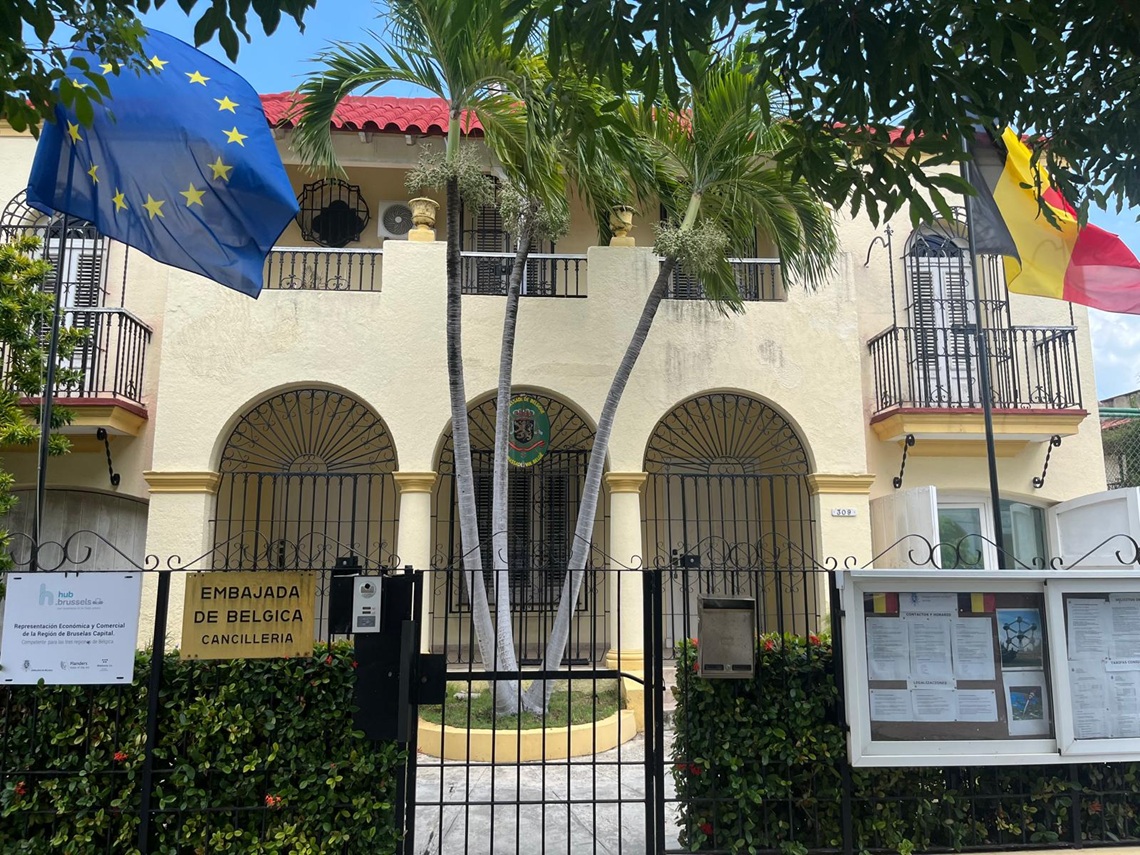
The closure of the Embassy of Belgium in Cuba, announced this week by the authorities of the European country, has caused “surprise and disappointment” in the island’s Government.
This was expressed by the Cuban Embassy in Brussels, in a note in which he points out that this decision “does not correspond to the historical and positive relations that exist between both countries, maintained uninterruptedly for more than one hundred and twenty years.”
The diplomatic representation of Cuba recalls that during all this time “both nations have consolidated close cultural, academic, scientific-technical, consular, economic and cooperation ties, supported by a respectful dialogue, which has transcended the bilateral sphere and has contributed to the strengthening of the relationship between Cuba and the European Union.”
In his opinion, this step by Brussels “also contrasts with the interest expressed by the Belgian authorities in deepening its ties with Latin America and the Caribbean, considering Cuba’s vocation in favor of concertation, cooperation and unity in the region within its diversity.”
Statement from the Embassy of #Cuba in the Kingdom of #Belgium.
•
Statement from the Cuban Embassy in the Kingdom of Belgium
•
Communiqué de l’ambassade de Cuba au Royaume de Belgique+ Info
EN | IN
https://t.co/OXIlAykPtpFR
https://t.co/yiIyW4V0ft pic.twitter.com/l7pusJVUlg— Embassy of Cuba in Belgium and the EU (@EmbaCubaBelgica) November 18, 2025
Through its Embassy in Belgium, which is also its representation before the European Union, the Cuban Foreign Ministry said it hopes that “a step of this magnitude does not lead to the deterioration of long-standing ties” between institutions and people from both countries.
In addition, he reiterated “the aspiration that Belgium continues to play a constructive role in the development of relations between Cuba and the European Union, within the framework of the Political Dialogue and Cooperation Agreement in force since 2017.”
Finally, he thanked the support received within the European country after that government decision and reaffirmed “his willingness to expand, with his diplomatic work, the ties of friendship and cooperation between both nations.”
Belgian decision
The closure of the Belgian Embassy in Havana responds to a “strategic” restructuring of the Government of that country, which includes the closure of a group of Belgian diplomatic offices and the opening of new ones.
The Belgian Minister of Foreign Affairs, Maxime Prévot, justified the step in the changes in the international scenario and the need to reduce costs.
“Trade and tariff wars force us to rethink our network of partners and diversify our reach and influence,” noted the Belgian Foreign Ministry in a statement, in which he assured that the closure of several embassies and consulates does not diminish “the importance that we continue to give to our bilateral relations with the countries involved.”
In addition to Cuba, Brussels reported the closure of diplomatic representations in countries such as Mozambique, Mali, Bosnia and Herzegovina, Kuwait and China, while those that will open include those of nations such as Oman and Albania.
This process will begin next year and will last until 2027.
Media and analysts point out that the closure of the Belgian Embassy in Cuba, even though it does not mean the rupture of relations between the two countries, does mark a precedent of bilateral distancing and will also entail difficulties for the consular procedures of Cubans, who would now have to travel to other countries to manage their trips to Belgium.