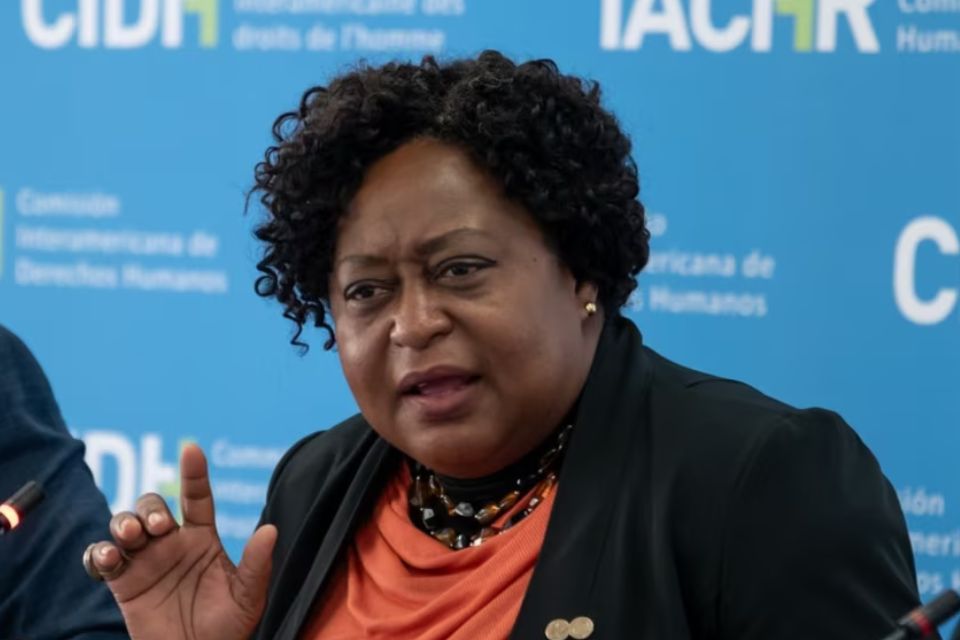
The Commissioner and Special Rapporteur for Venezuela of the Inter -American Commission on Human Rights (IACHR), Gloria de Mees, presented a report on the situation of the country to a year of the presidential elections and said that in the country there is no justice for the hundreds of post -electoral political prisoners
The Commissioner and Special Rapporteur for Venezuela of the Inter -American Commission on Human Rights (IACHR), Gloria de Mees, presented to the Organization of American States (OAS) an update of the situation of human rights in Venezuela and said that one year after the presidential elections and of the post -election protests “there is no justice or accountability.”
“A year later, there is still no justice, there is no accountability and no significant action to investigate these deaths or actions to protect the rights of the detainees who are still detained,” said Mees before the OAS on Wednesday, August 6.
Given this situation, «The IACHR firmly reiterates the request to the Venezuelan people to authorize a visit In situthat the Venezuelan State authorizes a visit In situ. This would allow the commission to carry out its mandate in the field, in their interactions with the victims, with the authorities, protect and see the situation of close human rights and unrestricted access to the reports of abuse, torture and of arbitrary arbitrary arrests, ”requested Gloria de Mees.
The commissioner of the IACHR described an alarming panorama of impunity, systematic repression by the State, violation of human rights and unjustified imprisonment of Human opponents and defenders.
Gloria de Mees recalled that after the presidential elections of 2024, at least 25 people were killed during the protests; of which, 24 were civilians, mostly young people under 30, from popular sectors. He stressed that 24 of the deceased died from shooting in the thorax or in the head, and that two of them were 15 and 17 -year -old teenagers.
*Also read: one year without justice
However, the commissioner condemned that effective investigations have not yet been opened; as well as many of the arrests have become prolonged arrests and others in forced disappearances. Hundreds of political prisoners remain arrested without access to lawyers, without contact with their relatives and under conditions that qualify as torture and inhuman treatment.
“The lack of investigations, the abuse of children and adolescents arbitrarily detained, can only be interpreted as acts of impunity,” said Mees. He also noted that repression includes a sustained campaign against the independent press, with arrests, disappearances and judicial processes without guarantees, all to silence dissent.
The Inter -American Commission on Human Rights claimed to have interviewed 91 victims of the repression “of the Venezuelan regime”, Citizens in exile in Colombia and others in the United States and affirmed that their statements “reflect a systematic pattern of abuse and abandonment.”
“They are not isolated cases of abuse, they are part of a deliberate repression strategy,” said the special commissioner and rapporteur for Venezuela of the Inter -American Commission on Human Rights (IACHR), Gloria de Mees, on the current situation of the country.
«Who are responsible for the 25 homicides that occurred during the protests that followed the electoral process? Where are Rocío, San Miguel, Freddy, Superlano, Juan Pablo Guanipa, Biagio Pilieri, Américo de Gracia, Perkins Rocha, Luis Palocz, Jesús Armas and other opposition leaders who are still detained? And why have they denied access to their families, a lawyer? ”Asked Gloria de Mees.
*Journalism in Venezuela is exercised in a hostile environment for the press with dozens of legal instruments arranged for the punishment of the word, especially the laws “against hatred”, “against fascism” and “against blockade.” This content was written taking into consideration the threats and limits that, consequently, have been imposed on the dissemination of information from within the country.
Post views: 155