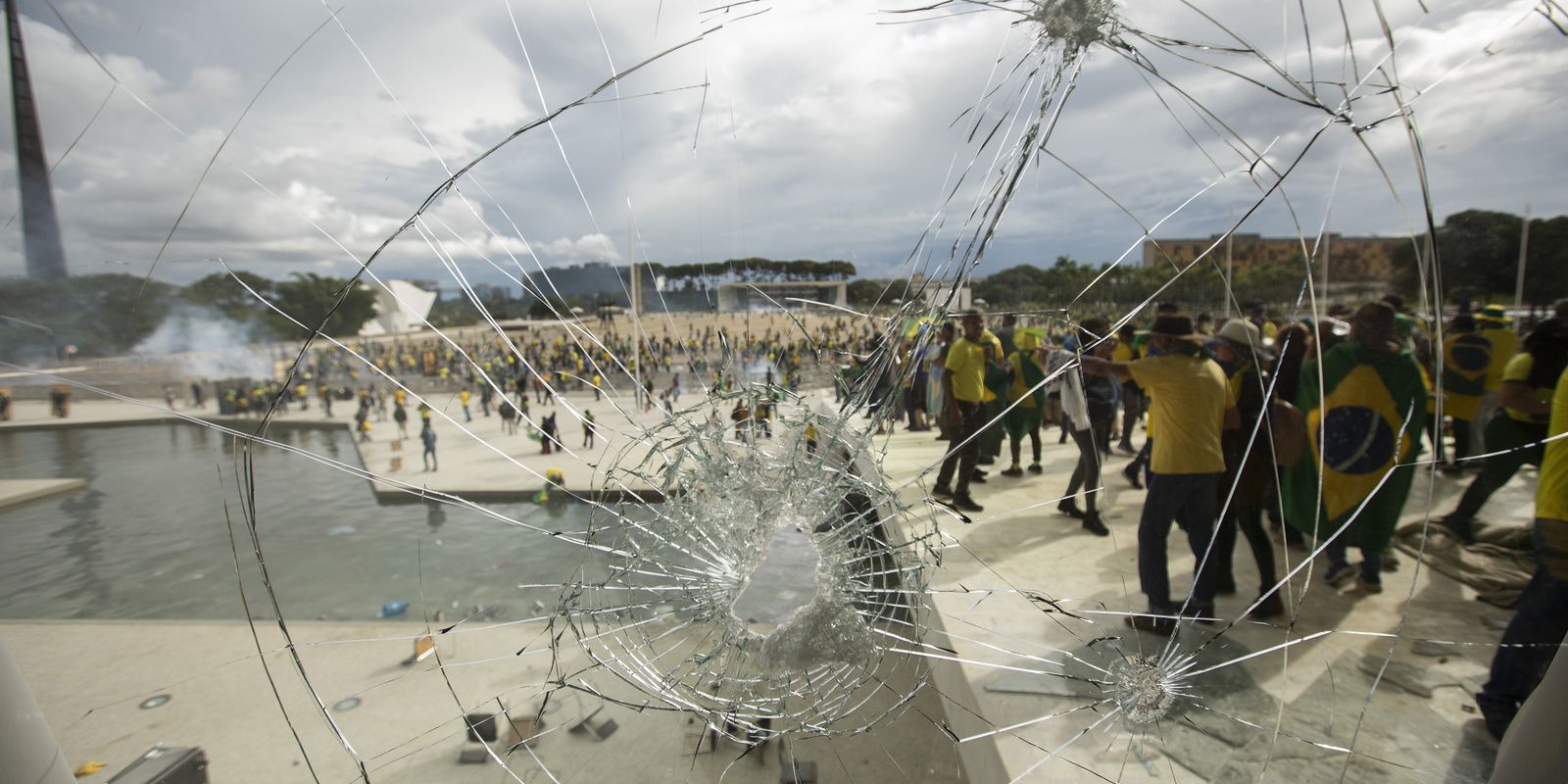
The images of depredation of the headquarters of the Three Powers of the Republicon January 8, 2023, which turns three years old this Thursday (8), traveled the world and went down in history as one of the most dramatic and dark pages in the trajectory of Brazilian democracy.
On that cloudy Sunday afternoon, in Brasília, thousands of supporters of former president Jair Bolsonaro, defeated at the polls two months earliermarched along the Esplanada dos Ministérios, crossed a police blockade and invaded the National Congress, the Planalto Palace and the Federal Supreme Court (STF), destroying everything in sight.
There, they reaffirmed a request that echoed in extremist segments of society: they wanted a coup d’état to depose President Luiz Inácio Lula da Silva, democratically elected, who at that time had only been in office for a week.
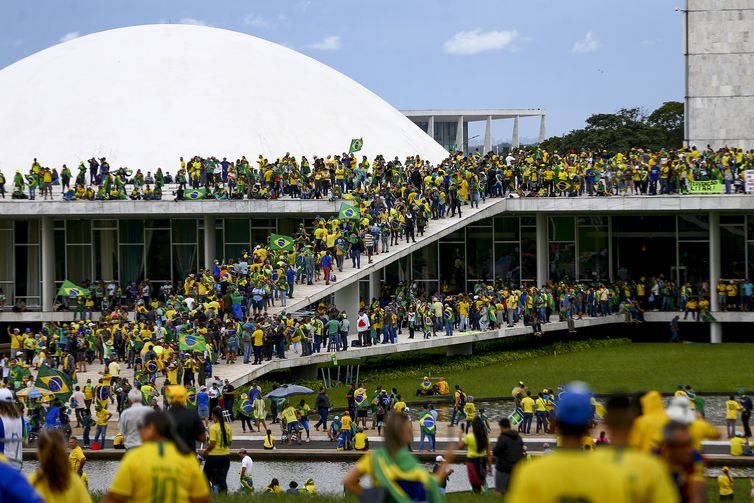
Bolsonaro supporters invade and vandalize the headquarters of the Three Powers on January 8, 2023 – Photo: Marcelo Camargo/Arquivo Agência Brasil
This moment is the culminating milestone of the call coup plota set of acts and movements, some well coordinated among themselves, others more isolated, which sought, ultimately, break with the democratic order and keep the Bolsonarist group in power.
The rupture plan, according to the complaint from the Attorney General’s Office (PGR) that led to the condemnation of Jair Bolsonaro and allies in the STFbegan to be drafted in 2021, a few days after Lula regained his eligibility. It was at that moment that the nucleus of the criminal organization began to consider whether the then President of the Republic would begin to confront and disobey the STF’s decisions and defend the idea of delegitimizing the Brazilian electoral process in the event of the victory of Bolsonaro’s opponent.
When the scenario of Bolsonar’s electoral defeat materialized in the election on October 30, 2022, a series of events, including episodes of violence, terrorist acts and coup protests, began to occur across the country. Below, Agência Brasil reconstructs these facts, chronologically, which occurred in the interval between the end of the elections and the fateful 8th of January.
Highway blocks

Truck drivers block highway in Paraná in protest against Bolsonaro’s defeat in the second round of elections – Photo: Rodolfo Buhrer/Reuters Archive/Rights reserved
In one of the fiercest presidential elections in Brazilian history, Lula beat Jair Bolsonaro with 50.9% of valid votes, against 49.1%. The result was not well digested by the then president’s supporters – nor by him himself, who It took two days to manifest itself, and it did so in an ambiguous wayfueling coup speculation.
That same Sunday night, while Lula supporters celebrated across the country, groups of truck drivers and supporters of Jair Bolsonaro began blocking highways in several states. There were more than a thousand total or partial closures on federal roads, according to the Federal Highway Police (PRF) mapped at the time. The blockades reached their peak in the first days of November, causing Bolsonaro to publicly ask for the highways to be cleared, marking his first public demonstration after the poll results. In that statement, he thanked the votes, but did not congratulate his opponent on the victory.
The blockages, which caused some specific problems with shortages and flight cancellations at airports, were losing strength throughout the days following the second round, until they were closed at the end of the first week of November.
Barracks camps
After the roadblocks eased, Bolsonaro groups began setting up camps in front of Armed Forces barracks in cities such as Brasília, São Paulo, Rio de Janeiro, Florianópolis, Salvador, Recife and municipalities in the interior, demanding military intervention and questioning the legitimacy of the elections.

Police and Army gather in front of the Army HQ, in Brasília, to demobilize the Bolsonarist camp, on January 9, 2023 – Photo: Marcello Casal Jr./Arquivo Agência Brasil
They were more than 100 campsincluding what became the most important of them, mounted in front of the Army Headquarters (HQ)in the federal capital, where the protesters who vandalized Praça dos Três Poderes on January 8, 2023 would leave.
Unlike the roadblocks, in which Bolsonaro went public asking supporters to stop these interventions, the coup camps, as they became known, had direct approval from the then President of the Republicas stated in the PGR complaint that ended up prevailing in the STF judgment. According to the complaint, the strategy would be used as justification for possible intervention. One of the proofs would have been the note from the commanders of the three forces authorizing the continued presence of people in front of the barracks by order of Jair Bolsonaro.
The barracks camp strategy gave impetus to the coup movement. These places became true centers of conspiracy and had the indifference and even connivance of authorities. The logistics for maintaining these spaces, which had food and accommodation facilities for thousands of people, were later the subject of legal proceedings in the STF that condemned those directly involved in these assemblies.
Terrorist acts and political violence

Protesters supporting Bolsonaro set fire to cars and buses in the federal capital on the night of December 12, 2022 – Photo: Adriano Machado/Reuters Archive/Rights Reserved
The tension in the coup camps, the refusal to recognize the defeat and even an action by the PL, Bolsonaro’s party, in the Superior Electoral Court (TSE), to invalidate votes from part of electronic voting machines The coup plot thickened throughout November and early December 2022. In the last month of that year, actions began to escalate into explicit political violence.
On December 12th, the date on which Lula graduated from the TSE to assume the position of President of the Republic, in an inauguration that would take place a few weeks later, Brasília experienced one of its most violent nights in decades. Protesters supporting Bolsonaro tried to invade the Federal Police (PF) headquarters in the city and started a protest that, at around 10 pm, closed the North Hotel Sector and part of Eixo Monumental, the central area of the capital. Several cars and buses were set on fire, in scenes that shocked the country due to the degree of vandalism and political violence.
On Christmas Eve, on December 24th, the driver of a fuel tanker, stopped near Brasília International Airport, noticed an explosive device in the vehicle and alerted police officers in the area, which turned out to be an attempt to bomb attack organized by Bolsonaro supporters who were also in the Army HQ coup camp. The tragedy was only not accomplished because the explosive failed.
Two of those involved were condemned by the Federal District Court in 2023, for crimes of explosion, fire and possession of a firearm. According to investigations, they intended to cause an episode of great social commotion and precipitate a military intervention in the country.

Bomb is found in a tanker truck near Brasília Airport, on December 24, 2022 – Photo: Adriano Machado/Reuters Archive/Reproduction prohibited
At the end of last year, George Washington de Oliveira Sousa, Alan Diego dos Santos Rodrigues and Wellington Macedo de Souza, the three involved in the attempt to serve at the airport, became defendants in the STF for the crimes of criminal association, violent abolition of the Democratic Rule of Law, attempted coup d’état and attack on air transport security.
The episodes of violence in December 2022 raised the level of tension even further, and the authorities prepared a strong security scheme for Lula’s inauguration, on January 1, 2023. The popular event, however, took place without complications, which, at that moment, may have conveyed a feeling of tranquility, which would be broken exactly one week later, in the coup acts of January 8.
For memory and democracy
To observe the date, special events in favor of democracy mark three years since the January 8 coup acts. At Palácio do Planalto, President Lula participates in a ceremony with authorities and civil society representatives in the morning. The event takes place every year to reinforce democratic values after the invasion and depredation of the headquarters of the Three Powers.
The Federal Supreme Court also prepared a special programming within the Unshakable Democracy campaign.