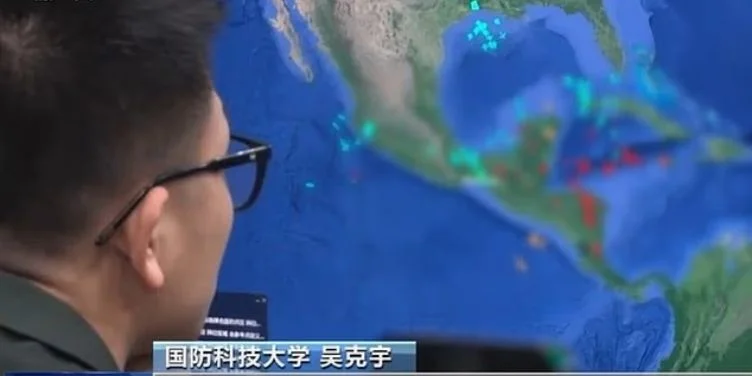
Beyond the virtual nature of the scenarios, the appearance of Cuba, Mexico and the Gulf of Mexico on the exercise maps fueled readings about the geographical scope of Chinese military planning.
MIAMI, United States. – Chinese state television (CCTV) broadcast images of a “war simulation” event held in the city of Xuchang, Henan province, in which conflict scenarios were seen located on maps that include Cuba, the Gulf of Mexico and the Caribbean Sea, in addition to the Sea of Okhotsk and Taiwan.
The revelation, spread in a CCTV report and reviewed this Wednesday by the South China Morning Post (SCMP)is unusual for showing—albeit in simulation format—military theaters in the Western Hemisphere, a region where China maintains a limited military presence.
The footage comes from CCTV coverage of a People’s Liberation Army (PLA) “war game” employment exchange and observation activity held recently in Xuchang. In its note dated December 19, CCTV reported that 20 units of military forces and academies participated, with demonstrations of different simulation modalities and emphasis on the use of digital tools and artificial intelligence.
The television report did not present an operations plan in America as a political advertisement, but it did allow us to see screens where, according to SCMP“red” and “blue” forces (common convention in EPL exercises: “red” as their own forces and “blue” as an adversary) were represented moving near the coasts of Cuba and Mexico. SCMP described that several “blue” markers appeared near Houston, Texas, advancing towards the Gulf of Mexico, while the “red” ones were located in the Caribbean; and that other screens included the Sea of Okhotsk and Taiwan as additional simulation scenarios.
In its publication, CCTV framed “war simulation” as a planning and training tool: “War simulation is an important means for the command training and operational planning of world-class armies, by creating a low-cost, immersive and repeatable confrontation environment, which allows commanders to learn to fight without going to war,” the state media noted.
Beyond the virtual nature of the scenarios, the appearance of Cuba, Mexico and the Gulf of Mexico on maps of an exercise shown on state TV fueled readings about the geographical scope of Chinese military planning. SCMP stressed that, despite China’s increase in economic ties in Latin America and the Caribbean, the Chinese military presence in the region remains reduced; Therefore, modeling possible contingencies there “suggests” a change in global ambitions and in the way the PLA thinks about scenarios outside the Asia-Pacific.
For Cuba, the dissemination occurs in a context of sustained international attention to Havana’s relationship with Beijing in matters of security and intelligence, an area in which governments and analysis centers in the United States have expressed concerns in recent years.
Chinese military bases in Cuba
Last May, US legislators asked their country’s Department of Homeland Security (DHS) for an urgent evaluation of the alleged collaboration between China and Cuba in matters of intelligence and security. The petition highlighted the risk posed by the Chinese regime’s electronic espionage capabilities just about 150 kilometers from the continental United States.
“The People’s Republic of China is positioning itself to systematically erode US strategic advantages without firing a single shot,” the congressmen warn in a letter addressed to the Secretary of Homeland Security, Kristi Noem. Among the signatories are the chairmen of the Homeland Security committees and the Select Committee on Strategic Competition with the Chinese Communist Party, Mark E. Green and John Moolenaar, as well as representatives Carlos Giménez, Sheri Biggs and Elijah Crane.
According to the document, satellite images and independent technical analyzes indicate that China has established—or is in the process of establishing— sophisticated signals intelligence (SIGINT) facilities in Cuba. These include stations in Bejucal, Wajay, Calabazar and El Salao, which would have been documented in reports from the Center for Strategic and International Studies (CSIS) in 2024.
The report highlights that, although activity has stopped at the El Salao site, “the Bejucal facility continues to undergo significant expansion, including a circular wide spectrum antenna (CDAA) and repositioning of satellite dishes.” For their part, the Calabazar and Wajay sites, closer to Havana, “remain operational” and would function as support within a broader SIGINT network.
These facilities, according to the signatories, could allow the Chinese regime to “monitor US detection and response capabilities, electronically profile military assets, and prepare the electromagnetic environment for future exploitation.”
The concern also extends to the cyber and technological sphere. It is noted that since 2000, China has financed key projects on the Island with almost 8 billion dollars, such as the port of Santiago de Cuba and a national telecommunications network built by Huawei and ZTE, companies sanctioned by the US Government.
The congressmen warned that these actions could turn Cuba into an “advanced base for electronic warfare” and a platform for intelligence and influence operations that directly compromise the national security of the United States.